15th Finance Commission ₹137 Crore Grants to Boost Rural Local Bodies
|
General Studies Paper II: Co-operative Federalism, Constitutional Bodies |
Why in News?
The Union Government, through the Ministry of Panchayati Raj, has released over ₹137 crore as Fifteenth Finance Commission (XV-FC) Grants to Rural Local Bodies (RLBs) in Goa, Meghalaya, Sikkim, and Uttarakhand during Financial Year 2025–26.
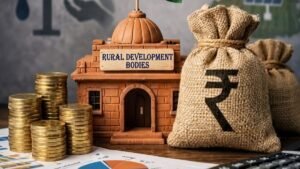
Highlights of State-wise Allocation of United Grants
- Goa: Under the Fifteenth Finance Commission (XV-FC), the Union Government released ₹11.60 crore as the second instalment of United Grants for FY 2023–24 to 2 eligible District Panchayats and 191 Gram Panchayats in Goa. Additionally, a withheld first-instalment amount of ₹2.979 crore has been released for 2 more District Panchayats and 24 Gram Panchayats.
- Meghalaya: In Meghalaya, the Centre allocated ₹27 crore as the second instalment for FY 2021–22 under XV-FC grants. These funds directly benefit the three Autonomous District Councils — Khasi, Garo and Jaintia, which function as key Rural Local Governance institutions.
- Sikkim: For Sikkim, an amount of ₹6.60 crore has been released as the second instalment for FY 2025–26 for 6 eligible District Panchayats and 199 Gram Panchayats. Further, a previously withheld grant of ₹0.165 crore has been disbursed to one additional eligible District Panchayat.
- Uttarakhand: Uttarakhand received the highest allocation of ₹89.4117 crore as the first instalment for FY 2025–26. This funding covers 13 District Panchayats, 95 Block Panchayats, and 7,568 Gram Panchayats.
|
15th Finance Commission (XV-FC)
|
What are Grants?
- About: Grants are financial transfers provided by the Central Government to States or Local Governments without any obligation of repayment.
- Grants to Rural Local Bodies (RLBs) are statutory fiscal transfers recommended by the Fifteenth Finance Commission to strengthen Panchayati Raj Institutions (PRIs).
- Purpose: The main objective of grants is to address vertical fiscal imbalance between the Centre and States and horizontal imbalance among States by providing need-based fiscal assistance.
- Constitutional Provision: Grants are governed by Article 275 and Article 282 of the Constitution, which empower the Union to provide Grants-in-Aid to States for welfare schemes.
-
-
- The provision of grants to RLBs is backed by Article 280(3)(bb), which mandates the Finance Commission to recommend measures to augment State Consolidated Funds for supporting Panchayats.
-
- Administration: These grants are released by the Ministry of Finance and implemented through the Ministry of Panchayati Raj.
- Distribution Criteria: Allocation among States is based on criteria like Population (2011 Census), Area, Forest Cover, and Income Distance, ensuring balanced horizontal devolution.
- Types: RLB grants are categorised into two components:
-
-
- Tied Grants (60%): These are sector-specific funds mandatorily utilised for drinking water supply, rainwater harvesting, and sanitation services, including solid and liquid waste management (SLWM).
- Untied Grants (40%): These provide functional autonomy to Panchayats for addressing location-specific developmental needs across the 29 subjects listed in the Eleventh Schedule.
-
- Performance-Linked: Release of RLB grants is subject to compliance, including: Submission of Audited Accounts, Online entry in the Public Financial Management System (PFMS), Notification of State Finance Commission (SFC) Reports and Minimum Own Source Revenue (OSR) mobilisation.
-
-
- RLBs must maintain accounts via e-GramSwaraj Portal and the Public Financial Management System (PFMS) to ensure transparency and real-time financial tracking.
-
- XV-FC Allocation: The XV-FC recommended about ₹2.36 lakh crore exclusively for Rural Local Bodies during FY 2021–22 to FY 2025–26, making it one of the largest fiscal devolution exercises to PRIs.
- Mechanism: Funds are released to States by the Ministry of Finance and transferred to PRIs through State Consolidated Funds, following due compliance with Utilisation Certificates (UCs).
What are the Other Types of Grands?
- Statutory Grants (Article 275): Statutory Grants are provided by the Union Government to States to support Scheduled Areas, Tribal Welfare, and address special developmental needs. These are mandatory transfers forming part of the Finance Commission recommendations to reduce regional fiscal imbalances.
- Revenue Deficit Grants: These grants are provided to States facing Post-Devolution Revenue Deficit (PDRD) even after receiving their share of tax devolution. The Finance Commission recommends Revenue Deficit Grants to maintain minimum standards of public expenditure.
- Disaster Management Grants: The Government of India provides Disaster Management Grants to establish National Disaster Mitigation Fund (NDMF) and State Disaster Mitigation Funds (SDMF) under the Disaster Management Act, 2005 to strengthen preparedness and risk reduction capacity.
- Local Government Grants: Apart from Rural Local Bodies, Urban Local Bodies (ULBs) receive Basic Grants and Performance-Based Grants. Notably, Million-Plus Cities are funded through the Challenge Fund, where 100% of the grant is performance-linked.
- Supplementary & Additional Grants: Under Article 115, Supplementary Grants are sanctioned when the allocated budget is insufficient, while Additional Grants meet new service expenditures arising during a financial year without prior approval in the annual budget.
- Exceptional & Token Grants: Exceptional Grants are provided for special purposes outside the normal budgetary framework, whereas Token Grants (Re 1) allow re-appropriation of funds from one head to another without increasing total expenditure.
- Vote on Account & Vote of Credit: Under Article 116, Vote on Account enables the government to meet short-term expenditure pending budget approval, while Vote of Credit is granted during national emergencies for unforeseen demands.
|
Rural Local Bodies (RLBs)
|
|
Also Read: 11 Years of Garib Kalyan |