




Indian Navy Set to Induct Advanced Black Shark Torpedo
|
General Studies Paper III: Defence Technology |
Why in News?
India’s Ministry of Defence recently signed contracts worth ₹4,666 crore, including a ₹1,896 crore deal with Italy’s WASS for 48 Black Shark heavyweight “submarine-killer” weapons to arm the Indian Navy’s Kalvari-class fleet.
- Under the agreement, the delivery of the torpedoes is scheduled to begin in April 2028. The complete delivery cycle is expected to be finished by early 2030.
What are the Black Shark Torpedoes?
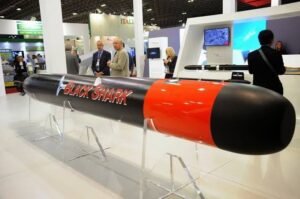
- About: The Black Shark is a heavyweight torpedo designed to be launched from submarines for anti-surface and anti-submarine warfare. It first entered service in 2004 and continues in active use around the world.
- Developed By: The Black Shark was developed by WASS Submarine Systems, an Italian company originally known as Whitehead Alenia Sistemi Subacquei. The company later became part of the larger defence conglomerate Leonardo, and more recently its underwater systems business was restructured under Fincantieri.
- Background: The Black Shark originated as an upgrade of an older Italian torpedo model called the A184, which had been in service since the 1970s. The goal was to increase range, speed, and sensing precision. In January 2014, an early version of the Black Shark Advanced was successfully launched from a submarine during tests in the La Spezia Gulf in Italy.
- Features:
-
-
- The Black Shark Torpedoes has a length of about 6.3 metres and a diameter of 533 mm, which is the standard size for heavyweight submarine torpedoes.
- It uses electric propulsion powered by advanced batteries and can travel at speeds exceeding 50 knots. Effective range of approximately 50 km (27 nmi).
- The Black Shark uses a forward-thinking guidance system that is often wire-guided via a fibre-optic link between the submarine and the torpedo. This guves real-time control.
- Its sonar system can distinguish targets underwater with advanced spatial analysis.
- The weapon uses a contra-rotating direct-drive brushless motor and high-energy batteries that help it maintain speed and range at deeper depths.
- Its warhead contains a high explosive charge weighing around 350 kg, designed to neutralise large warships or other submarines.
- It has multiple frequency capabilities and signal processing features that help it maintain track even in cluttered acoustic conditions.
- The Black Shark Advanced is a modernised version of the original design. It has upgraded power systems like lithium-polymer batteries that offer better endurance and performance under various conditions.
-
- Users: Several countries currently using Black Shark or BSA torpedo:
-
- Italy: The developer nation, using the Black Shark and Black Shark Advanced (BSA) on its U212A Todaro-class submarines.
- Chile: The Chilean Navy utilizes the Black Shark for its Scorpène-class (O’Higgins-class) and Type U209 submarines.
- Malaysia: The Royal Malaysian Navy (RMN) operates the torpedo on its Scorpène-class submarines (Perdana Menteri-class). In July 2025, Malaysia conducted its first live-fire test of a war-configured Black Shark.
- Singapore: The Republic of Singapore Navy has acquired the Black Shark Advanced for its submarine fleet.
- Indonesia: The Indonesian Navy handles the Black Shark on its Nagapasa-class and KRI Alugoro submarines.
- Portugal: The Portuguese Navy uses the torpedo to arm its Type 209PN submarines (Tridente-class).
Significance for India
- Strengthens Undersea Capability: India’s acquisition of Black Shark heavyweight torpedoes significantly enhances its submarine combat power underwater. The Kalvari-class submarines will be equipped with modern torpedoes that can engage enemy submarines and surface vessels effectively. This upgrade fills a long-standing operational gap.
- Enhances Deterrence in the Indo-Pacific: Modern torpedoes add to India’s deterrent capability in the Indo-Pacific region. The Indian Ocean is a major arena for naval competition involving China and other regional powers. With advanced torpedoes on its submarines, India can send a clear signal that any hostile actions near its maritime spaces would be met with potent defensive and offensive responses.
- Boosts Operational Readiness: Having heavyweight torpedoes on all six Kalvari-class submarines greatly improves India’s operational readiness. The torpedoes can strike both underwater and surface threats at extended ranges, increasing mission flexibility. They also allow submarines to undertake diverse tasks, including sea denial, intelligence gathering, and support for other naval operations.
- Supports Broader Naval Modernisation: This torpedo acquisition aligns with India’s larger effort to modernise its defence forces. The MoD has approved multiple modernisation contracts across platforms, including ships, aircraft, and missiles. In 2025-26, Indian defence procurement has seen large capital investments aimed at upgrading technology and expanding force projection capabilities. The Black Shark deal is a part of this broader strategic push.
|
What is a Torpedo?
|