




DRDO Successfully Conducted Salvo Launch of Pralay Missiles
|
General Studies Paper II: Government policies and interventions, Defence Technology |
Why in News?
Recently, the Defence Research and Development Organisation (DRDO) has successfully conducted the salvo launch capability of the indigenously developed Pralay missile. This achievement highlights the system’s operational reliability and growing maturity within India’s advanced missile ecosystem.
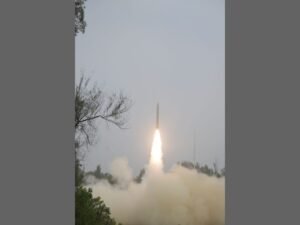
India’s Indigenous ‘Pralay Missile’
- About: Pralay is an indigenously developed tactical missile of India. It is a quasi‑ballistic surface‑to‑surface missile designed to strike with precision. It flies in a low trajectory and can make mid‑flight adjustments to avoid interception. Its advanced guidance systems make it difficult to defeat by enemy air defence.
- Developed By: The Defence Research and Development Organisation (DRDO) is the primary developer of the Pralay missile. The research lead is the Research Centre Imarat (RCI), supported by several DRDO laboratories.
- Background: Work on Pralay was sanctioned by the Indian government in 2015 as a response to gaps in conventional battlefield strike capabilities. It evolved from earlier missile programmes such as Prahaar, which had a shorter range and lighter payload.
- Technical Specifications: Pralay has a range of 150–500 kilometres, depending on warhead weight. It can carry warheads between 350 and 1,000 kilograms, including high‑explosive and penetration types.
- Rocket Motor Launcher: The missile uses a solid propellant rocket motor and advanced navigation systems for terminal guidance. It is a road‑mobile system that can be rapidly deployed from Transporter Erector Launchers (TELs). Its Circular Error Probable (CEP) is very low, meaning very high precision.
- Flight Profile: The missile’s propulsion is based on a solid‑fuel dual‑phase motor, allowing rapid launch readiness and long shelf life. Pralay follows a quasi‑ballistic trajectory, combining features of both ballistic and guided flight paths. Its terminal phase speed reaches hypersonic levels.
- Precision: Pralay uses a combination of inertial navigation systems (INS) and satellite navigation to maintain accurate flight. It also has terminal guidance that enables mid‑course corrections. This ensures pinpoint accuracy against high‑value targets such as enemy bases, radar sites, and command posts.
-
- Capability: The munition capable of carrying a high explosive preformed fragmentation warhead, penetration-cum-blast (PCB), and runaway denial penetration submunition (RDPS).
- Major Tests: Pralay underwent its maiden flight test on 22 December 2021 off the Odisha coast. It met all objectives by following its flight path and reaching the target accurately. In 2025, DRDO conducted multiple successful flight trials to validate both minimum and maximum range capabilities as part of user evaluation.
- Salvo Launch Capability: On 31 December 2025, DRDO successfully conducted a salvo launch of two Pralay missiles from the same launcher in quick succession. This trial demonstrated the missile’s rapid repeat‑fire ability from a single platform. Both missiles followed intended trajectories and achieved test goals.
Significance of Pralay Missile
- Fulfilling the Conventional Strike Gap: Previously, India lacked a high-precision, tactical ballistic missile to bridge the distance between the Pinaka multi-barrel rocket system and the long-range, nuclear-capable Agni series. Pralay fills a critical void in India’s missile inventory by providing a long-range, surface-to-surface conventional (non-nuclear) ballistic capability.
- Core Pillar of the Integrated Rocket Force (IRF): The missile is a foundational asset for India’s proposed Integrated Rocket Force, a dedicated tri-services command for conventional missiles. By separating conventional assets from the nuclear-focused Strategic Forces Command, the IRF (with Pralay and BrahMos) provides military commanders with a flexible, rapid-response strike option.
- Strategic Deterrence Against Two-Front Threats: Pralay is specifically designed for deployment along the Line of Actual Control (LAC) and the Line of Control (LoC). It serves as a direct counter to China’s Dong Feng 12 (DF-12) and Pakistan’s tactical missile systems like the Nasr. Its ability to strike targets up to 500 km away strengthens India’s “Punitive Deterrence” posture in the Tibetan Plateau and against border-adjacent infrastructure.
- Advanced Interceptor-Evading Capability: As a quasi-ballistic missile, Pralay follows a low-altitude trajectory and can perform terminal maneuvers to change its path mid-flight. This makes it extremely difficult for modern enemy air defense systems, such as China’s HQ-9, to detect and intercept. Its terminal speeds ensure high survivability and mission success against fortified or well-defended targets.
- Advancement in Indigenous Defense Technology: Developed by the DRDO under the Atmanirbhar Bharat initiative, Pralay signifies a leap in self-reliance for precision-guided technology. By integrating indigenous technologies like the solid-propellant motor and a specialized Indian GIS platform (INDIGIS) for trajectory planning, it eliminates dependence on foreign satellite data and guidance systems, enhancing strategic autonomy in 2026.
|
Important Terminologies
|
|
Also Read: India Successfully Tests Long-Range Pinaka Guided Rocket |