




US Concerned Over UK-Mauritius Chagos Islands Deal
|
General Studies Paper II: Effect of Policies & Politics of Countries on India’s Interests |
Why in News?
President Donald Trump condemned the United Kingdom’s agreement to cede sovereignty of the Chagos Islands (including Diego Garcia) to Mauritius, calling it an “act of total weakness”.
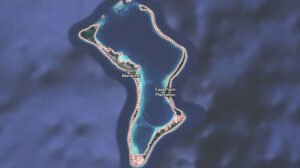
What is the UK-Mauritius Chagos Islands Deal?
- The UK-Mauritius Chagos Islands Deal is a historic bilateral agreement signed on 22 May 2025 resolving the long-standing dispute over the Chagos Archipelago’s sovereignty by transferring full sovereignty of the islands from the United Kingdom to the Republic of Mauritius while securing continued strategic operations on Diego Garcia.
- Under this legally binding international treaty, Mauritius now holds sovereign authority over the entire Chagos Archipelago, including Diego Garcia, marking a formal end to the territory’s status as the British Indian Ocean Territory (BIOT) pending ratification by both states’ parliaments. However, to maintain long-term security cooperation, the UK retains the right to exercise sovereign authority over Diego Garcia for an initial period of 99 years. This period can be extended further with mutual consent, offering strategic continuity for Western military interests.
- A central element of the agreement is its financial framework: the UK will pay Mauritius an annual sum averaging about £101 million (at 2025–26 prices) over the 99-year lease. These payments are structured with higher sums (about £165 million annually in the first three years and £120 million thereafter, adjusted for inflation) and are expected to total roughly £3.4 billion in present value terms. The treaty includes multi-year grants for economic development and a Trust Fund for the benefit of the Chagossian community, intended to address historical injustices arising from forced displacement in the 1960s–70s.
- The deal also incorporates cooperation provisions between Mauritius and the UK on environmental protection, maritime security, and combating illegal activities within the archipelago. Mauritius will have the authority to establish a marine protected area, reflecting shared objectives for conservation of one of the world’s richest marine ecosystems.
Historical Background of the Chagos Islands Dispute
- The Chagos Archipelago is a group of remote islands in the central Indian Ocean, historically administered by the United Kingdom as part of the colony of Mauritius. In 1965, three years before Mauritius gained independence from British rule, the UK detached the Chagos Islands from Mauritius to form the British Indian Ocean Territory (BIOT)—a decision widely regarded as driven by Cold War strategic interests rather than the will of the local people.
- The detachment was formalised through the British Indian Ocean Territory Order 1965, despite strong objections from the United Nations General Assembly, which in 1965 and 1966 passed resolutions expressing “deep concern” over the dismemberment of Mauritius’ territory and warning against violating its territorial integrity.
- Shortly thereafter, in 1966, the UK leased Diego Garcia, the largest island in the chain, to the United States for the establishment of a strategic military base crucial for global power projection. This base has since been central to U.S. and UK military operations in the Middle East, South Asia and East Africa.
- To make way for the base, British authorities forcibly evicted the indigenous Chagossian population during the late 1960s and 1970s, relocating roughly 1,500–2,000 residents primarily to Mauritius and the Seychelles. Many more descendants of these displaced people—now estimated around 10,000—continue to advocate for their right of return and compensation.
- Over the decades, Mauritius has consistently contested the legality of the UK’s retention of the archipelago, arguing the separation was conducted without genuine consent and contrary to the principle of self-determination. The dispute gained international traction when, in 2019, the International Court of Justice (ICJ) delivered a landmark advisory opinion stating that the detachment was illegal under international law, that Mauritius’ decolonisation was not lawfully completed in 1968, and that the UK had an obligation to end its administration “as rapidly as possible.”
- Subsequently, the United Nations General Assembly overwhelmingly endorsed the ICJ opinion and called for the UK to relinquish control within six months, reinforcing global calls for decolonisation and respect for sovereign rights. After years of stalled diplomacy and legal pressure, in May 2025 the UK and Mauritius signed this historic agreement.
Why the United States is Concerned?
- Security of the Diego Garcia Military Base: The foremost U.S. concern relates to the long-term security of the Diego Garcia base, which hosts one of America’s most critical overseas military facilities. Diego Garcia supports strategic bombers, nuclear-capable submarines and logistics hubs for operations across the Indo-Pacific, Middle East, and East Africa. Although the UK-Mauritius deal provides a 99-year lease-back, U.S. fear that sovereignty transfer introduces legal and political uncertainty, potentially exposing the base to future diplomatic pressure or renegotiation risks.
- China’s Expanding Influence in the Indian Ocean: A major strategic anxiety stems from Mauritius’ growing economic and diplomatic engagement with China. The U.S. views the Indian Ocean as a core theatre of great-power competition, where China has already established a military base in Djibouti and expanded port access through the Belt and Road Initiative. America worry that Chinese leverage over Mauritius—through infrastructure finance or maritime cooperation—could indirectly compromise operational secrecy or access around Diego Garcia.
- Intelligence, Surveillance, and Secrecy Risks: Diego Garcia plays a vital role in signals intelligence (SIGINT), satellite tracking, and missile early-warning systems. U.S. intelligence agencies fear that a change in sovereignty may increase legal exposure to international inspections, litigation, or multilateral environmental regimes, potentially limiting classified activities. Even symbolic Mauritian oversight is viewed as a long-term intelligence vulnerability, particularly amid intensifying cyber and electronic warfare threats from rival powers.
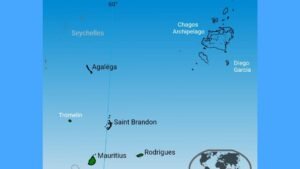
Chagos Archipelago
Chagos Islands
Diego Garcia
|
|
Also Read: India-Mauritius Relations |