




Government Issues New Guidelines for Playing Vande Mataram in Official Events
|
General Studies Paper II: Government Policies & Interventions, Modern Indian History |
Why in News?
Recently, the Ministry of Home Affairs (MHA), has issued detailed and formal guidelines that strictly govern how the national song ‘Vande Mataram’ must be played or sung at official functions, aiming to create a uniform ceremonial protocol across government functions and institutions.
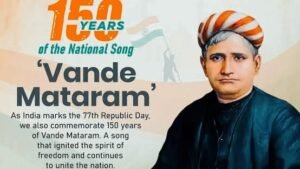
Provisions of the New Government Guidelines on Vande Mataram
- Mandatory Full Six-Stanza Rendition: The new guidelines make it compulsory that all six stanzas of Vande Mataram must be played or sung at designated official events such as government programmes, school assemblies and ceremonies involving the President and Governors. This official composition must last approximately 3 minutes and 10 seconds.
-
- Sequence with National Anthem: Whenever Vande Mataram and the national anthem (Jana Gana Mana) are performed together at the same event, the national song must be rendered first, followed by the national anthem.
- Duty to Stand: The guidelines state that all attendees must stand at attention when the official version of Vande Mataram is played or sung at official functions, similar to the respect accorded to the national anthem. The guidelines provide an explicit exemption for cinema halls: individuals need not stand if the song is played as part of a newsreel, documentary or film soundtrack.
- Specific Occasions and Protocols: Vande Mataram must be played at key occasions such as:
-
-
- Unfurling of the national flag,
- Arrival and departure of the President and Governors at formal events,
- Before and after the President’s addresses to the nation on radio/TV,
- Civilian award ceremonies (like the Padma awards), and any other official occasion the government specifies.
- Events where a band performance is arranged, a drum roll or bugle call should be used to alert the audience before singing.
-
- Directives for Schools: The guidelines direct schools to include the singing of Vande Mataram in their daily assembly routines and to promote respect for national symbols among students. School authorities are expected to make appropriate arrangements, including printed lyrics and sound systems for enriched participation.
Objectives of the New Vande Mataram Guidelines
- Restoration of Original Legacy: A primary objective is to restore the song to its original form by mandating the rendition of all six stanzas written by Bankim Chandra Chatterjee. This move aims to address historical debates and reclaim the full national heritage that was truncated in 1937 due to political sensitivities.
- Standardization of National Honor: The guidelines seek to ensure uniform practice, dignity, and respect for the National Song across all official platforms. By codifying protocols—such as standing at attention—the government intends to align Vande Mataram’s public treatment with its constitutional status.
- Strengthening National Sentiment: A major goal is to foster national pride and unity by transforming the song into an impactful movement. The initiative aims to reconnect citizens, especially youth and students, with the song’s original revolutionary spirit, linking India’s past struggle for independence with its future aspirations.
- Educational and Cultural Integration: The guidelines mandate institutional engagement to popularize the song through daily school assemblies. By encouraging students to explore the song’s connection to the freedom movement through art and discussion, the objective is to embed its legacy in the next generation.
Earlier Measures to Promote and Institutionalise Vande Mataram
- Nationwide 150th Year Commemoration: In 2025, the Union Cabinet, led by the Prime Minister, approved a nationwide celebration marking 150 years of Vande Mataram. The Ministry of Culture launched an official campaign portal, curated exhibitions, short films, and participatory activities like “Karaoke with Vande Mataram”.
- Republic Day 2026 Vande Mataram Tableau: During the 77th Republic Day Parade on January 26, 2026, the Ministry of Culture showcased a specially themed tableau titled “Swatantrata Ka Mantra – Vande Mataram”, reflecting the song’s historical journey and role in the freedom struggle. The presentation included a replica of the original manuscript and performances.
- State-Level Educational Mandates: Prior to national protocol changes, state governments such as Uttar Pradesh announced directives requiring Vande Mataram to be made mandatory in all educational institutions within the state.
- Affidavit in Delhi High Court (2022): The Government of India filed an affidavit in the **Delhi High Court asserted that Vande Mataram and the national anthem “Jana Gana Mana” should be accorded equal respect, despite the national song lacking explicit constitutional status.
- Madras High Court Ruling: In 2017, the Madras High Court ruled that Vande Mataram must be played or sung in schools, colleges and universities at least once a week (preferably Mondays or Fridays) and in government offices and private establishments once a month.
Constitutional and Legal Framework Related to National Symbols in India
-
- The Prevention of Insults to National Honour Act, 1971: This is the primary legislation protecting the National Flag, National Anthem, and Constitution. Section 2 of the Act mandates that anyone who burns, mutilates, or shows disrespect to the Flag or Constitution can face imprisonment for up to three years. Section 3 specifically addresses the National Anthem, making it a punishable offence to intentionally prevent the singing or cause disturbance to an assembly engaged in such singing.
- Emblems and Names (Prevention of Improper Use) Act, 1950: The Emblems and Names (Prevention of Improper Use) Act, 1950, which prohibits unauthorised commercial use of national symbols, emblems, names, and insignia without government permission. These protections apply to a broad class of national symbols, including names and emblems.
- The State Emblem of India (Prohibition of Improper Use) Act, 2005: The Sarnath Lion Capital is protected under this Act, which prohibits the use of the emblem for commercial or private purposes without central government permission. The State Emblem of India (Regulation of Use) Rules, 2007, further specifies that only high-ranking constitutional authorities and government departments are permitted to use the emblem on official stationery, vehicles, and buildings.
- Flag Code of India, 2002 (Amended 2022): The Flag Code provides executive instructions for the display of the Tiranga. Significant recent amendments in July 2022 allowed the flag to be flown day and night if displayed in the open or on a house. Additionally, the code was updated to permit the use of machine-made and polyester flags, expanding beyond the traditional hand-spun Khadi requirement to facilitate the Har Ghar Tiranga movement.
- Article 51A: Under the 42nd Amendment, Article 51A(a) of the Constitution mandates that it shall be the duty of every citizen of India to abide by the Constitution and respect its ideals and institutions, specifically mentioning the National Flag and the National Anthem. While these duties are non-justiciable (cannot be enforced by a writ), they serve as the moral and legal foundation for interpreting statutes related to national symbols.
- Judicial Standing on National Symbols: The Supreme Court of India, in the landmark Shyam Narayan Chouksey v. Union of India case, initially mandated the playing of the Anthem in cinemas but later made it optional. Furthermore, in 2022, the Delhi High Court clarified that Vande Mataram holds a unique constitutional status; while not governed by the 1971 Act, it is entitled to equal honor as the Anthem based on the historical consensus of the Constituent Assembly.
|
Facts About Vande Mataram
|
|
Also Read: Winter Session on Vande Mataram Debate |