




Bharat-VISTAAR AI Platform for Farmers
|
General Studies Paper II: Government Policies & Interventions |
Why in News?
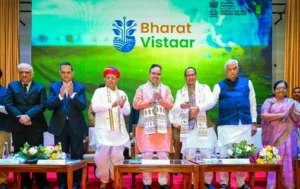
On February 17, 2026, Union Agriculture Minister Shivraj Singh Chouhan launched Bharat-VISTAAR in Jaipur, announced in the 2026-27 Union Budget.
What is Bharat-VISTAAR AI Platform?
- About: Bharat-VISTAAR (Virtually Integrated System to Access Agricultural Resources) is a newly launched Artificial Intelligence (AI)-powered multilingual digital advisory platform to support farmers in farm-level decision-making through data-driven customised guidance.
-
- Objectives: The primary objective of Bharat-VISTAAR is to make agriculture accessible, affordable, and technology-driven by providing tailored advice directly to the farmgate. It aims to bridge the information gap between scientific research (lab) and field application (land).
- Authority: The initiative is implemented by the Ministry of Agriculture & Farmers’ Welfare, Government of India.
- Budget: It was formally proposed by Finance Minister Nirmala Sitharaman in the Union Budget 2026-27 with an initial allocation of ₹150 crore.
- Features:
-
-
- Voice-First AI Assistant ‘Bharati’: Farmers can dial a toll-free helpline (155261) to interact with “Bharati,” a talking AI assistant that provides instant answers without requiring a smartphone or internet.
- Multilingual Support: The platform is initially available in Hindi and English, with plans to expand to 11 Indian languages within six months and eventually cover over 22 regional dialects.
- Single-Window Scheme Access: It provides information on 10 major central schemes, including PM-KISAN, PM Fasal Bima Yojana (PMFBY), Kisan Credit Card (KCC), and Soil Health Card (SHC).
- Real-Time Data Integration: The system pulls live data from the India Meteorological Department (IMD) for weather, Agmarknet for mandi prices, and the National Pest Surveillance System (NPSS) for pest alerts.
- Personalised Digital Farmer ID: It will eventually link with AgriStack, using a unique Farmer ID to automatically access land records and crop history to provide highly specific local advice.
- Ethical AI Framework: It incorporates built-in tools for bias detection and fairness audits, ensuring that the AI solutions developed on the platform adhere to India’s “AI for All” ethical guidelines.
-
- Mechanism: It operates as a “plug-and-play” digital public infrastructure, using voice-first AI to analyze data from agricultural departments, IMD weather inputs, and market prices, delivering targeted advice on crops, soil, and pests in local languages.
Need for AI-Driven Digital Agriculture in India
- Overcoming Climate Vulnerability: India’s agriculture is highly susceptible to climate variability, as roughly 51% of the net sown area remains rain-fed. AI-driven predictive analytics utilize historical weather data and satellite imagery to provide real-time advisories. A 2025 pilot for monsoon onset forecasting reached 3.88 crore farmers, with up to 52% of them adjusting their sowing decisions based on AI insights.
- Precision Resource Management: Traditional farming often leads to the suboptimal use of water and fertilizers. AI-enabled precision farming uses IoT sensors and drones to apply inputs only where needed. These systems can reduce water usage by up to 30% and fertilizer consumption by 20%, directly lowering input costs for smallholder farmers who make up 86% of the sector.
- Early Pest and Disease Detection: India loses an estimated 15–20% of its crops annually to pests and diseases. The National Pest Surveillance System (NPSS) uses AI and machine learning to analyze field images, allowing for early detection and targeted intervention. This technology can reduce chemical usage by 30%, protecting both crop yields and environmental health.
- Bridging Information Asymmetry: Farmers often capture only a small fraction of the final consumer price due to fragmented supply chains. AI platforms analyze datasets from e-NAM and AGMARKET to provide market intelligence and price forecasting. Tools like the Kisan e-Mitra chatbot, which handles 8,000+ daily queries in 11 languages, ensure that even marginal farmers have access to critical government schemes.
- Strategic Digital Infrastructure: The Digital Agriculture Mission, launched with an outlay of ₹2,817 crore, has created a robust foundation through AgriStack, generating over 8.48 crore Farmer IDs. These digital twins of farms enable faster, transparent AI-driven crop insurance settlements through initiatives like YES-TECH and CROPIC, ensuring financial resilience for the rural economy.
Significance of Agri-Tech in India
- Export Competitiveness: Agri-Tech enables compliance with international Phytosanitary Standards. By using Blockchain-based Traceability, Indian exporters can provide “farm-to-table” documentation, allowing Indian grapes, pomegranates, and organic cereals to command premium prices in EU and US markets.
- Climate-Resilient Seed Tech: Startups are leveraging Genomic Data and AI to develop climate-smart seeds that are drought and saline-resistant. This is vital as nearly 30% of Indian land is undergoing degradation, necessitating varieties that thrive in harsh environments.
- Labor Shortage Mitigation: As rural youth migrate to urban areas, Agri-Robotics and autonomous tractors fill the labor void. Mechanization via Uber-style rental models (Custom Hiring Centers) ensures that even smallholders can access high-end machinery without heavy Capital Expenditure.
- Soil Health Restoration: Beyond basic testing, AI-driven Hyperspectral Imaging provides deep insights into micro-nutrient deficiencies. This precision prevents the “over-urea” phenomenon, restoring the Soil Organic Carbon (SOC) levels essential for long-term land fertility.
- Waste-to-Wealth Conversion: Agri-Tech facilitates the Circular Economy by converting crop residue into Bio-CNG or high-quality silage. This provides farmers with an ancillary income stream while solving the critical issue of stubble burning in Northern India.
- Localized Extension Services: Digital platforms bypass traditional, slow physical extension networks. Through Natural Language Processing (NLP), farmers receive hyper-local agronomic advice in dialects, translating complex satellite data into actionable tasks for specific micro-climatic zones.
|
Government Agri-Tech AI Initiatives
|
|
Also Read: Biostimulants in Agriculture |