




India-France Special Global Strategic Partnership
|
General Studies Paper II: Effect of Policies & Politics of Countries on India’s Interests |
Why in News?
In February 2026, India and France elevated bilateral ties to a Special Global Strategic Partnership during President Macron’s fourth official visit to India. This landmark upgrade, guided by the Horizon 2047 Roadmap, deepens cooperation in defense, AI, and space to promote global stability and a rules-based international order.
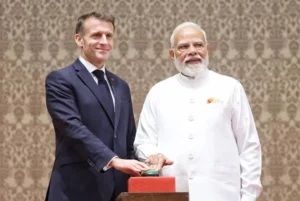
Outcomes of India–France Strategic Partnership Roadmap
- Governance: Both nations established an Annual Foreign Ministers Dialogue to monitor the implementation of the Horizon 2047 Roadmap and review progress on global issues.
- Defense and Sovereignty: Contract to procure 26 Rafale-Marine fighter jets finalized. Inauguration of the first private-sector H125 helicopter assembly line in Karnataka (a TATA-Airbus venture) and a Joint Venture between BEL and Safran to manufacture HAMMER missiles in India. Additionally, the two countries agreed on the reciprocal deployment of officers in each other’s land forces to enhance operational synergy.
- Critical and Emerging Technologies: To maintain a technological edge, both sides constituted a Joint Advanced Technology Development Group to co-develop cutting-edge military and dual-use systems. A specific Letter of Intent (LoI) was signed to establish a Centre on Advanced Materials between India’s DST and France’s CNRS.
- Artificial Intelligence and Digital Health: The partnership launched the Indo-French Centre for AI in Health at AIIMS, New Delhi, aimed at integrating AI into diagnostics and patient care. An Indo-French Centre for Metabolic Health Sciences was established, alongside a Joint Declaration to create a dedicated center for general Digital Sciences and Technology.
- Innovation and Startup Ecosystems: The leaders declared 2026 as the India-France Year of Innovation, aimed at fostering joint research and market access. This is supported by the new India-France Innovation Network and a strategic partnership between T-Hub (Hyderabad) and Nord France to connect startup hubs and facilitate cross-border entrepreneurship.
- Critical Minerals and Energy Transition: Recognizing the need for resource security, a Joint Declaration of Intent for Cooperation in Critical Minerals and Metals was signed to secure supply chains for the green transition. Both nations also renewed their MoU on Renewable Energy Cooperation, focusing on decarbonized hydrogen and the establishment of a European office for the International Solar Alliance (ISA) in Paris.
- Civil Nuclear Energy: Building on the 2025 roadmap, the two countries reaffirmed their commitment to the Jaitapur Nuclear Power Project. A key focus shifted toward Small and Advanced Modular Reactors (SMR/AMR), with France supporting India’s reforms to allow private investment in the nuclear sector via the SHANTI Act, 2025.
- Economics, Trade, and Taxation: To facilitate smoother cross-border business, an Amending Protocol on the Double Tax Avoidance Agreement (DTAA) was signed to modernize fiscal rules. This agreement aims to reduce barriers for the 39 billion Euro worth of French investments in India and support the ongoing negotiations for the India-EU Free Trade Agreement.
- Aeronautics Skilling and Education: To support the growing aviation sector, a National Centre of Excellence for Skilling in Aeronautics was established to train Indian engineers and technicians. France also reiterated its goal to host 30,000 Indian students by 2030, supported by a five-year Schengen visa for alumni and new “International Classes” for non-French speakers.
- Global Health and Bio-Research: Agreements were reached between India’s DBT and France’s ANRS for intensive research on infectious diseases and global health preparedness. This also includes a memorandum of understanding for broader scientific collaboration between India’s Department of Science and Technology (DST) and the French CNRS.
India–France Strategic Partnership
- Origin: India–France relations formally entered a new era with the 1998 Strategic Partnership, making France the first country to establish such ties with India after Pokhran-II—despite global sanctions. This marked France’s support for India’s strategic autonomy and began structured cooperation in defence, nuclear energy, space and counter-terrorism.
- Space Cooperation: India and France share over 50 years of space cooperation between ISRO and CNES. Joint projects like Megha-Tropiques and SARAL strengthened India’s capabilities in oceanography and meteorology-based climate science. India will participate in France’s International Space Summit 2026.
- Counter-Terrorism: France has consistently supported India’s concerns on cross-border terrorism in multilateral forums. Institutionalized Strategic Dialogue at NSA level ensures coordination on intelligence sharing, cyber-security and global security architecture in emerging threat environments.
- Defence Supplier: Between 2019–2023, France emerged as India’s top most defence supplier, gradually shifting ties from a buyer-seller model to co-design and co-development of advanced air, naval and land systems.
-
-
- France is India’s second-largest supplier, providing Rafale and Rafale-M fighters, Scorpene submarines, HAMMER missiles, and M88 engines.
-
- Indo-Pacific Maritime Cooperation: France is the only EU country with a permanent military presence in the Indian Ocean Region (IOR).
- Both nations coordinate under the 2018 Joint Strategic Vision for the Indian Ocean Region, promoting a free, open and rules-based Indo-Pacific maritime order.
-
-
- As resident powers, they conduct regular exercises like Varuna (Navy), Garuda (Air Force), and Shakti (Army).
-
- Trade & Economic Integration: Bilateral merchandise trade reached approximately US $11.68 billion in FY 2024-25, reflecting balanced economic engagement. Cooperation spans aerospace, transport, defence manufacturing and renewable energy sectors, with France among India’s major EU investors.
-
-
- France was the first European country to accept UPI payments, starting at the Eiffel Tower and expanding to Galeries Lafayette and other major retailers.
- France is the 11th largest foreign investor in India, with cumulative foreign direct investment (FDI) inflows of €9.79 billion (approximately US$ 11.75 billion).
- The top two sectors for French FDI include services (17.68%) and cement and gypsum products (8.33%).
-
- Climate & Sustainability Initiatives: India and France jointly promote solar energy, biodiversity protection and ocean governance, aligning development goals with the Paris Climate Agreement.
-
- The two nations co-lead the International Solar Alliance (ISA) and the Coalition for Disaster Resilient Infrastructure (CDRI). A shared Green Hydrogen Roadmap focuses on decarbonizing industrial value chains.
- Global Recognition: France consistently supports India’s bid for permanent membership in the UN Security Council and its entry into the Nuclear Suppliers Group.