



India-Azerbaijan Relations
|
General Studies Paper II: Bilateral Groupings & Agreements, Effect of Policies & Politics of Countries on India’s Interests |
Why in News?
Recently, India and Azerbaijan resumed first high-level talks in Baku to rebuild strained ties after Azerbaijan’s support to Pakistan during Operation Sindoor, signalling a calibrated diplomatic reset through confidence-building measures.
Highlights of Resumed High-Level Talks
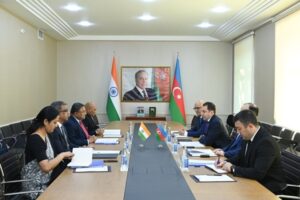
- After nearly 11 months of strained relations, India and Azerbaijan held their first high-level meeting on 3 April 2026 in Baku, marking a formal diplomatic re-engagement.
- The high-level meeting was the 6th round of India-Azerbaijan Foreign Office Consultations, co-chaired by senior diplomats. Both sides initiated a Confidence Building Mechanism (CBM) process to restore mutual trust.
- Discussions extended beyond political tensions to include trade, energy, technology, tourism, pharmaceuticals, culture, and people-to-people exchanges, indicating a multi-sectoral approach to revive cooperation.
- A notable inclusion was cooperation on countering cross-border terrorism, indirectly referencing Pakistan. India used the platform to assert its security concerns diplomatically without escalating rhetoric.
- The talks covered regional security issues, including the ongoing tensions in the Middle East and Iran-related developments, highlighting Azerbaijan’s geostrategic location.
- India acknowledged Azerbaijan’s critical assistance in evacuating around 200 Indian nationals from Iran, which served as a confidence-restoring humanitarian gesture and created positive momentum for diplomatic normalization.
- Both countries agreed to continue dialogue and hold the next consultations in New Delhi, indicating commitment to sustained engagement.
India-Azerbaijan Relations
-
- Historic Ties: India and Azerbaijan share deep-rooted civilizational connections that date back to antiquity.
- The Great Silk Route served as a vital bridge for the exchange of goods and ideas between the two regions. Medieval monuments in Azerbaijan, particularly the Ateshgah Fire Temple near Baku, contain wall inscriptions in Devanagari and Gurmukhi, proving the presence of Indian merchants and pilgrims in the 18th century.
- Historical records mention Azerbaijani travelers like Zeynalabdin Shirvani, who wrote extensively about Indian cities and people during his travels.
- Diplomatic Relations: Modern diplomatic ties began after the dissolution of the Soviet Union.
- India was among the first countries to recognize Azerbaijan’s independence on December 26, 1991.
- Official diplomatic relations were established on February 28, 1992. India opened its Embassy in Baku (1999), while Azerbaijan established its embassy in New Delhi in October 2004.
- High-level political exchanges have consistently strengthened the bond between the two nations, including significant visits like Indian Vice President M. Venkaiah Naidu‘s trip to Baku in 2019 and External Affairs Minister Sushma Swaraj‘s visit in 2018.
- Prime Minister Narendra Modi participated in an online NAM Summit hosted by Azerbaijan in 2020. Recent meetings continue on the sidelines of international forums.
- Bilateral Agreements: The two countries have formalized their cooperation through numerous legal frameworks.
- The first major agreement was the Economic and Technical Cooperation Treaty signed in June 1998.
- Bilateral ties are anchored in structured mechanisms such as the Foreign Office Consultations (FOC), which serve as the primary dialogue platform for reviewing cooperation.
- Other critical treaties include the Air Communication Agreement (2013), Mutual Legal Assistance Treaties (MLAT) in civil and criminal matters (2013), and the Extradition Treaty (2013).
- An Inter-Governmental Commission (IGC) on Trade, Economic, Scientific, and Technological Cooperation was established in 2007 to regularly review bilateral ties.
- Energy Sector Cooperation: Energy is the primary pillar of economic engagement between India and Azerbaijan. India’s ONGC Videsh Ltd (OVL) has made substantial investments exceeding USD 1.2 billion in the region.
- OVL holds a 2.925% participating interest in the Azeri-Chirag-Gunashli (ACG) oil fields and a 3.097% stake in the Baku-Tbilisi-Ceyhan (BTC) pipeline.
- In late 2024, OVL completed the acquisition of additional stakes from Equinor to further secure India’s energy interests.
- Azerbaijan being an important supplier of crude oil to India through its national company SOCAR (State Oil Company of Azerbaijan Republic). India’s interest is also linked to the Caspian Sea energy reserves, and potential collaboration in petrochemicals continues to be explored.
- Economic Trade: Bilateral trade reached a peak of USD 1.88 billion in 2022, primarily driven by crude oil imports. By 2023, India became Azerbaijan’s seventh-largest trading partner.
- India’s major imports from Azerbaijan are almost exclusively crude oil and natural gas. Conversely, India’s exports to Azerbaijan have diversified to include rice, pharmaceuticals, machinery, electronics, and ceramics.
- Trade is facilitated through agreements like the Bilateral Investment Promotion and Protection Agreement (BIPPA), aimed at enhancing investor confidence.
- Capacity Building: India actively supports Azerbaijan’s human resource development through the Indian Technical and Economic Cooperation (ITEC) program.
- Every year, India offers approximately 30 fully paid training courses to Azerbaijani officials.
- The Indian Council for Cultural Relations (ICCR) provides scholarships for Azerbaijani students to pursue higher education in India.
- India has offered technical training programs under ITEC (Indian Technical and Economic Cooperation), benefiting Azerbaijani professionals in fields like cybersecurity, artificial intelligence, and e-governance.
- Cultural Ties: Cultural engagement is a strong pillar, driven by India’s soft power appeal. Indian cinema, yoga, and cuisine are popular in Azerbaijan.
- The works of Azerbaijani poet Nizami Ganjavi significantly influenced eminent Indian poets like Amir Khusrau.
- Modern connections are maintained through Indian films, which are highly popular in Azerbaijan, and the friendship between legends like Raj Kapoor and Azerbaijani singer Rashid Behbudov.
- Events such as International Day of Yoga celebrations, cultural festivals, and Bollywood film screenings strengthen people-to-people ties.
- Tourism is also surging, with India becoming the fourth-largest source of inbound tourists for Azerbaijan in 2023.
- Historic Ties: India and Azerbaijan share deep-rooted civilizational connections that date back to antiquity.
- Multilateral Cooperation: Both countries collaborate in multilateral platforms such as the United Nations, Non-Aligned Movement, and Conference on Interaction and Confidence-Building Measures in Asia (CICA).
- Indian Diaspora: A small but vibrant Indian community of approximately 1,500 people resides in Azerbaijan.
- This diaspora includes professionals in the oil and gas industry, business owners in the catering and trading sectors, and about 350 students.
- Several associations, such as the Indian Association Azerbaijan (IAA) and Baku Tamil Sangam, regularly organize social events to celebrate Indian festivals.
- Azerbaijan emerged as a popular destination for Indian tourists due to visa-on-arrival facilities and connectivity via direct flights.
Strategic Importance of Azerbaijan for India
- Geostrategic Location: Azerbaijan occupies a critical position between Europe and Asia, bordered by Russia, Iran, and Turkey, making it a gateway to the South Caucasus and Central Asia. It supports India’s “Connect Central Asia Policy”.
- Energy Powerhouse: Rich in oil and natural gas reserves, Azerbaijan is a major energy exporter through pipelines like the Baku–Tbilisi–Ceyhan (BTC) pipeline. It contributes to Europe’s energy security diversification, reducing dependence on Russian energy, thereby increasing its global strategic relevance.
- Connectivity Corridors: Azerbaijan is central to major connectivity initiatives such as the International North-South Transport Corridor (INSTC) and the Middle Corridor (Trans-Caspian route). These routes connect India, Central Asia, Russia, and Europe, reducing transit time and costs significantly.
- Investment Opportunities: Azerbaijan is India’s largest trading partner in the Caucasus, with bilateral trade around $1.4 billion (2023). India exports pharmaceuticals, machinery, rice, and chemicals, making Azerbaijan important for balanced trade expansion.
- Diplomatic Engagement: Both nations engage through platforms like NAM and Shanghai Cooperation Organisation (SCO), where Azerbaijan is a dialogue partner. These forums allow India to coordinate on global issues such as terrorism and regional stability.
Challenges in India–Azerbaijan Ties
- Pro-Pakistan Geopolitical Bias: Azerbaijan maintains a strong “Three Brothers” alliance with Pakistan and Turkey, which frequently clashes with India’s core interests. Baku openly supports Pakistan’s stance on Kashmir, while India conducted “Operation Sindoor“ in 2025 to dismantle terror infrastructure in Pakistan, a move Azerbaijan officially condemned.
- Armenia Defense Factor: India has significantly bolstered its defense ties with Armenia, supplying Akash missiles and other weapons worth approximately $250 million. Baku views this military support as a threat to its security, leading to formal diplomatic protests and accusations that India is fueling the Nagorno-Karabakh conflict.
- Connectivity and Infrastructure Gaps: While both nations are part of the INSTC, regional instability often halts progress. The lack of a direct transit route bypassing Pakistan forces India to rely on complex pathways through Iran, where sanctions and infrastructure gaps create significant logistics delays.
- Declining Trade Volumes: Bilateral trade has faced a downward trend, dropping from a peak of $1.88 billion in 2022 to just $401 million in 2025. India’s exports to Azerbaijan plummeted to roughly $86 million in 2024-25, representing a meagre 0.02% of India’s total outbound shipments.
- Diplomatic Friction: Political tension has recently spilled into international forums. Azerbaijan has publicly accused India of blocking its bid for full membership in the Shanghai Cooperation Organisation (SCO), claiming New Delhi is using its veto power as retaliation for Baku’s support of Pakistan.
- Lack of High-Level Engagement: High-level engagement between India and Azerbaijan remains limited, characterized by a historical lack of top-tier leadership visits that hinders deeper political and strategic understanding. No Indian Prime Minister has ever visited Azerbaijan since its independence in 1991.
|
Also Read: India-Argentina Relations |