



NASA Prepares ISS Endgame Mission
| General Studies Paper III: Space Technology |
Why in News?
Recently, NASA awarded SpaceX an $843 million contract to build the U.S. Deorbit Vehicle (USDV) for the International Space Station (ISS) Endgame Mission.
What is NASA’s ISS Endgame Mission?
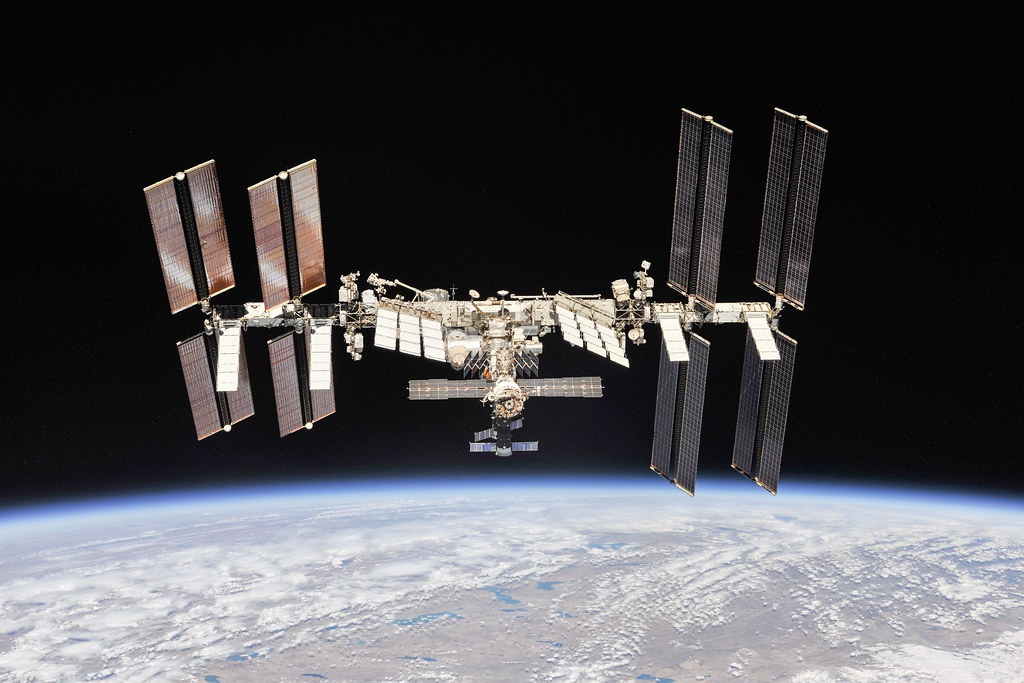
- About: The ISS Endgame Mission is NASA’s long-term plan to safely retire the International Space Station (ISS) at the end of its operational life.
- Under this mission, NASA will conduct a controlled deorbit, ensuring debris does not threaten populated regions.
- Need: The ISS has been operating since 1998 and has supported continuous human presence in space for over 24 years.
- Aging hardware, increasing maintenance demands, and the transition toward commercial space stations have led partner agencies to plan retirement.
- It has been experiencing frequent technical problems. Maintaining the station costs billions of dollars.
- Announcement: In June 2024, NASA announced the ISS retirement program.
- On 26 June 2024, NASA announced that SpaceX had been selected to develop the U.S. Deorbit Vehicle (USDV).
- In 2026, NASA has announced its complete plans to safely return it to Earth.
- Funding: NASA has developed a $1 billion (approximately ₹9,500 crore) plan to safely deorbit and retire ISS.
- NASA awarded SpaceX a single contract worth up to $843 million for the development of the USDV, covering vehicle development and delivery.
- Deorbit Timeline: NASA is preparing to safely deorbit and dismantle the aging ISS, starting with a phased transition in 2028, followed by its atmospheric reentry and disposal in 2030.
- The United States, Europe, Japan, and Canada have committed operations through 2030, while Russia has committed through at least 2028.
- Execution Plan:
- 2028 (Altitude Reduction): NASA and its international partners will begin gradually lowering the station’s orbit from its standard operating altitude of roughly 400 km.
- Pre-reentry Departure: The last crew will safely depart before the station drops into the unstable atmospheric boundary (below 280 km) where the “point of no return” is crossed.
- Final Descent (18-Month Window): The SpaceX-developed USDV will permanently dock to the ISS, utilizing powerful thrusters over an 18-month period to meticulously push the station lower.
- Atmospheric Reentry and Splashdown: The fiery breakup of the station will occur during the final targeted plunge, sending the remaining debris into a highly remote, unpopulated region of the South Pacific.
- Target Destination: The debris footprint is strictly targeted at Point Nemo isolated location, often referred to as the “spacecraft cemetery“.
- Located roughly 2,688 kilometers from the nearest landmass, this area is intentionally selected by NASA and its partners to completely mitigate risks to populated areas and terrestrial property.
| International Space Station (ISS):About: The International Space Station (ISS) is the world’s largest permanently inhabited space laboratory in Low Earth Orbit (LEO). It serves as a platform for scientific research, technology testing, and human spaceflight operations that support future Moon and Mars missions. Launch: ISS has been operating since 1998.The Russian-built Zarya module launched on November 20, 1998, serving as the nucleus for power and orientation.Partnership: The station is jointly operated by five major agencies: NASA, Roscosmos, European Space Agency, JAXA, and Canadian Space Agency, representing 15 partner nations. Characteristics: The ISS orbits Earth at approximately 400 km altitude and travels at nearly 28,000 km/h (17,500 mph), completing one orbit every 90 minutes and about 16 Earth revolutions daily.The station is the largest human-made object in orbit, with a mass of about 420 metric tons. Its solar-array wingspan reaches 109 meters, exceeding that of an Airbus A380.The ISS has been continuously occupied since November 2000, making it the longest-running human presence in space. A typical crew consists of seven astronauts and cosmonauts.Thousands of experiments have been conducted in microgravity, covering medicine, biotechnology, physics, materials science, agriculture, and Earth observation. The ISS was assembled through 42 major assembly missions, involving space shuttles, Proton rockets, and Soyuz launches. Eight major solar arrays generate approximately 75–90 kilowatts of electricity. The station operates through millions of lines of software code running across interconnected onboard computers. Since 1998, astronauts and cosmonauts have conducted more than 277 spacewalks for construction, maintenance, repairs, and technological upgrades.Records: More than 290 individuals from 26 countries have visited the ISS. It remains a symbol of peaceful international cooperation and one of the greatest engineering achievements in human history. |
IMPORTANT POINTS TO KNOW:
- United States Deorbit Vehicle (USDV): The U.S. Deorbit Vehicle (USDV) is a custom spacecraft built by SpaceX to safely guide the International Space Station (ISS) out of Low Earth Orbit (LEO).
- The USDV is essentially a heavily modified Dragon spacecraft with a much larger propulsion section (“enhanced trunk”) to carry additional fuel.
- It will feature roughly 16,000 kg of propellant and carry 46 Draco thrusters, compared with only 16 thrusters on a standard Dragon spacecraft.
- USDV will have approximately six times more usable propellant than current Dragon spacecraft.
- Point Nemo: It is the most remote location in Earth’s oceans and is officially known as the Oceanic Pole of Inaccessibility.
- It lies in the South Pacific Ocean, approximately 48°52.6′S, 123°23.6′W.
- It was found in 1992 by Croatian-Canadian survey engineer Hrvoje Lukatela, who used a custom geospatial program to find the globe’s loneliest point.
- It lies 1,670 miles away from three distinct points: Ducie Island (to the north), Motu Nui near Easter Island (to the northeast), and Maher Island in Antarctica (to the south).
- The location is incredibly difficult to reach, but in January 2025, the Indian Navy’s INSV Tarini sailed by and successfully crossed the coordinates.
- The location was named after the infamous fictional submarine commander from Jules Verne’s Twenty Thousand Leagues Under the Sea.
- In 1997, underwater microphones near the area detected an ultra-low frequency, high-amplitude underwater sound known as “The Bloop“.
- Global Space Station Efforts:
- Tiangong (China): China’s modular space station in LEO has been fully operational since late 2022. Consisting of three main modules (Tianhe core, Wentian, and Mengtian), it accommodates a standard crew of three and supports advanced microgravity research, including year-long extended missions.
- Bharatiya Antariksh Station (India): Led by ISRO, India’s indigenous space station is progressing. Development focuses on a five-module configuration, with the first human-rated module (BAS-01) scheduled for launch by 2028 and full operational capability targeted for 2035.
- Russian Orbital Station (Russia): Roscosmos plans to build an independent, standalone space station to succeed its portion of the ISS. Construction is slated to begin around 2027–2028, with older functional modules potentially separating from the ISS to form its initial core cluster.
- Haven-1 (Vast Space): California-based Vast plans to launch Haven-1, which is expected to be the world’s first commercial space station. Scheduled for early 2027 atop a SpaceX Falcon 9, the bus-sized habitat will initially support crews of four for 10-day stays.
- Axiom Station (Axiom Space): Operating under a NASA contract, Axiom is building habitable commercial modules. These will initially attach to the ISS to form a commercial segment, later detaching to become a free-flying orbital outpost before the ISS is deorbited.
- Orbital Reef (Blue Origin & Sierra Space): Designed as a “mixed-use business park” in space, Orbital Reef aims to serve a diverse array of corporate, scientific, and private users.
- Starlab (Starlab Space): Backed by international and private partnerships, Starlab is developing a large-scale, free-flying commercial station designed to carry microgravity research.
| FAQs:1. What is NASA’s ISS Endgame Mission? NASA’s ISS Endgame Mission is the plan to safely retire the International Space Station, transition to commercial stations, and conduct a controlled deorbit around 2030.2. When will the ISS be retired? The ISS is currently planned to end operations in 2030, after which it will be deliberately deorbited following the completion of its scientific mission.3. How will NASA deorbit the ISS? NASA’s U.S. Deorbit Vehicle (USDV), developed by SpaceX, will gradually lower the ISS’s orbit and guide a controlled reentry over the remote South Pacific. 4. What will replace the International Space Station? NASA plans to use commercial space stations such as those being developed by Axiom Space, Starlab, and Orbital Reef, rather than building a new government-owned station. |
| Also Read: Axiom Mission 4 (Ax-4) |