PM Modi Sets Up Exam Reform Task Force Under Nilekani
| General Studies Paper II: Government Policies & Interventions, Transparency & Accountability |
Why in News?
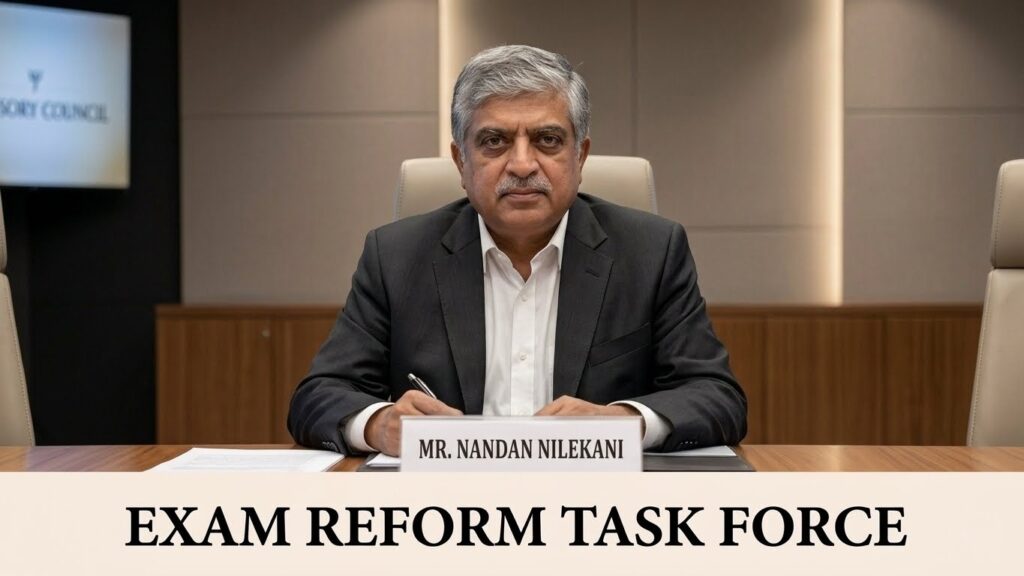
Recently, Prime Minister Narendra Modi constituted a high-powered Exam Reform Task Force led by Nandan Nilekani to overhaul India’s examination system.
What is the High-Powered Exam Reform Task Force?
- About: The High-Powered Exam Reform Task Force is a multidisciplinary expert committee constituted to recommend structural, technological and governance reforms for India’s public examination system, especially examinations conducted by the National Testing Agency (NTA).
- It was constituted on 26 July 2026 by Prime Minister Narendra Modi under the leadership of Nandan Nilekani.
- Objective: The task force aims to build a credible, transparent, secure and technology-driven examination ecosystem.
- It was created following recurring paper leaks, examination irregularities and declining public trust in competitive examinations.
- It addresses widespread public concern and controversies regarding malpractices in high-stakes tests like NEET.
- Systemic evaluation failure highlighted the urgent requirement to replace obsolete analog logistics with advanced digital infrastructure.
- Structure: The task force comprises six members led by Chairperson Nandan Nilekani. Task Force Members are:
- Nandan Nilekani: Nandan Nilekani is an Indian tech leader and the co-founder of Infosys. He served as the head of the Unique Identification Authority of India (UIDAI) and earned fame as the architect of the Aadhaar digital ID project.
- In 2009, the Government of India appointed him the founding Chairman of UIDAI with Cabinet rank.
- Nilekani is regarded as one of the principal architects of India’s Digital Public Infrastructure (DPI) model, which integrates: Aadhaar (Digital Identity), UPI (Digital Payments), DigiLocker, e-KYC and Account Aggregator Framework.
- He authored the influential book Imagining India: The Idea of a Renewed Nation (2008), discussing: Demographic dividend, Urbanisation and Education reforms.
- He was appointed by the Reserve Bank of India (RBI) as the Chairman of the High-Level Committee on Deepening of Digital Payments in January 2019.
- He was appointed to the Supreme Court of India’s Artificial Intelligence Committee as an external expert to help guide the ethical adoption.
- He was honoured with the country’s prestigious civilian award Padma Bhushan.
- S. Somanath: S. Somanath is a prominent rocket scientist and the former Chairman of the Indian Space Research Organisation (ISRO). He played a key role in guiding India’s advanced space missions, including lunar exploration and complex launch vehicle technologies.
- Tapan Deka: Tapan Deka is a senior security specialist and the former Director of the Intelligence Bureau (IB). He has decades of experience handling national security, intelligence gathering, and critical operational strategies across the country.
- V. Kamakoti: V. Kamakoti is an expert in computer science and the Director of IIT Madras. He is widely known for his pioneering work in artificial intelligence, cybersecurity, and developing India’s first indigenous microprocessors.
- Anita Karwal: Anita Karwal is a veteran bureaucrat and the former Secretary of School Education and Literacy. She has vast experience in shaping national education policies, school administration systems, and large-scale academic frameworks.
- Amrit Lal Meena: Amrit Lal Meena is a senior administrator recognized for his expertise in governance and logistics management. He has managed complex administrative systems and supply chain networks across various key government sectors.
- Nandan Nilekani: Nandan Nilekani is an Indian tech leader and the co-founder of Infosys. He served as the head of the Unique Identification Authority of India (UIDAI) and earned fame as the architect of the Aadhaar digital ID project.
- Focus Areas:
- Technology Integration: The panel will recommend digital-first examination systems, secure online infrastructure, AI-enabled monitoring, encrypted question-paper management and modern authentication mechanisms to minimise human intervention.
- Examination Security: A major priority is creating leak-proof examinations through stronger cybersecurity, secure paper transmission, controlled access, real-time surveillance and advanced digital security protocols.
- Governance and Institutional Reforms: The task force will recommend reforms in NTA governance, accountability, operational procedures, audit systems and crisis-management mechanisms to strengthen institutional credibility.
- Logistics and Operational Efficiency: The committee will review examination logistics, including centre management, candidate verification, transportation, scheduling and coordination, ensuring uniform national standards.
- Transparency and Fairness: Recommendations will promote transparent procedures, objective evaluation, grievance redressal, public communication and standard operating procedures to ensure equal opportunity.
Significance for India’s Education and Recruitment System
- Building Long-Term Public Confidence: A secure and transparent examination system increases confidence among students, parents, educational institutions, employers and investors.
- Greater trust in public institutions enhances the legitimacy of government-led recruitment and educational reforms.
- Secure Digital Examination Infrastructure: A technology-driven examination ecosystem will establish end-to-end encrypted digital infrastructure.
- This strengthens cyber resilience, safeguards national examination databases and supports India’s broader Digital Public Infrastructure (DPI) ecosystem.
- Integrating Artificial Intelligence (AI) and data analytics can enable predictive detection of impersonation, such proactive monitoring shifts the system from reactive investigations to preventive governance, reducing examination fraud.
- Modernisation of Public Recruitment: Reforms will help to create a uniform recruitment architecture across agencies such as NTA, UPSC, SSC, RRBs and State recruitment bodies by promoting standard operating procedures, digital verification and common security benchmarks.
- Strengthening Human Capital Formation: A credible examination system improves identification of genuine talent.
- This strengthens human capital, enhances workforce quality and supports India’s long-term demographic dividend, where skilled youth become productive economic assets.
- Enhancing Global Competitiveness: International universities, multinational companies and research institutions value credible assessment systems.
- Strong examination governance can improve India’s reputation for educational quality, supporting student mobility, and the country’s ambition to become a global education hub under National Education Policy (NEP) 2020.
- Reducing Litigation and Administrative Burden: Paper leaks and examination irregularities frequently result in court cases, exam cancellations and delayed admissions.
- A secure system can reduce legal disputes, lower administrative costs and enable faster completion of admission and recruitment cycles across institutions.
- Stronger National Cybersecurity Ecosystem: Since examinations involve sensitive personal and academic data, enhanced security protocols will strengthen India’s cybersecurity preparedness against hacking, ransomware, data theft and insider threats.
- The task force supports good governance, Digital India, Atmanirbhar Bharat, Ease of Living and Ease of Doing Government, creating a future-ready examination and recruitment ecosystem.
FAQs:
1. What is the Exam Reform Task Force announced by PM Modi?
A government-appointed expert panel led by Nandan Nilekani to recommend comprehensive Examination Reforms for secure, transparent and technology-driven public exams.
2. Why was Nandan Nilekani chosen to lead the task force?
The Infosys Co-Founder was chosen for his expertise in Digital Public Infrastructure, Aadhaar and large-scale technology-driven governance reforms.
3. What are the objectives of the Exam Reform Task Force?
To strengthen Paper Leak Prevention, improve transparency, adopt Digital Exams, enhance governance and restore trust in Competitive Exams.
4. How will the task force help prevent paper leaks?
By recommending encryption, AI monitoring, secure digital systems, stronger cybersecurity and standard operating procedures for examinations.
5. Which examinations will be covered under the proposed reforms?
Primarily NTA-conducted Competitive Exams, with recommendations applicable to other national and state examination agencies.
Disclaimer: Information in this article is based on official announcements and public records. Regulations and implementation details may evolve over time.