



Indian Railways Nears 100% Electrification, Accelerating India’s Green Rail Transition
| General Studies Paper III: Infrastructure, Sustainable Development |
Why in News?
Indian Railways has electrified 99.7% of its broad-gauge network, leaving just 191 route kilometers pending across Assam, Karnataka, and Goa.
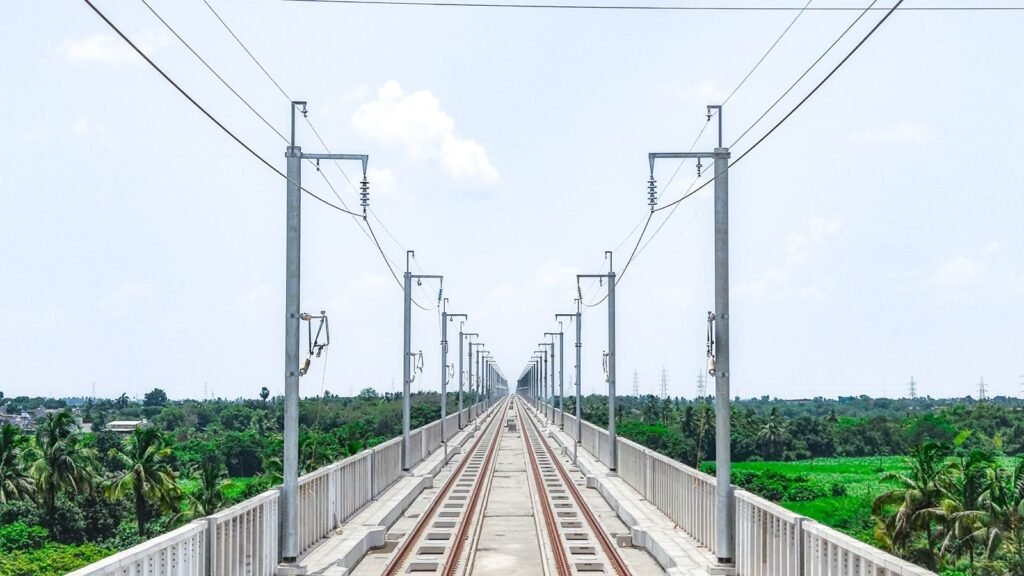
Electrification in Indian Railways
- Current Electrification: The Indian Railways has achieved an unprecedented milestone, electrifying 99.7% of its total Broad Gauge (BG) network as of October 2026.
- Out of the total 70,502 route kilometers (RKM), 70,311 RKM have been fully electrified, leaving only a minuscule 191 RKM pending across three remaining states.
- This massive transition secures India’s position as the world’s second most extensively electrified railway network, trailing only behind Switzerland.
- Historical Foundation: The journey of electric traction in India began over a century ago on February 3, 1925.
- The country’s very first electric train operated on a 1,500-volt DC system over a short harbor stretch between Bombay Victoria Terminus and Kurla Harbour.
- Electrification later reached Madras in 1931, but the modern milestone occurred on August 11, 1960, when the Rajkharswan–Dongoaposi section adopted the highly efficient 25 kV AC system.
- Institutional Framework: To manage the heavy structural challenges, the Central Organisation for Railway Electrification (CORE) was institutionalized in 1961 as PORE in Kolkata, later relocating its permanent headquarters to Prayagraj (Allahabad).
- CORE has single-handedly executed over 70% of the total network electrification in India.
- The organizational push helped structural setups, leading the Ministry of Railways to decree that all new lines and multi-tracking projects must be automatically constructed with electrification.
- Progress: The pace of tracking altered dramatically after 2014 under a mission-mode strategy.
- Before 2014, only about 21,801 RKM (roughly 20-30%) of the network had been electrified over six decades.
- In contrast, between 2014 and 2026, the network added a staggering 48,072 route kilometers.
- The average execution speed surged from a sluggish 1.42 km/day to over 15 km/day, powered by automated technologies like advanced wiring trains.
- The share of electrified tracks surged from 24% in 2000 to over 96% by the end of 2024, and 99.2% by November 2025.
- Global Comparison: India’s electrification rate outperforms major systems like China (82%), Japan (64%), and the United Kingdom (39%).
- Regional Milestone: 27 States and Union Territories have officially declared 100% electrification of their Broad Gauge lines.
- 15 prominent railway zones, including the Central, Northern, and Western zones, are entirely electrified.
- A historic breakthrough occurred recently when the Southern Railway completed its final 71-km Pattukkottai-Karaikkudi section to reach absolute 100% electrification, alongside the complex engineering feat of electrifying the landslide-prone Sakleshpur-Subramanya Road ghat section in Karnataka.
- Only three states Assam, Karnataka, and Goa have remaining non-electrified sections.
- Assam: 2,534 RKm electrified out of 2,589 RKm total BG network (97.9% complete, with 55 RKm remaining).
- Karnataka: 3,623 RKm electrified out of 3,743 RKm total BG network (96.8% complete, with 120 RKm remaining).
- Goa: 171 RKm electrified out of 187 RKm total BG network (91.4% complete, with 16 RKm remaining).
Strategic Significance of Railway Electrification
- Environmental Benefits: Electric traction delivers a 95% environmental benefit over diesel, functioning as the backbone of India’s green transport pipeline.
- Phasing out diesel engines eliminates trailing soot, smoke, and localized greenhouse gases, preventing nearly 60 million tonnes of CO₂ emissions annually.
- This systemic overhaul aligns with the Paris Agreement and drives the carrier toward its Net-Zero Carbon Emission target by 2030.
- Energy Security: Massive grid transition has significantly reduced vulnerable exposure to global oil price shocks.
- By shifting traction load to domestic power grids, the network slashed annual diesel consumption by 178 crore litres—a massive 62% reduction compared to baseline years.
- This structural shift curbed heavy crude oil imports, saving precious foreign exchange and boosting national energy self-reliance.
- Economic Gains: Electrification acts as a powerful catalyst for inclusive regional development and economic growth along high-density transit corridors.
- The transition has stimulated localized industrial demand for electrical components, generating over 5.5 lakh man-years of employment.
- It additionally maximizes the potential of large vacant railway land parcels for massive commercial solar farm installations.
- As of mid-2026, more than 1,260 MW of renewable capacity has been successfully commissioned, consisting of 1,161 MW of solar plants and 103 MW of wind energy.
- Operational Efficiency: Modern electric locomotives boast a far superior power-to-weight ratio, allowing them to haul heavier 4,500 to 9,000-tonne freight loads with ease.
- They offer significantly faster acceleration and higher sectional speeds, which drastically reduces travel time.
- This helps optimize track slot utilization, enhances network-wide punctuality, and eliminates technical bottlenecks at zone boundaries.
- Cost Savings: Electric propulsion is roughly 70% more economical than diesel traction on a per-kilometer basis.
- The national transporter successfully lowered its annual energy expenditure from ₹37,841 crore down to ₹32,378 crore, translating to over ₹5,000 crore in direct energy cost savings.
- These recurring fiscal savings directly improve the internal operating ratio of Indian Railways.
- Maintenance Reductions: Electric locomotives contain drastically fewer moving mechanical parts than complex internal combustion diesel engines.
- Consequently, they require less frequent servicing, have a longer asset lifespan, and lower overhead repair expenses.
- This basic structural simplicity guarantees higher fleet reliability and lower maintenance costs, freeing up workshop capacity.
- Technology Integration: The electrification network serves as an infrastructural anchor for advanced utility systems like copper-free optical fiber communication cables.
- It directly powers modern Head-on-Generation (HOG) systems, drawing hotel load directly from overhead lines to eliminate noisy power cars.
- It utilizes automated microprocessor-based SCADA systems for seamless, real-time power grid management.
Challenges in Electrification of Railways
- OHE Terrain Disruptions: Maintaining high-voltage Overhead Equipment (OHE) infrastructure inside challenging geographic zones like the North-East and deep Himalayan corridors represents a severe technical challenge.
- These high-altitude stretches are highly susceptible to unpredictable landslides, extreme snowfall, and heavy structural collapses.
- Indirect Carbon Shift: Over 60% of the traction current drawn from the national grid is still generated by conventional, coal-based thermal power plants.
- The electrification layout effectively shifts greenhouse gas emissions from track zones to industrial power generation plants, diluting the overall ecological benefits.
- Rolling Stock Shortages: The accelerated pace of route electrification has severely outstripped the corresponding output of the manufacturing units.
- This structural gap has triggered a critical shortage of high-speed passenger electric locomotives nationwide.
- Grid Strategic Vulnerability: Transitioning away from self-reliant internal combustion engines introduces a severe single-point failure risk across the entire transit pipeline.
- Centralizing traction operations onto external power lines makes the entire railway network completely vulnerable to widespread grid failures, cyberattacks, or natural catastrophes.
Way Forward
- Renewable RTC Agreements: To eliminate the indirect carbon footprint of fossil-fueled grids, the carrier must scale up Round-the-Clock (RTC) clean energy contracts.
- Integrating hybrid wind-solar packages backed by large-scale battery energy storage systems (BESS) ensures a continuous, reliable flow of green traction power.
- Locomotive Fleet Conversions: Serviceable mainline diesel locomotives can be converted into specialized shunting engines or dual-mode utility tractors.
- The ministry can actively export these functional diesel assets to developing nations in Africa or South Asia to recoup residual asset values.
- Dual-Mode Border Deployment: To mitigate grid failure vulnerabilities, the transporter must selectively retain strategic redundancy.
- Deploying modern dual-mode locomotives (diesel + electric hybrid) along critical international borders and high-risk catastrophe zones guarantees uninterrupted operations.
- Universal Open Access: The national transporter must aggressively enforce Open Access power procurement policies across all state boundaries.
- Bypassing expensive commercial tariffs levied by localized state power distribution companies (DISCOMs) allows the carrier to buy electricity directly from cheap, high-capacity generators.
- Regenerative Braking Standardization: Future updates must mandate the production of three-phase IGBT locomotives equipped with regenerative braking capabilities across all assembly plants.
- Standardizing this loops energy usage, improving net network energy efficiency by up to 15-20%.
Frequently Asked Questions (FAQs)
1. What is the current electrification status of Indian Railways?
Approximately 99.7% of India’s broad-gauge railway network was electrified by September 30, 2026.
2. When is Indian Railways expected to achieve 100% electrification?
Electrification is nearing completion, but an official nationwide completion date has not been confirmed in the latest report.
3. Why is railway electrification important for India?
It strengthens energy security, operational efficiency, freight competitiveness, environmental sustainability, and reduces dependence on imported petroleum.
4. How does railway electrification reduce carbon emissions?
Electric trains eliminate direct diesel exhaust during operation; emissions decline further when electricity comes from renewable energy sources.
5. What are the major benefits of electric trains over diesel trains?
Electric trains offer lower operating costs, better acceleration, reduced local pollution, improved energy efficiency, and less diesel dependence.
6. How much of India’s railway network has been electrified?
Approximately 70,311 of 70,502 broad-gauge route kilometres were electrified by September 30, 2026.
Disclaimer: Information in this article is based on official announcements and public records. Details may evolve over time.