



DAC Defence Deal 2026: ₹2.12 Lakh Crore Approved for LMR Helicopters, Kamikaze Drones
| General Studies Paper III: Defence Technology, Modernization of Defence Forces |
Why in News?
Recently, the Defence Acquisition Council (DAC) chaired by the Defence Minister approved ₹2.12 lakh crore in defence acquisition proposals, covering drones, artillery, helicopters and air defence systems.
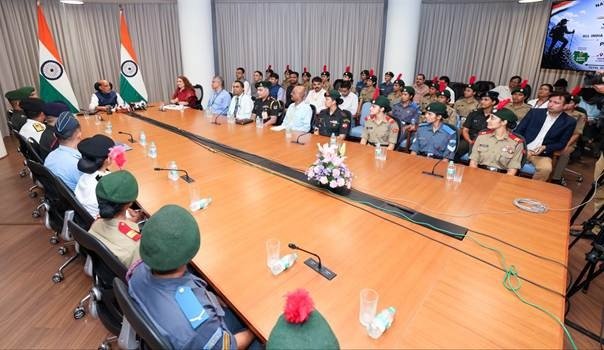
DAC Defence Deal 2026: Approval Highlights
- Approval: On 26 October 2026, the Defence Acquisition Council (DAC), chaired by Defence Minister Rajnath Singh, granted Acceptance of Necessity (AoN) to capital acquisition proposals for India’s armed forces.
- Financial Outlay: It involves a massive financial value evaluated at approximately ₹2.12 lakh crore ($25.4 billion).
- Coverage: The approvals cover the Indian Army, Indian Navy and Indian Air Force, targeting operational mobility, surveillance, firepower, air defence and combat preparedness.
- Indian Army Platforms: The Army received massive allocations encompassing High Mobility Vehicles (HMV) for logistical swiftness in rough terrains and Self-Propelled Tracked Gun Systems for mechanised firepower.
- Air shield and reconnaissance are reinforced via Light Multi Role Helicopters (LMRH), Very Short-Range Air Defence Systems (VSHORADS), and Gun Shot Response Systems (GSRS).
- Additionally, advanced surveillance UAVs, Counter-UAS platforms, and Long Range Kamikaze Drone Systems were cleared.
- Indian Navy Platforms: The naval branch secured indigenous defensive equipment headlined by the Active Offboard Decoy Systems (AODS) to shield front-line capital warships against modern anti-ship cruise missiles.
- The council also authorized additional major indigenously designed and built naval combat vessels to expand maritime dominance.
- Indian Air Force Platforms: The Air Force will receive a high-tech combination of specialized utilityhelicopters for forward transport operations and advanced air defence systems to protect vital airspace.
- The approval also packages sophisticated new weapon systems and localized Mobile X-Band Doppler Weather Radar Systems to track micro-weather patterns dynamically near borders.
- Significance:
- 82% of this budget, translating to about ₹1.74 lakh crore, is strictly reserved for procurement from domestic Indian industries.
- This acts as a monumental catalyst for the Make in India and Aatmanirbhar Bharat frameworks.
- It actively shifts reliance away from foreign original equipment manufacturers (OEMs), strengthening India’s internal industrial defense base.
- The proposals address emerging challenges involving drones, counter-drone systems, mobile artillery, missile threats and multi-domain surveillance.
- 82% of this budget, translating to about ₹1.74 lakh crore, is strictly reserved for procurement from domestic Indian industries.
Features of Defence Platforms Under this Approval
- High Mobility Vehicles (HMVs): High Mobility Vehicles are tactical, heavy-duty logistics platforms engineered by domestic manufacturers like Tata Advanced Systems and Ashok Leyland to provide rapid troop movement and supply lines across extreme terrains.
- These multi-axle all-terrain trucks feature high-ground clearance, run-flat tires, and centralized tire inflation systems.
- They possess exceptional payload capacities capable of hauling heavy artillery, mechanical equipment, and combat troops through deep mud, snow, and steep mountain passes.
- Self-Propelled Tracked Gun Systems: Tracked Gun Systems, represented by platforms like the indigenously assembled K9 Vajra-T, are armored mobile artillery units featuring 155mm/52-caliber guns mounted on continuous track chassis.
- Developed by Larsen & Toubro in collaboration with global defense technology partners, these platforms boast automatic ammunition.
- They provide rapid “shoot-and-scoot” firepower to evade counter-battery strikes.
- Gun Shot Response Systems (GSRS): Gun Shot Response Systems are advanced acoustic-electronic battlefield surveillance frameworks designed by domestic electronics firms and the Defence Research and Development Organisation (DRDO) to serve as critical force multipliers.
- It utilizes distributed acoustic sensor grids, advanced digital signal processing algorithms, and automated thermal cameras.
- These networks capture the supersonic shockwaves and muzzle flashes of enemy gunfire.
- The platform automatically calculates the exact spatial coordinates, bearing, and distance of hostile snipers or hidden firing positions.
- Light Multi-Role Helicopters (LMRH): Light Multi-Role Helicopters are versatile, high-altitude rotary-wing aviation assets designed and built by Hindustan Aeronautics Limited (HAL) to operate in challenging mountainous regions.
- Powered by twin turboshaft engines with digital controls, these helicopters feature composite rotor blades, crashworthy structures, and glass cockpits optimized for day-and-night navigation.
- Very Short-Range Air Defence Systems (VSHORADS): Very Short-Range Air Defence Systems are portable, low-altitude surface-to-air missile systems indigenously conceptualized and developed by DRDO to neutralize sudden aerial threats.
- It is specifically engineered to target and intercept fast-moving, low-flying adversarial assets, including unmanned aerial vehicles, low-flying fighter jets, and cruise missiles.
- Platform-Based Counter-Unmanned Aerial Systems (C-UAS): Counter-Unmanned Aerial Systems are mobile, vehicle-integrated electronic warfare and hard-kill shielding platforms developed by Bharat Electronics Limited (BEL) and private Indian aerospace entities.
- This networks integrate active electronically scanned array (AESA) micro-radars, radio-frequency jammers, and multi-spectral electro-optical tracking modules.
- The platforms jam control frequencies, disrupt satellite navigation links of rogue micro-drones, or deploy kinetic interceptors.
- Long Range Kamikaze Drone Systems: Kamikaze Drone Systems, classified as loitering munitions, are precision-guided expendable aerial weapon systems designed by cutting-edge Indian defense startups and public defense enterprises.
- These are equipped with high-resolution electro-optical/infrared sensors, secure jam-resistant data links, and high-explosive armor-piercing warheads.
- These platforms can hover quietly over targeted areas for extended durations.
- Active Offboard Decoy Systems (AODS): Active Offboard Decoy Systems are sophisticated naval electronic warfare mechanisms engineered by maritime labs under the DRDO to protect frontline capital warships.
- The platform consists of expendable, rocket-launched or chaff-launched active radio-frequency electronic emitters deployed far away from the host vessel.
- Next-Generation Destroyers: These are large, stealth-optimized surface combatant warships designed by the Warship Design Bureau and built at premier domestic shipyards like Mazagon Dock Shipbuilders.
- These naval platforms feature highly integrated radar cross-section reduction structures, combined gas turbine propulsion engines, and deep vertical launch system (VLS) cells.
- They are armed with long-range supersonic cruise missiles, multi-tier air defense grids, advanced sonar arrays, and heavy anti-submarine torpedoes.
- Mobile X-Band Doppler Weather Radar System: A Mobile X-Band Doppler Weather Radar (DWR) System is a compact, transportable meteorological radar that uses short-wavelength microwave radiation to track localized weather events, cloud microphysics, and atmospheric shifts in real time.
- It was developed domestically by organizations like the Indian Space Research Organisation (ISRO) and manufactured by Bharat Electronics Limited (BEL).
- It operates in the 8–12 GHz frequency range with wavelengths of approximately 2.5 to 4 cm.
- It typically covers a shorter effective observation range (around 100 to 150 km) compared to S-band or C-band radars, making it ideal for localized nowcasting.
What Is the Defence Acquisition Council (DAC)?
- About: The Defence Acquisition Council (DAC) is the highest decision-making body within the Ministry of Defence.
- It was established in 2001 following the recommendations of the Group of Ministers on reforming the national security system after the 1999 Kargil War.
- Objective: Its primary objective is to ensure the expeditious procurement of approved requirements for the armed forces.
- Structure: The council is chaired by the Union Minister of Defence.
- Its members include the Chief of Defence Staff (CDS), the Chiefs of the Army, Navy, and Air Force, as well as the Defence Secretary.
- This structure enables fast-tracked policy decisions and smooth capital acquisitions for the Indian Armed Forces, Coast Guard, and Paramilitary forces.
- Functions: The primary mandate of the DAC is to accord Acceptance of Necessity (AoN) for capital acquisition proposals.
- It acts as the ultimate authority for approving the Long-Term Integrated Perspective Plan (LTIPP) for defense procurement.
- It translates military requirements into technological capabilities.
- The DAC categorizes acquisitions to promote self-reliance under the Defence Acquisition Procedure (DAP).
- It prioritizes categories like Buy (Indian-IDDM) (Indigenously Designed, Developed, and Manufactured), Buy (Indian), and Buy and Make (Indian).
- The council plays a pivotal role in the Atmanirbhar Bharat (Self-Reliant India) initiative by promoting the indigenous defense industry.
- It approves Positive Indigenisation Lists that ban the import of specific military hardware, forcing domestic sourcing.
- It fosters innovation by supporting local Micro, Small, and Medium Enterprises (MSMEs) and private defense startups.
- Innovations for Defence Excellence (iDEX) supports defence innovation by encouraging start-ups, entrepreneurs and MSMEs to develop technologies addressing military requirements.
- The SRIJAN portal, launched in August 2020, connects defence organisations with Indian industry to facilitate the indigenisation of imported items.
- India has established defence industrial corridors in Uttar Pradesh and Tamil Nadu to support manufacturing ecosystems, investment and industrial development.
- It acts as the ultimate authority for approving the Long-Term Integrated Perspective Plan (LTIPP) for defense procurement.
Frequently Asked Questions (FAQs):
1. What is the DAC helicopter and drone deal approved in 2026?
DAC granted in-principle approval for light multi-role helicopters, special utility helicopters and multiple surveillance, counter-drone and kamikaze drone systems.
2. What is the total estimated value of the defence acquisition proposals?
Approximately ₹2.12 lakh crore (₹2,12,000 crore).
3. Who chaired the Defence Acquisition Council meeting?
Defence Minister Rajnath Singh chaired the DAC meeting on 26 October 2026.
4. Which helicopters and drone systems received DAC approval?
Light Multi Role Helicopters, Special Utility Helicopters, Surveillance UAVs, Integrated Surveillance and Strike Systems, Long Range Kamikaze Drone Systems and other unmanned aerial systems.
Disclaimer: Information in this article is based on official announcements and public records. Details may evolve over time.