


Solar Magnetic Threads Discovery, Significance of Mapping Sun’s Magnetic Structure
| General Studies Paper III: Scientific Discoveries, Space Technology |
Why in News?
Recently, astronomers using the Sunrise-III solar observatory discovered a complex network of fine, thread-like magnetic structures woven within the Sun’s chromosphere.
Discovery of Solar Magnetic Threads
- Researchers: An international research team led by Japan’s National Astronomical Observatory of Japan (NAOJ).
- Instruments: The discovery utilized the advanced Sunrise-III solar observatory.
- The critical magnetic data was captured using its onboard Sunrise Chromospheric Infrared Polarimeter (SCIP) instrument.
- SCIP operates in the near-infrared spectrum to precisely isolate and measure multi-layered magnetic fields.
- Note: Sunrise-III Solar Observatory is an international, balloon-borne stratospheric solar research mission built around a 1-meter aperture telescope.
- It was launched on July 10, 2024, from the Esrange Space Center near Kiruna, Sweden, and flew for 6.5 days across the Arctic Circle to Canada.
- It operated at an altitude of approximately 35 kilometres to bypass Earth’s atmospheric interference.
- The critical magnetic data was captured using its onboard Sunrise Chromospheric Infrared Polarimeter (SCIP) instrument.
- Publication: The findings were officially published in The Astrophysical Journal Letters on October 24, 2026.
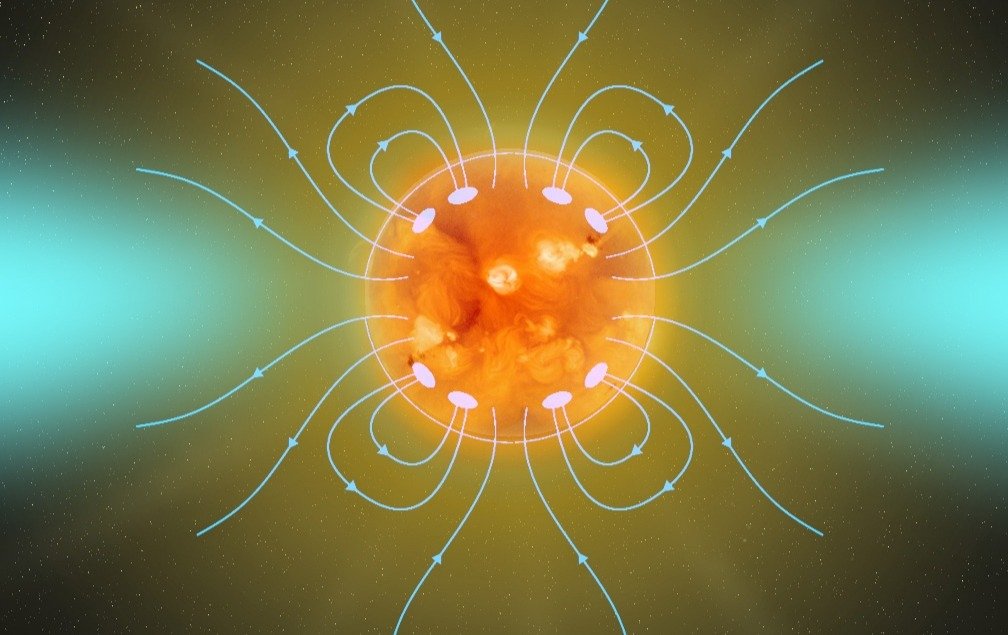
- Findings: The international research team detected fine, thread-like magnetic structures within a “quiet-Sun” region (areas lacking prominent features like sunspots).
- The threads are typically narrower than one arcsecond, and some show magnetic polarity opposite to their surroundings.
- Their measured line-of-sight fields are typically 10–20 gauss weaker than the surrounding canopy.
- Instead of a uniformly expanding magnetic field structure as previously assumed, the observation revealed highly concentrated, narrow, and distinct magnetic features within the solar magnetic canopy.
- These structures were mapped across the chromosphere.
- Driven by computer simulations matching the data, twisting motions at the solar surface (photosphere) physically shape the magnetic field lines into these thread-like structures higher up in the atmosphere.
- These threads serve as conduits that transfer energy upward through the solar atmosphere.
- The mission measured and mapped the exact magnetic fields inside spicules.
- The threads are typically narrower than one arcsecond, and some show magnetic polarity opposite to their surroundings.
Solar Atmosphere and Its Magnetic-Field
- Structure: The Sun’s atmosphere comprises the photosphere, chromosphere, transition region and corona.
- The photosphere is the visible surface of the Sun. It is the lowest layer of the solar atmosphere, measuring about 250 miles thick.
- The temperature here ranges from 4,500 to 6,000 degrees Celsius.
- This layer emits the light we see on Earth. It features bubbling cells called granules, which are caused by hot gas rising and cooling.
- Located just above the photosphere, the chromosphere is a glowing red layer of gas.
- It is roughly 1,200 miles deep. Temperatures rise as you move upward, reaching up to 20,000 degrees Celsius.
- This layer is famous for spicules, which are narrow jets of hot gas shooting upward like fiery spikes. It is best seen during a total solar eclipse.
- The transition region is a thin, dynamic gateway between the chromosphere and the outer atmosphere.
- It is only a few tens of miles thick. In this narrow zone, the temperature increases drastically from thousands to nearly a million degrees Celsius.
- The exact cause of this rapid heat spike remains one of solar physics’ greatest mysteries.
- The corona is the outermost atmospheric layer, extending millions of miles into space.
- Surprisingly, it is much hotter than the surface, reaching 1 to 3 million degrees Celsius.
- The corona consists of extremely thin plasma. It is shaped into beautiful loops and streamers by the Sun’s powerful magnetic forces, visible as a white halo during eclipses.
- The photosphere is the visible surface of the Sun. It is the lowest layer of the solar atmosphere, measuring about 250 miles thick.
- Magnetic-Field: The solar dynamo is the internal engine that generates the Sun’s magnetic field.
- This mechanism operates deep inside the convection zone. Because the Sun is fluid, its equator rotates faster than its poles, a process called differential rotation.
- This uneven spinning stretches and twists internal magnetic lines, creating a powerful magnetic network.
- Sunspots are temporary, dark patches on the photosphere. They appear dark because they are cooler than their surroundings, around 3,500 degrees Celsius.
- Sunspots are caused by intense concentrations of magnetic flux that block the upward flow of hot gas. They serve as the primary hubs for major solar activity.
- When twisted magnetic fields suddenly snap and reconnect, they release massive energy.
- This process triggers solar flares, which are sudden flashes of intense radiation.
- It also causes Coronal Mass Ejections (CMEs), which blast billions of tons of magnetized plasma into space.
- These events can trigger disruptive geomagnetic storms on Earth.
Significance of This Discovery
- Advancing Fundamental Solar Physics: The discovery challenges the simplified picture of the chromospheric magnetic canopy as a smoothly expanding structure.
- These new findings improve constraints on the magnetic topology connecting the photosphere and chromosphere, helping researchers refine theories of solar magnetism and plasma dynamics.
- Solving Coronal Heating: By mapping how kinetic energy moves from the surface up into the upper atmosphere, scientists can better resolve the coronal heating problem—why the corona is millions of degrees hotter than the surface.
- The thread layout provides empirical proof of small-scale magnetic reconnections and impulsive nanoflares, which release massive thermal energy.
- Practical Space Applications: Understanding these subtle magnetic webs can help scientists forecast how coronal mass ejections expand, accelerate, and transform en route to Earth.
- This can provide crucial early warnings to protect critical infrastructure, including global power grids, GPS navigation, and orbital satellites.
Frequently Asked Questions (FAQs):
1. What are the magnetic threads recently detected above the Sun?
They are thin, elongated magnetic structures embedded within the Sun’s chromospheric magnetic canopy.
2. Which observatory discovered the magnetic structures above the Sun?
The balloon-borne Sunrise-III solar observatory, during its 2024 stratospheric flight.
3. In which layer of the Sun’s atmosphere were the magnetic threads detected?
They were detected in the chromosphere, above the photosphere, within the magnetic canopy.
4. What role did the Sunrise-III observatory play in this discovery?
Its SCIP instrument mapped solar magnetic fields precisely using near-infrared spectropolarimetry, minimising atmospheric blurring from Earth.
5. Why is the discovery of magnetic threads important for understanding solar activity?
It reveals complex magnetic structures and offers clues about magnetic reconnection, energy transport and heating of the solar atmosphere.
Disclaimer: Information in this article is based on official announcements and public records. Details may evolve over time.
| Also Read: Rare Quadruple Star System in Milky Way |