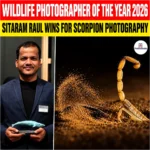



Wildlife Photographer of the Year 2026: Sitaram Raul Won the Award for Scorpion Photography
| General Studies Paper III: Environment & Ecology, Wildlife, Biodiversity |
Why in News?
Recently, Indian photographer Sitaram Raul won the Behaviour: Invertebrates category at Wildlife Photographer of the Year 2026 for Shifting Sand, capturing a Thar Desert scorpion burrowing to escape rising temperatures.
Highlights of Wildlife Photographer of the Year 2026
- Announcement: The Wildlife Photographer of the Year 2026 competition announced its winners during a grand ceremony in London in October, 2026.
- The event featured an exhibition that officially opened to the public on October 16, 2026.
- The contest is globally recognized as the “Oscars of wildlife photography”.
- For this edition, judges reviewed more than 65,000 entries submitted from 121 countries around the world.
- Winners:
- The highest honor of the entire competition went to Italian photographer Federico Veronesi.
- He won the overall Wildlife Photographer of the Year award for his heartbreaking photograph titled The Aftermath.
- His image captures an elephant carrying its deceased calf.
- The photo was highly praised by judges for its deep technical skill, emotional impact, and compelling natural storytelling.
- Indian wildlife photographer and fine artist Sitaram Dinkar Raul, who is based in Badlapur, Maharashtra, achieved global recognition.
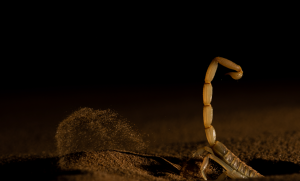
- He won the first prize in the “Behaviour: Invertebrates” category for his outstanding photograph titled Shifting Sand.
- Raul’s award-winning photo captures a rare, fast-paced action moment in the Thar Desert near Sam village in Rajasthan.
- It vividly shows a tiny Thar Desert Buthacus scorpion digging its home. By using an off-camera flash and adjusting light angles, Raul perfectly timed the exposure.
- This technique froze the kicked-up sand particles so they appear beautifully suspended in mid-air against the dark desert landscape.
- The photograph showcases a vital desert survival strategy.
- He made history by delivering his official acceptance speech in Marathi on the international stage.
- He also received a ‘Highly Commended’ distinction in the Urban Wildlife category at the Wildlife Photographer of the Year 2025 competition for his photograph Nature Reclaims its Space.
- The highest honor of the entire competition went to Italian photographer Federico Veronesi.
About Thar Desert Scorpions
- The Thar Desert scorpion (Indian Buthacus scorpion) inhabits the Great Indian Desert, an arid ecoregion spanning northwestern India (primarily Rajasthan, Gujarat, Haryana, and Punjab) and eastern Pakistan.
- Scorpions belong to phylum Arthropoda, subphylum Chelicerata and class Arachnida.
- They are not insects. They belong to the order Scorpiones. Their close relatives include spiders, ticks and mites.
- They thrive in hyper-arid ecosystems characterized by shifting aeolian sand dunes (barchans), rocky outcroppings (bhakars), and saline lake beds.
- They micro-inhabit loose, calcareous desert soils, sheltering under rocks, craggy formations, or inside specialized subterranean burrows.
- They possess a distinct exoskeleton shielded by an epicuticular wax layer composed of heavy hydrocarbons, minimizing trans-evaporative water loss (desiccation) under extreme thermal conditions.
- Their body is divided into the prosoma (cephalothorax) and opisthosoma (abdomen).
- They feature slender pedipalp pincers, specialized sand combs (pectines) on their underbelly to navigate moving substrates and gauge humidity, and a highly bulbous telson (stinger).
- Their cuticle displays unique ultraviolet fluorescence under moonlight, which protects against sudden radiation and aids conspecific signaling.
- To combat ambient temperatures exceeding 50°C and plunging near freezing, scorpions utilize strict nocturnality and deep burrowing behavior (up to 90 cm).
- Their metabolic rate is phenomenally low, allowing them to reduce oxygen consumption and survive up to a full year on a single insect.
- They excrete nitrogenous waste as dry, insoluble guanine pellets to conserve internal moisture, extracting necessary hydration directly from the bodily fluids of their prey.
- As peak nocturnal carnivorous apex invertebrates, they maintain the delicate desert food web by regulating populations of insects, spiders, and small vertebrates.
- Hottentotta tamulus is globally recognized as the most lethal scorpion species, producing a potent cardio-pulmonary neurotoxin (including the peptide tamapin).
- In public health, envenomation causes severe autonomic storms, historically mitigated by the vasodilator prazosin.
- Medical research targets their venom toxins for developing breakthroughs in immunosuppressive and autoimmune disease treatments.
What is Wildlife Photographer of the Year Award?
- About: The Wildlife Photographer of the Year is an international wildlife photography competition widely regarded as the “Oscars of wildlife photography“.
- It serves as a global platform highlighting the relationship between science, art, and nature conservation.
- Objective: The award compitition’s primary goal is to encourage professional and amateur photographers to document the diversity of nature.
- It aims to highlight environmental beauty and inspire global care and protection for the natural world.
- Organisation: The competition is developed, owned, and solely run by the Natural History Museum, London.
- It was historically co-founded and organized alongside BBC Wildlife Magazine (originally called Animals).
- Origin: The competition originated in 1965 under Animals magazine.
- The inaugural event was small and received only 361 entries.
- The very first Grand Title winner was C.V.R. Dowdeswell.
- His winning black-and-white photograph depicted a tawny owl bringing food to its young, which also won the British Birds category.
- Eligibility: The contest is open to all photographers globally, regardless of age or nationality.
- It features an Adult division (ages 18 and over) and a Young division (ages 17 and under).
- Selection Process: Entries undergo a rigorous three-round judging process by an international jury panel.
- The panel evaluates images based on originality, narrative, and strict ethical practices, followed by an authenticity check.
- Award: The Adult Grand Title winner receives a cash prize of £15,000, a trophy, and a certificate.
- Portfolio and Photojournalist story winners get £2,500, category winners receive £1,250, and the Young Grand Title winner receives £2,000.
- Awardees: Over the years, global photographers have secured the title, including Laurent Ballesta, Tim Laman, and Wim van den Heever.
- The 2025 adult Grand Title went to Wim van den Heever of South Africa for Ghost Town Visitor.
- Prominent indian achievers include Rajesh Bedi (1986), Aishwarya Sridhar; Highly Commended (2020), Vidyun R. Hebbar (2021), Sriram Murali (2023), and youth prodigy Shreyovi Mehta; Runner-up (2024).
Frequently Asked Questions (FAQs):
1. Who is Sitaram Raul, and which award did he win in 2026?
Sitaram Raul is an Indian wildlife photographer and fine artist who won a category award in Wildlife Photographer of the Year 2026.
2. In which category did Sitaram Raul win the award?
He won the Behaviour: Invertebrates category.
3. What is the title of Sitaram Raul’s award-winning photograph?
His award-winning photograph is titled Shifting Sand.
4. Where was Sitaram Raul’s winning photograph captured?
It was captured in the Thar Desert, Rajasthan, India, near the village of Sam.
5. Which organisation conducts the Wildlife Photographer of the Year competition?
The Natural History Museum, London, United Kingdom, organises the competition.
Disclaimer: Information in this article is based on official announcements and public records. Details may evolve over time.