



India Tunnel Boring Machine Development, Countering China’s Export Restrictions
| General Studies Paper III: Science and Technology, Development, Indigenous Manufacturing |
Why in News?
Recently, the Commerce Minister asserted that India would indigenously develop Tunnel Boring Machines (TBMs) to counter China’s export restrictions.
What are Tunnel Boring Machines (TBMs)?
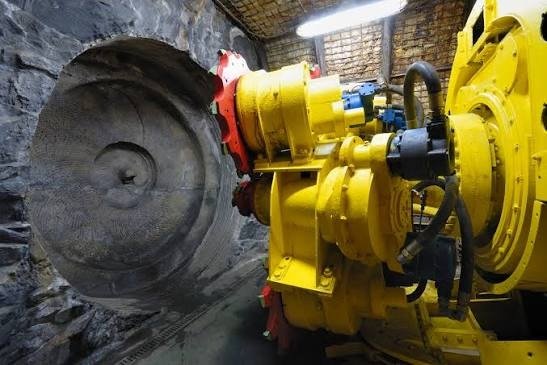
- About::Tunnel Boring Machines (TBMs) are sophisticated mechanical excavation systems designed to construct underground tunnels through hard rock, soft soil, mixed geological formations and water-bearing strata.
- They excavate circular or near-circular tunnels while simultaneously supporting surrounding ground and installing tunnel linings.
- Development: In 1818, engineer Marc Isambard Brunel patented an innovative tunnelling shield inspired by shipworms boring through wood. His invention introduced protected, compartment-based excavation.
- Brunel’s tunnelling shield was first practically deployed in 1825 during construction of the Thames Tunnel beneath the River Thames in London, completed in 1843.
- American engineer Charles Wilson developed an early mechanical tunnelling machine in 1851.
- The first modern TBM was developed by James Robbins in 1952 for South Dakota’s Oahe Dam project.
- Manufacturer: Leading manufacturers include Herrenknecht AG (Germany), China Railway Engineering Equipment Group (CREG), China Railway Construction Heavy Industry (CRCHI), The Robbins Company (USA), Komatsu (Japan), and TERRATEC (Australia).
- Working Technology: TBMs operate through a rotating cutterhead fitted with cutting tools or disc cutters.
- Hydraulic jacks generate thrust, advancing the machine into the excavation face.
- Excavated material, called muck or spoil, is transported through conveyors, screw conveyors or slurry pipelines.
- Simultaneously, guidance systems maintain alignment and lining equipment installs precast concrete segments.
- Types:
- Main Beam/Open Gripper TBM: Designed for competent hard rock, using mechanical grippers against tunnel walls to generate forward thrust.
- Earth Pressure Balance (EPB) TBM: Uses conditioned excavated soil to maintain pressure at the excavation face, particularly suitable for soft and cohesive urban ground.
- Slurry Shield TBM: Uses pressurised slurry, commonly bentonite-based, to stabilise water-bearing and granular ground.
- Features:
- Simultaneous Structural Lining: The machine houses a hydraulic segment erector that acts concurrently with excavation.
- It places pre-cast concrete voussoir rings into position behind the shield, ensuring immediate overhead protection and creating a strong, durable structure.
- Hydraulic Propulsion Systems: To achieve massive penetration forces, TBMs utilize sets of heavy perimeter thrust jacks. These jacks push forward by bracing against the newly erected concrete segment rings.
- Continuous Spoil Removal Logistics: Muck removal is fully automated inside the trailing gear.
- Broken stone or liquefied earth travels continuously from the cutter face via screw conveyors onto external transit systems.
- Digital Geotechnical Monitoring: Advanced automated software continuously tracks structural alignment. Integrated sensor networks provide real-time data on rock strength, hydrostatic pressure, and mechanical cutter wear.
- Simultaneous Structural Lining: The machine houses a hydraulic segment erector that acts concurrently with excavation.
- Engineering Applications: TBMs are extensively used in metro railways, high-speed railway corridors, road tunnels, Himalayan transportation tunnels, hydropower projects, water-supply networks, mining operations and strategic defence infrastructure.
- TBMs bypass surface obstructions, eliminate noise, and permit complex civil development underneath highly populated cities without disrupting everyday traffic or infrastructure.
China’s Export Restrictions and Global Supply Chain Vulnerabilities
- Export Restriction: China announced new export-control requirements for Tunnel Boring Machines and related tunnelling equipment on 19 October 2026.
- The measures require exporters to obtain licences under China’s export-control framework and dual-use items regulations.
- They are scheduled to take effect from 18 November 2026.
- Reason: Beijing has placed specialised tunnelling equipment under tighter controls because of its potential civilian and military applications.
- Such machinery supports underground transportation, strategic infrastructure and potentially sensitive construction projects.
- Export licensing provides China with greater oversight of technology transfers and overseas equipment supplies.
- Vulnerabilities:
- China dominates the TBM market, commanding an estimated 60% to 70% share of international production.
- China has emerged as a major global manufacturer and exporter through companies such as CREG and CRCHI.
- State-backed manufacturing subsidies allow Chinese firms to undercut European competitors on price by 20% to 40%.
- TBMs are critical industrial equipment for metro networks, railway corridors, highways, hydropower facilities and underground utilities.
- Foreign infrastructure projects increasingly depend on Chinese systems, leaving international supply chains exposed to sudden regulatory shifts.
- TBMs are highly customized for specific geological profiles, substituting a Chinese manufacturer mid-project can cause multi-year delays and billions in cost overruns.
- Dependence on a limited number of technologically advanced manufacturers creates supply risks.
- Trade disputes, diplomatic tensions and strategic competition can disrupt deliveries.
- India experienced difficulties obtaining TBMs manufactured by German company Herrenknecht at its Chinese facilities.
- In 2024, delays in Chinese customs clearance affected equipment intended for Indian infrastructure projects. The issue highlighted how geopolitical relations can influence international equipment deliveries.
- The 508-km Mumbai–Ahmedabad High-Speed Rail Corridor includes a challenging underground section, including a seven-kilometre undersea tunnel.
- Its construction requires specialised TBMs capable of operating under complex geological and groundwater conditions.
- Delayed equipment deliveries can affect construction schedules and project costs.
- China dominates the TBM market, commanding an estimated 60% to 70% share of international production.
India’s Push for Indigenous Tunnel Boring Machine Development
- Status: India is increasingly prioritising indigenous TBM manufacturing to reduce dependence on imported critical infrastructure equipment.
- On 3 November 2026, Union Commerce and Industry Minister Piyush Goyal stated that India will develop its own tunnelling machines.
- India has accelerated its manufacturing of advanced 8-meter and 15-meterdiameter TBMs right on its soil, with engineering preparations underway for massive units exceeding 16 meters.
- State-run BEML has issued global design tenders, and private giants like Larsen & Toubro (L&T) are prototyping indigenous versions.
- A pivotal manufacturing hub in Tamil Nadu is leading local assembly, ensuring over 60% localization on mega-machinery.
- The Mumbai Metropolitan Region Development Authority (MMRDA) has undertaken TBM refurbishment and launching activities for its infrastructure projects.
- TBM refurbishment was completed and tunnel excavation had crossed 1,000 metres.
- Significance: TBM technology is structurally vital for executing complex Himalayan border connectivity networks, subsea rail paths, and crucial links like the Mumbai-Ahmedabad Bullet Train corridor.
- Achieving complete technological sovereignty safeguards India’s military logistical infrastructure along sensitive frontiers, neutralizing the risk of geopolitical coercion or supply-chain blackmail.
- Domestic availability can reduce procurement delays and improve project execution certainty.
- Domestic TBM development supports Atmanirbhar Bharat, Make in India and advanced manufacturing objectives.
- It can strengthen indigenous capabilities in precision engineering, industrial automation, robotics, hydraulic systems and specialised materials, reducing exposure to external technology restrictions.
- A projected $9.6 billion tunneling investment pipeline over the next five years creates immense opportunities for heavy engineering startups, domestic foundries, and skilled technical employment, positioning the nation as a prospective global creator and exporter.
- Challenges: Despite significant progress, India remains structurally dependent on importing critical high-end elements, including cutterheads, main bearings, and propulsion systems.
- Access to critical rare-earth materials required for high-capacity industrial motors remains volatile due to global supply bottlenecks.
- TBM research, manufacturing facilities and testing infrastructure require substantial investment.
- Precision components, advanced metallurgy, automation and geological adaptability require specialised expertise.
- Indian conditions require machines suitable for Himalayan geology, hard rock, soft soil and water-bearing formations.
- Way Forward: India must deploy its planned $1.2 billion construction equipment incentive scheme to financially de-risk domestic private production.
- The government must incentivize deep academic-industry collaborations for intellectual property transfer while funding startups to mass-produce rare-earth-free electric motors.
- Establishing a centralized, lifecycle-wide maintenance, repair, and overhaul (MRO) ecosystem will cement absolute long-term self-reliance.
- India should establish a dedicated national TBM research and manufacturing programme, bringing together IITs, CSIR laboratories, engineering companies, startups and infrastructure developers.
Frequently Asked Questions (FAQs):
1. Why is India developing indigenous TBMs?
To reduce Chinese dependence, strengthen technological self-reliance, secure supply chains and ensure uninterrupted infrastructure development.
2. What are Tunnel Boring Machines (TBMs)?
TBMs are specialised mechanical machines that excavate underground tunnels through rock, soil and mixed geological formations.
3. How could China’s export restrictions affect India?
They could delay equipment deliveries, increase project costs, disrupt construction schedules and expose critical infrastructure to geopolitical risks.
4. What role will indigenous manufacturing play?
It will strengthen domestic engineering, generate employment, promote innovation, develop supply chains and enhance India’s strategic autonomy.
Disclaimer: Information in this article is based on official announcements and public records. Details may evolve over time.