




Abu Dhabi Tops as World Safest City for 10th Consecutive Year
|
General Studies Paper II: Transparency & Accountability, Government Policies and Interventions |
Why in News?
Abu Dhabi has been named the world’s safest city for the tenth consecutive year in the latest Numbeo Global Safety Index 2026, ranking first among over 400 cities. This decade‑long achievement reflects its strong security strategy and high quality of urban life.
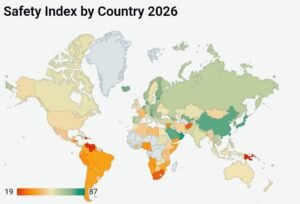
World’s Safest City Abu Dhabi
- Position: Abu Dhabi has been named the World’s Safest City for the 10th consecutive year in the 2026 Numbeo Global Safety Index, ranking first among more than 400 cities from over 150 countries.
- The city achieved a high safety index of 89.0 and a remarkably low crime index of 11.0, reflecting high levels of public confidence among its residents.
-
-
- Concerns about crime fell into the “very low” category across all major indicators: Violent Crimes (8.9), Muggings or Robbery (9.0), Home Burglary (8.9), Car Theft (8.3), Attacks (9.9), Property Crimes (10.7), Corruption or Bribery (16.9), Bias-Motivated Attacks (10.0).
- Other UAE Cities:
- Ras al-Khaimah: Ranked 2nd with a safety score of 86.5 and a crime index of 13.5.
- Ajman: Ranked 3rd, matching Ras al-Khaimah with a safety score of 86.5 and a crime index of 13.5.
- Sharjah: Ranked 4th with a safety score of 84.5 and a crime index of 15.5.
- Dubai: Ranked 6th with a safety score of 83.9 and a crime index of 16.1.
-
- Reasons:
- Low Crime Levels: A key component of Abu Dhabi’s safety is its extremely low crime levels across categories such as violent crime, property crime, assaults, and theft — all scoring in the “very low” range on global survey scales.
- Urban Planning: The city emphasises well‑lit public spaces, organised neighbourhood layouts, and integrated transport systems that reduce the opportunity for criminal activity.
- Public Safety: The use of advanced digital tools — such as AI‑driven surveillance, predictive analytics, and real‑time monitoring systems supports efficient detection and rapid emergency response.
- Social Factors: The city’s diverse population benefits from strong community engagement programs, where residents, businesses, and security authorities collaborate to preserve public order. Cultural emphasis on respect, tolerance, and social stability fosters a shared commitment to peaceful coexistence.
|
Numbeo Global Safety Index 2026
|
What is the Numbeo Global Safety Index?
- About: The Numbeo Global Safety Index is a crowd-sourced index that measures how safe people perceive cities or countries to be based on responses to an online survey, providing a comparative tool for personal safety worldwide.
- Published By: The index is published by Numbeo.com, a Serbian crowd-sourced online database founded in April 2009 by Mladen Adamović, designed to let users share and compare data about crime, living costs, and quality of life across cities and countries.
- Sources: The primary source of data for the Safety Index is crowd-sourced surveys completed by Numbeo users worldwide. Data are updated continuously and semi-annually, with results scaled from 0 to 100, where a higher Safety Index means a higher perceived safety level.
- Parameters: The Safety Index considers multiple perception parameters, including general crime levels, perceived safety walking alone during the day and at night, worries about mugging, robbery, car theft, physical attack, and harassment, discrimination concerns based on ethnicity or gender, property crimes (e.g., burglary and theft), and severity of violent crimes (e.g., assault or homicide).
- Methodology: Respondents rate items on a scale from -2 (very negative perception) to +2 (very positive perception), which the system then normalizes to a 0–100 scale for easy interpretation.
- The Crime Index reflects the overall perceived crime level; the Safety Index is essentially the inverse of this.
- Indices are calculated using algorithms and filters that exclude outliers and weight manual data more heavily to improve quality.
-
- The platform uses 17 core survey factors in its proprietary model.
Other Safety Indexes
- Safety Perceptions Index: The Safety Perceptions Index (SPI) is a global risk perception index that assesses how citizens across more than 120 countries feel about risks such as violent crime, severe weather, food and water security, and mental health risks, based on the World Risk Poll conducted by the Lloyd’s Register Foundation in partnership with the Institute for Economics & Peace (IEP). It provides a comparative understanding of perceived safety and everyday risks, highlighting differences between experienced harm and risk perceptions across countries and regions.
- Global Peace Index: The Global Peace Index is a comprehensive global security and peace ranking produced annually by the Institute for Economics & Peace (IEP). It evaluates 163 countries using 23 qualitative and quantitative indicators across three domains—societal safety and security, ongoing domestic and international conflicts, and the level of militarisation. A lower peace score denotes greater peace and security, with Iceland, Ireland, and New Zealand usually topping the list.
- Women, Peace and Security (WPS) Index: The Women, Peace and Security (WPS) Index is a global perception-based index that measures the security, inclusion, and justice of women across nations. Developed by the Georgetown Institute for Women, Peace and Security (GIWPS) in collaboration with the Peace Research Institute Oslo (PRIO), it uses 13 indicators tied to women’s access to justice, safety from violence, political inclusion and economic opportunities.
|
Also Read: Global Terrorism Index 2025 |