Anna Chakra Finalised for Franz Edelman Award 2026
|
General Studies Paper II: Government Policies & Interventions, Food Security |
Why in News?
Recently, the Department of Food and Public Distribution (DFPD) initiative “Anna Chakra” has been selected as one of six global finalists for the prestigious 2026 Franz Edelman Award.
- The DFPD initiative stands as the only public-sector finalist alongside global corporate giants: Google, Microsoft, NVIDIA, Chewy and ECCO Shoe.
What is Anna Chakra?
- About: Anna Chakra is a Public Distribution System (PDS) supply chain optimisation tool designed to strengthen and modernise India’s foodgrain logistics network. It is a decision support system based on advanced operations research and analytics.
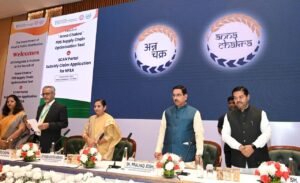
- Launched: Anna Chakra was officially launched on 5 December 2024 by Union Minister Shri Pralhad Joshi, who heads the Ministry of Consumer Affairs, Food and Public Distribution. The launch was part of broader efforts to digitalise and streamline India’s PDS logistics.
- Involvement: The project is spearheaded by the Department of Food & Public Distribution (DFPD) under the Ministry of Consumer Affairs, Food and Public Distribution.
- It was developed in collaboration with the United Nations World Food Programme (WFP) in India and the Foundation for Innovation and Technology Transfer (FITT) at the Indian Institute of Technology Delhi (IIT-Delhi).
-
- Objectives: The primary objectives of Anna Chakra are:
- Enhancing logistical efficiency by optimising transport routes for food grains.
- Reducing transportation costs and fuel consumption within the PDS, with estimated annual savings of around ₹250 crore.
- Minimising delays and ensuring timely delivery of essential commodities to beneficiaries.
- Improving transparency, accountability, and monitoring within the PDS supply chain.
- Contributing to environmental sustainability by lowering carbon emissions through reduced travel distances.
- Operation: Anna Chakra operates as a digital analytics platform integrated with national logistics systems:
- Freight Operations Information System (FOIS) of Indian Railways via the Unified Logistics Interface Platform (ULIP), enabling real-time planning of railway movements.
- PM Gati Shakti platform, which provides geospatial mapping of warehouses and Fair Price Shops for precise route planning across the PDS network.
- It covers approximately 4.37 lakh Fair Price Shops and about 6,700 warehouses, ensuring widespread coverage nationwide.
- Features: Key features include:
- Route optimization using advanced algorithms to determine best delivery paths.
- Integration with national platforms (FOIS & Gati Shakti) for seamless logistics coordination.
- Real-time tracking and data analytics dashboards to support decision-making.
- Significant environmental gains by reducing transportation distances by an estimated 15–50%, thus cutting emissions and carbon footprint.
- Wide-scale deployment across 30 states and union territories, with full coverage expected soon.
- Objectives: The primary objectives of Anna Chakra are:
- Achievements: It benefited over 81 crore PDS beneficiaries by improving efficiency and reducing delays. It gained national and international acclaim, including the CDSA ORSI Excellence in Management Science and Analytics Practice Award at the Indian Institute of Management Ahmedabad.
India’s Public Distribution System (PDS)
-
- About: The Public Distribution System (PDS) in India is a government-run food security mechanism that distributes subsidised staple food grains and essential commodities such as wheat, rice, sugar and kerosene to eligible households through a network of Fair Price Shops (FPS) managed by Central and State Governments.
- Ministry: The system was originally introduced to manage scarcity and stabilise foodgrain prices and has evolved into one of the largest targeted food security programmes in the world, operating under the Ministry of Consumer Affairs, Food and Public Distribution.
- Legal Framework: The National Food Security Act (NFSA), 2013 provides a legal entitlement to food security through PDS, covering about 67% of India’s population based on the 2011 Census. Under NFSA, beneficiaries are categorised as Priority Households (PHH) and Antyodaya Anna Yojana (AAY) households, with entitlements of 5 kg of grains per person per month for PHH and 35 kg per household per month for AAY families.
- Coverage: As per government data, approximately 80.5 crore persons are covered under NFSA through the PDS across all States and Union Territories. Nearly 20.5 crore ration cards have been fully digitised, and Aadhaar seeding levels exceed 99.8%. PDS represents a core pillar of India’s food security strategy by ensuring subsidised food grains to low-income populations.
- Governance: PDS operates on a joint framework: the Central Government, through the Food Corporation of India (FCI), is responsible for foodgrain procurement, storage, transportation and allocation to States/UTs.
- The State Governments handle beneficiary identification, ration card issuance, and management of Fair Price Shops along with local distribution. FPSs are the primary delivery points.
-
- States are introducing innovations to improve PDS performance—for instance, GPS-based tracking of foodgrain transportation in Uttar Pradesh has been scaled to reduce theft and leakage.
- Modernisation: PDS reforms focus on digitisation and transparency:
- 95%+ Fair Price Shops equipped with electronic Point-of-Sale (ePoS) devices using Aadhaar authentication.
- One Nation One Ration Card (ONORC) enables beneficiaries to access entitlements from any FPS across India.
|
About Franz Edelman Award
|
|
Also Read: Towards a Hunger-Free India: Ensuring Food Security for All |