




BNP Rejects Second Oath on July Charter
|
General Studies Paper II: Impact of Policies and Politics of Developed and Developing Countries on India’s Interests |
Why in News?
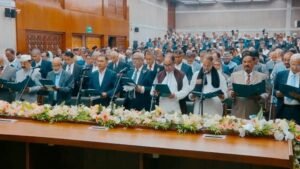
Following their victory in Bangladesh 2026 general elections, lawmakers of the Bangladesh Nationalist Party (BNP) took the standard parliamentary oath but refused to take a second oath linked to the proposed Constitution Reform Council under the July Charter, stating that the council lacks constitutional recognition and legal authority at present.
|
Bangladesh Election 2026 & Oath Ceremony Snapshot
|
What is the July Charter?
- About: The July National Charter 2025 is a major political–constitutional reform document introduced in Bangladesh to fundamentally restructure the governance system.
- Origin: It emerged after the July 2024 student-led uprising that led to the removal of the long-standing executive leadership and demanded democratic institutional reforms to prevent authoritarianism in future.
-
- Objectives: The fundamental aim of the July Charter is to: Promote Good Governance, Ensure Checks and Balances, Strengthen Democratic Accountability and Prevent future Authoritarian Rule.
- Drafting Authority: The Charter was drafted by the National Consensus Commission, chaired by Chief Adviser Muhammad Yunus, as part of the Interim Government (2024–26) reform roadmap.
- Political Consensus: It was based on consultations with 30+ political parties and recommendations of six reform commissions dealing with the Constitution, Judiciary, Electoral System, Public Administration, Anti-Corruption Framework and Police Reforms.
-
- Signature: On 13 November 2025, President Mohammed Shahabuddin signed the July National Charter (Constitutional Reform) Implementation Order, 2025.
- Reform Proposals: The July Charter includes over 884 reform proposals, out of which nearly 47 require Constitutional Amendments.
- Provisions: Major structural Provisions proposed under the Charter include:
-
-
- Introduction of a Bicameral Parliament (with a new Upper House).
- Term Limits for the Prime Minister.
- Strengthened Role of the President.
- Establishment of an Independent Election Commission.
- Creation of a Caretaker Government Mechanism.
- Greater Judicial Autonomy and Accountability.
- Formation of a National Constitutional Council to balance Legislature–Executive–Judiciary relations.
-
- Referendum: A National Referendum held on 12 February 2026 asked citizens to approve the Charter reforms. The proposal received nearly 68% public support with a 60% voter turnout. The referendum result is considered politically binding but not automatically legally enforceable.
- Implementation: If implemented, a Constitution Reform Council comprising newly elected Members of Parliament will function temporarily to finalize amendments within 180 working days, after which the Council will be dissolved. The elected Parliament may also act as a Constituent Assembly for this transformation.
Why BNP Rejected Second Oath on July Charter?
- Lack of Constitutional Recognition: The BNP clearly stated that the proposed Constitution Reform Council (CRC) has no mention or legal basis in the existing Constitution of Bangladesh. BNP leaders argued that taking an oath for a body that is not yet constitutionally incorporated would violate the principle of constitutional supremacy.
- Electoral vs Reform Mandate: BNP emphasized that its lawmakers received a popular mandate through parliamentary elections, not through the July Charter referendum process. The second oath would legally bind MPs to implement the Charter’s amendment agenda, which BNP claims was not part of their election manifesto mandate.
- Conversion of Parliament: The July Charter seeks to empower the newly elected Parliament to function as a Constituent Assembly for 180 working days to enact structural constitutional changes. BNP leaders opposed this arrangement, stating that the current Parliament has a legislative mandate, not a constitution-making mandate unless explicitly amended.
|
About Bangladesh Nationalist Party (BNP)
|
Way Ahead
Following the refusal by the Bangladesh Nationalist Party MPs to take the mandatory second oath linked to the Constitution Reform Council, the implementation of the July Charter reform package has entered a phase of institutional uncertainty. Although the Charter received over 60% public approval in the 2026 constitutional referendum, execution now depends on its formal constitutional adoption by the National Parliament, as BNP leaders clarified that reform steps may proceed only after legislative ratification. Meanwhile, allied parties have warned of possible parliamentary boycott or protest, creating the risk of a constitutional impasse during the proposed 270-working-day reform timeline.
|
Also Read: Bangladesh Announces Referendum on National Reform Charter |