




Census 2027 First Phase to Include 33 Questions
|
General Studies Paper II: Government Policies & Interventions, Population and Associated Issues |
Why in News?
On January 22, 2026, the Registrar General and Census Commissioner of India announced 33 mandatory questions for residents during the first phase of the 2027 Census. This phase is scheduled to take place from April 1 to September 30.
Highlights of India’s Census 2027
-
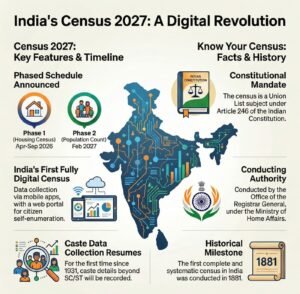
- About: Census 2027 is the 16th decennial population census of India, marking the next comprehensive socio‑demographic enumeration for the country after the 2011 Census. It is a statutory exercise mandated every 10 years to collect detailed data on the population, households and housing conditions across all states and union territories.
- Timeline: The Census 2027 is scheduled to be conducted in two major phases from April 2026 to February 2027.
- The first phase (House‑listing & Housing Census) will be carried out between 1st April to 30th September, 2026 and involves 33 core questions.
- The second phase (Population Enumeration) is planned for February 2027, with reference dates set accordingly.
- Pre-Test: The pre-test for the first phase of the Census 2027 was conducted from November 10 to November 30, 2025, across select sample areas in all States and Union Territories.
- Purpose: The purpose of the census is to gather updated, comprehensive demographic and housing data that inform critical areas like resource allocation, public service delivery, infrastructure planning, urban development and future electoral delimitation exercises.
- Legal Basis: Census 2027 will be conducted under the Census Act, 1948 and Census Rules, 1990, which empower the Government of India to collect detailed population and housing information.
- A gazette notification under Section 3 of the Census Act formally announces the schedule and empowers enumerators to ask specified questions during the process.
- Conducted By: The Census is carried out by the Office of the Registrar General and Census Commissioner, India (RGCCI) under the Ministry of Home Affairs (MHA). The Registrar General coordinates field operations, data processing, analysis and publication of results in collaboration with states/UTs and district‑level officials.
- Delay: Census 2027 comes after an unprecedented delay of over five years; the decadal census originally due in 2021 was postponed due to the COVID‑19 pandemic and related administrative constraints. The government has since reset the process, retaining much of the 2021 questionnaire structure.
- Features: Census 2027 is distinctive in several ways:
- It will be India’s first fully digital census with mobile and web‑based data capture, including household amenities data.
- It is expected to feature caste‑based enumeration for the first time since 1931.
- The government will introduce an optional self‑enumeration window of 15 days prior to the 30‑day house‑listing operations.
Census 2027 First Phase: 33 Key Questions
|
Qs |
Question / Data Item |
Explanation |
|
1 |
Building Number |
Unique administrative identifier (municipal/local authority/census number) to locate and catalogue each structure. |
|
2 |
Census House Number |
Unique census code for each housing unit to link household data in a national database. |
|
3 |
Predominant Floor Material |
Housing quality indicator (e.g., mud, tile, concrete), reflecting living standards. |
|
4 |
Predominant Wall Material |
Reflects structural robustness, economic status and vulnerability to weather. |
|
5 |
Predominant Roof Material |
Indicates durability and weather resilience of dwelling. |
|
6 |
Use of Census House |
Categorizes whether structure is residential, commercial, or other, aiding land‑use mapping. |
|
7 |
Condition of Census House |
Assesses whether the house is good, needs repair, or dilapidated. |
|
8 |
Household Number |
Identifies distinct household units within buildings or compounds. |
|
9 |
Total Persons Normally Residing |
Captures usual residents living in households, foundational for demographic totals. |
|
10 |
Name of Head of Household |
Principal respondent and household anchor in data records. |
|
11 |
Sex of Head of Household |
Gender profile of household leadership. |
|
12 |
Social Category of Head |
Classifies SC/ST/Other for socio‑economic profiling. |
|
13 |
Ownership Status of House |
Captures whether the dwelling is owned, rented, etc., informing tenure security. |
|
14 |
Number of Rooms |
Measures living space used exclusively by the household. |
|
15 |
Number of Married Couples |
Indicates family composition and joint family patterns. |
|
16 |
Main Source of Drinking Water |
Essential water access indicator (tap, hand pump, etc.). |
|
17 |
Availability of Drinking Water Source |
Records actual availability and proximity of drinking water. |
|
18 |
Main Source of Lighting |
Captures energy access (electricity/gas/other). |
|
19 |
Access to Latrine |
Indicates presence/absence of sanitation facility. |
|
20 |
Type of Latrine |
Differentiates flush, pit, public etc., for hygiene assessment. |
|
21 |
Waste Water Outlet |
Records drainage arrangement, important for environment/health. |
|
22 |
Bathing Facility |
Captures availability of personal hygiene facilities. |
|
23 |
Kitchen & LPG/PNG Connection |
Indicates kitchen presence and clean cooking fuel access. |
|
24 |
Main Fuel Used for Cooking |
Captures energy use pattern (wood, LPG, electricity). |
|
25 |
Radio/Transistor |
Household ownership of basic media device, indicating information access. |
|
26 |
Television |
Records TV ownership, another media/access indicator. |
|
27 |
Access to Internet |
Newly added: reflects digital connectivity and inclusion. |
|
28 |
Laptop/Computer |
Indicates digital device ownership. |
|
29 |
Telephone/Mobile/Smartphone |
Captures communication device ownership and mobile penetration. |
|
30 |
Bicycle/Scooter/Motorcycle/Moped |
Personal transport ownership, a proxy for mobility and economic status. |
|
31 |
Car/Jeep/Van |
Larger vehicle ownership, often indicating higher income. |
|
32 |
Main Cereal Consumed |
Newly added: records primary staple cereal (wheat, rice, etc.) for food security/nutrition analysis. |
|
33 |
Mobile Number (Census Communication) |
Mobile contact for census‑related communication only, improving follow‑up and accuracy. |
Methodology and Implementation Strategy for Census 2027
- Enumeration Process: The census enumeration process fundamentally involves door‑to‑door visits by enumerators to every building and household in the country. In the first phase, enumerators will cover 33 core housing and household questions, while in the second phase, they collect detailed individual population data (age, sex, education, occupation, etc.).
- Field Operations: Field operations will be executed by an estimated 30 lakh enumerators and supervisors, primarily recruited from local communities. Each enumerator is assigned specific census blocks, and their progress is monitored through centralized digital dashboards.
- Central Monitoring & Management System (CMMS): To oversee the massive national operation, a Census Monitoring & Management System (CMMS) will be deployed. This central portal enables real‑time tracking of enumeration progress, helps resolve inconsistencies quickly, and allows officials to allocate resources dynamically based on field reports. The CMMS ensures transparency and accountability throughout the exercise.
- Geo‑Tagging: Enumerators will use geo‑tagging and mapping tools integrated within the mobile app to record precise location coordinates of buildings and households. This helps in validating coverage, preventing omissions, and improving the spatial accuracy of census maps.
|
Also Read: Announcement of Caste Census in India |