China First Reusable Rocket Launch Fails
|
General Studies Paper II: Space Technology |
Why in News?
China’s first attempt to showcase a fully reusable rocket ended in setback on 3 December 2025, as the Zhuque-3 booster, launched by a private space firm, reached orbit but failed to execute its historic return and landing.
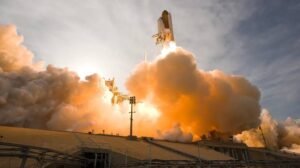
China’s Reusable Rocket Programme: Zhuque-3
China’s Reusable Rocket Programme is a national effort led by emerging private firms to create launch vehicles that can fly multiple times and reduce mission costs. Zhuque-3 is its first major test platform.
- Zhuque-3: Zhuque-3 is an active two-stage methane-fuelled launch vehicle created by LandSpace, a private company in Beijing. The rocket uses stainless steel construction to support high stress during launch and recovery.
- LandSpace designed this system to introduce partial reusability for China’s commercial missions.
- The Zhuque-3 stands about 65.9 metres tall and weighs nearly 550 tonnes, which places it in the medium-to-heavy category.
- The rocket carries between 11.8 tonnes in expendable mode and 8 tonnes when the first stage is recovered downrange.
- Objectives: LandSpace created Zhuque-3 with a clear intention to demonstrate reusable first-stage technology using methane and oxygen.
- The main goal is to build a vehicle family that can support stable commercial launches in China by the end of this decade.
- The company aims to recover the first stage through vertical takeoff and vertical landing (VTVL) techniques similar to other global systems.
- The programme also targets improvements in payload capacity through future variants like the Zhuque-3E.
- Features: Zhuque-3 uses liquid oxygen and liquid methane as propellants, which help maintain cleaner engine cycles and simpler reuse.
- The first stage runs on nine TQ-12A engines that deliver almost 7200 kN of thrust at sea level, while the upper stage uses a TQ-15A vacuum engine that produces more than 944 kN.
- The rocket’s stainless-steel body gives strong thermal resistance and structural efficiency during ascent and descent.
- The Zhuque-3E variant will feature nine TQ-12B engines, five capable of gimbaling for precise control.
- LandSpace designed the first stage to be reused for up to twenty flights when the system reaches full maturity.
- The Zhuque-3E will extend the height to 76.2 metres and raise the liftoff mass to about 654.5 tonnes.
- Trials: LandSpace began its structured test cycle in January 2024 with a successful VTVL trial using the Zhuque-3 VTVL-1 stage. The test lasted about 60 seconds and reached nearly 350 metres, with a landing accuracy of 2.4 metres. The stage used a single Tianque-12 engine and demonstrated stable descent control.
- In September 2024, the company conducted a second major VTVL test that achieved a height of more than 10 kilometres. This flight demonstrated a mid-air engine cutoff and restart, which was a first for a Chinese commercial rocket programme.
- In June 2025, LandSpace fired a full booster test article on the launch pad for 45 seconds with nine TQ-12A engines. The test produced 769 tonnes of thrust and validated gimbal operations.
- From October 18 to 20, 2025, the team conducted propellant loading rehearsals and a first-stage static fire to prepare for the maiden launch.
The Launch Outcome of Zhuque-3
-
- Orbital Insertion: The mission lifted off on 3 December 2025 from the Jiuquan Satellite Launch Center (Site-96). The upper stage of Zhuque-3 delivered its payload into the planned Low-Earth orbit (LEO). Also stage separation worked correctly. The second stage engine ignited as expected, enabling successful orbit insertion.
- Booster Re-entry: After stage separation, the first stage executed a re-entry burn about 6 minutes 11 seconds after liftoff to slow down and begin descent. Later, at about 8 minutes post-lift-off, the booster ignited engines for a landing burn aimed at a down-range pad nearly 390 km from the launch site.
- Landing Attempt: During the final landing burn the booster suffered an “abnormal combustion event.” This anomaly prevented a controlled, soft landing. The first stage caught fire mid-air and crashed just meters away from the intended landing pad. The recovery test was declared a failure by the company. The primary objective to recover and reuse the first stage remains unmet.
Why the Zhuque-3 Landing Attempt Failed?
- Engine Ignition Instability: The first-stage booster of Zhuque-3 failed due to engine ignition instability during the final landing burn. The engines did not produce steady thrust. This caused the booster to lose balance and crash.
- Abnormal Combustion Event: Investigators reported an abnormal combustion event as a major cause of failure. The fire occurred mid-air during the landing sequence. The anomaly disrupted the planned descent trajectory and prevented a controlled landing.
- Thermal Load: The booster experienced intense structural and thermal stress during re-entry. High-speed atmospheric friction heated the stainless steel body and engines. Any minor weakness can affect engine performance or landing stability.
- Control Errors: The booster’s guidance and control system may have underperformed during the final landing phase. Grid fins and cold gas attitude controls could not fully correct the trajectory. The rocket deviated slightly from the intended landing pad, contributing to the crash.
Significance of Zhuque-3 Mission
- China’s Commercial Space Sector: The Zhuque-3 mission marks a major step for China’s commercial space sector. The successful orbital insertion proves that private companies can develop heavy-lift rockets. The mission encourages investment in commercial space ventures. Even with the first-stage failure, the programme provides valuable experience in rocket design, engine operation, and flight testing.
- Global Competition: Zhuque-3 places China among global leaders pursuing reusable launch technologies. The rocket’s partial reusability goal is similar to systems developed by SpaceX and Blue Origin. The flight demonstrates that Chinese private firms can challenge traditional space programs. Future missions will determine how quickly China narrows the technological gap with the U.S. and Europe.
- Launch Technologies: The Zhuque-3 programme provides critical data for reusable launch systems. The mission, despite a failed landing attempt, represents China’s first-ever in-flight verification of the necessary technologies (e.g., high-precision reentry navigation, guidance, and control) for an orbital-class reusable launch vehicle.
- Industry Impacts: The mission influences China’s space economy by encouraging investment, jobs, and technology development. Private firms like LandSpace attract funding for further research, improving domestic manufacturing and aerospace supply chains. Successful reuse reduces launch costs and makes satellite deployment accessible for small companies.
|
Americas Achievements in Reusable Rocket Technology
|
|
Also Read: ISRO Successfully Conducts Air Drop Test ahead of Gaganyaan Launch |