




DRDO Successfully Tests Advanced Solid Fuel Ramjet Missile Technology
|
General Studies Paper II: Indigenization of Technology, Defence Technology |
Why in News?
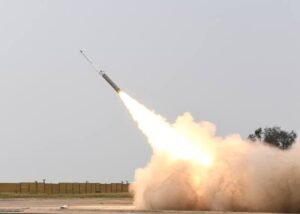
Recently, DRDO has successfully demonstrated the Solid Fuel Ducted Ramjet (SFDR) technology, a major step toward developing long-range air-to-air missiles. This system enhances speed, strengthening India’s indigenous defence and strategic capabilities.
What is Solid Fuel Ducted Ramjet (SFDR) Technology?
- About: Solid Fuel Ducted Ramjet (SFDR) is an advanced missile propulsion system developed indigenously by the Defence Research and Development Organisation (DRDO) of India. It represents a significant leap in air-breathing propulsion technology, enabling long-range air-to-air missiles with sustained high-speed flight and superior combat effectiveness.
- Background: DRDO began developing the SFDR in 2017 to enable long-range, supersonic air-to-air missiles. Following development, successful flight tests were conducted in 2018 and 2019.
- Fundamental Principle: SFDR integrates a solid-fuel based ramjet engine with a nozzle-less booster stage and air intake ducts. SFDR’s ramjet sustainer uses atmospheric oxygen for combustion during flight. This air-breathing mechanism eliminates the need for onboard oxidisers.
- Working Phases: The system works in two phases:
-
-
- A nozzle-less booster first accelerates the missile to high speed (supersonic regime).
- Once sufficient speed is attained, the ramjet sustainer ignites solid fuel while drawing oxygen from the atmosphere through specially designed air intakes. The combustion generates sustained thrust for extended flight duration.
-
- Features: This Technology has multiple features, include:
-
-
- Air-Breathing Ramjet Engine: The ramjet principle relies on the missile’s forward motion to compress incoming air for combustion, eliminating complex mechanical compressors. This results in a lighter, simpler, and more reliable propulsion system optimized for high Mach flight.
- Nozzle-Less Booster: Early acceleration is achieved without a traditional nozzle, improving safety and integration with aircraft launch platforms. The booster pushes the missile to speeds where ramjet combustion becomes efficient.
- Thrust Modulation and Fuel Flow Control: SFDR incorporates advanced fuel flow controllers and hot gas valves that regulate combustion based on speed and altitude, allowing dynamic thrust adjustment during flight.
- Efficient Aerodynamics: Special air intake designs ensure optimum air compression and delivery to the combustion chamber, sustaining thrust even at varying flight conditions.
-
- Performance Capabilities: SFDR technologies dramatically extend missile range and engagement envelope compared to conventional solid-rocket-propelled missiles. The system allows missiles to maintain high average speeds (often between Mach 2 and Mach 3+) and extended powered flight.
-
-
- Combat Advantages: In practical terms, SFDR-powered missiles can engage targets at ranges well beyond 300 km, offering larger no-escape zones and enhanced maneuverability against agile enemy aircraft.
-
- Indigenous Development: DRDO laboratories such as the Defence Research and Development Laboratory (DRDL), Research Centre Imarat (RCI), and High Energy Materials Research Laboratory (HEMRL) have jointly developed SFDR, reflecting India’s growing defence R&D ecosystem.
- Significance: The successful demonstration of SFDR places India in an elite group of nations possessing this cutting-edge propulsion technology, alongside countries such as the United States, Russia, China, France, and Israel. India’s achievement signals its arrival on the global stage of cutting-edge missile technology.
Applications of SFDR Technology
- Long-Range Air-to-Air Missiles for Modern Combat: SFDR technology is primarily applied to long-range air-to-air missiles (AAMs), enabling them to achieve sustained supersonic cruise, extended engagement envelopes, and superior manoeuvrability compared with conventional rocket-propelled missiles. A notable example is the Astra MK-3 ‘Gandiva’, an SFDR-powered Beyond Visual Range Air-to-Air Missile (BVRAAM) under development by DRDO, which is expected to strike targets at distances of around 300–350 km while maintaining speeds up to Mach 4.5.
- Potential Surface-to-Air Missile (SAM) Integration: Beyond air-to-air roles, SFDR propulsion can be adapted for surface-to-air missile systems that defend ground or naval assets from aerial threats. The technology’s ability to sustain high speeds and extended range improves anti-air defence effectiveness against incoming aircraft, unmanned aerial vehicles (UAVs), and even cruise missiles. This supports layered air defence architectures by expanding the reach.
- Future Anti-Ship and Multi-Role Missile Platforms: SFDR offers potential for enhancing anti-ship and multi-role missile platforms, where sustained high-speed cruise and long range are advantageous. Scaled-up versions of SFDR engines could be integrated into anti-ship cruise missiles, enabling them to strike naval targets while maintaining high terminal speeds that reduce enemy reaction time. This aligns with modern naval warfare demands, where fast, long-range strike capability is crucial for sea control and deterrence.
|
What is a Ramjet?
|
|
Also Read: Supersonic Ramjet Engine – Tezz |