DRDO Tested New High-Speed Fighter Escape System
|
General Studies Paper II: Government Policies & Interventions, Defence Technology |
Why in News?
DRDO has successfully conducted a high-speed rocket-sled test of a new fighter aircraft escape system, confirming its precise and safe functioning during extreme conditions. The trial marks a major step in enhancing pilot-ejection reliability, strengthening India’s indigenous aviation safety technologies.
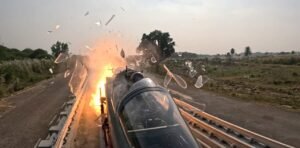
Highlights of DRDO’s High-Speed Fighter Escape System
- Location: On 2 December 2025, DRDO successfully carried out a high‑speed rocket‑sled trial of a fighter‑aircraft escape system. The trial happened at the Rail Track Rocket Sled (RTRS) facility located in the Terminal Ballistics Research Laboratory (TBRL) in Chandigarh.
- Collaboration: The trial was carried out with collaboration among DRDO, Aeronautical Development Agency (ADA), and Hindustan Aeronautics Limited (HAL).
- Configuration: The test employed a dual‑sled setup carrying the forebody of a light combat aircraft, specifically the forebody of the Light Combat Aircraft (LCA) Tejas. An instrumented anthropomorphic test dummy stood in place of the pilot. The dummy carried sensors to record critical loads, accelerations, and stresses that a human pilot would undergo during ejection.
- Speed: The rocket‑sled propelled the test article to a precisely controlled velocity of 800 km/h. This speed roughly simulates the conditions experienced by a combat aircraft in high‑speed flight, making the test close to real‑life emergency scenarios.
- Validation: The test successfully validated three critical components of the escape system:
- Canopy severance — the canopy covering the cockpit was cleanly and safely removed.
- Ejection sequencing — the ejection seat fired in the correct sequence under high‑speed dynamic conditions.
- Full aircrew recovery — the test dummy was recovered safely, indicating that the mechanism could allow safe pilot escape under real‑time emergency.
- Milestone: This dynamic test goes beyond static or “zero-zero” seat tests. The Ministry of Defence described this as placing India in an “elite club of nations” with advanced in-house escape‑system testing capability.
What Is a High-Speed Fighter Escape System?
-
- About: A fighter escape system is a safety mechanism built into combat aircraft to allow a pilot to exit the aircraft swiftly and safely during emergencies. The system ensures pilot survival when the aircraft becomes uncontrollable or suffers critical failure.
- Components: The main parts include the ejection seat, the canopy or canopy‑severance apparatus (CSS), a catapult or rocket motor, a parachute system (often with a drogue chute and a main chute), and safety gear like a restraint harness, leg restraints, and an environmental sensor/automatic sequencer for safe deployment.
- Principle: The priority is to clear the pilot’s path out of the cockpit before launching the seat. The canopy or hatch must go clear in milliseconds. This clearing avoids collision with the canopy or aircraft structure. The CSS must act almost instantaneously compared to older canopy‑jettison systems which took much longer.
- Initiation: The pilot initiates ejection by pulling a handle or face‑curtain trigger inside the cockpit. This action activates the canopy‑severance or jettison system first. Immediately after canopy removal the catapult or rocket‑motor fires and sends the seat up the guide rails.
- Stabilisation: Many modern ejection seats combine a ballistic catapult with an under‑seat rocket. The rocket adds thrust to lift the pilot to safe altitude especially at high speed or low altitude. Once clear, a small drogue parachute or stabilization chute deploys. This stabilizes the seat, controls tumble or spin.
- Sequencing: Modern systems use automatic sequencers and environmental sensors (airspeed, altitude, attitude) to decide when to deploy the main parachute. The system ensures that parachute deployment occurs only when conditions are safe.
- Ejection: Once the seat clears aircraft and stabilises, the drogue chute deploys. Then at the right altitude and speed the main parachute opens. The seat separates from the pilot. The pilot descends under a parachute. On landing, survival kit activates, giving supplies, first‑aid, flotation gear if needed.
Strategic Significance of This
- Boost to India’s Defence Self‑Reliance: The successful test of the escape system at 800 km/h by DRDO shows that India can now design, validate, and certify advanced safety systems in‑house. This reduces dependence on foreign suppliers for critical components like ejection seats and canopy‑severance systems. Over time this saves foreign exchange and gives India control over upgrade cycles of safety‑critical systems.
- Strengths Aerospace R&D: Conducting a high‑speed rocket‑sled test demands advanced engineering, sophisticated instrumentation, and rigorous safety protocols. DRDO’s success underlines that India now masters these complex technologies within domestic institutions. This builds a deeper pool of aerospace‑engineering expertise.
- Raises Pilot Safety Standards: A successful high-speed ejection test validates that critical escape sequences canopy severance, seat ejection, parachute recovery work reliably under combat‑like conditions. This increases confidence that pilots flying indigenous or future jets will have credible chances of survival in high‑velocity emergencies. This success can lead to updates in pilot safety doctrine and operational protocols.
- Enhances Strategic Autonomy: By joining a small group of nations that can fully test and certify advanced ejection‑seat technology domestically, India strengthens its strategic autonomy in defence manufacturing. When India exports combat aircraft, a domestically developed, certified escape system adds value, enhancing export potential and reducing export‑licence hurdle.
|
Also Read: Indian Army Successfully Conducts Combat Launch of BrahMos Supersonic Cruise Missile |