




Government Announces Comprehensive Development Plan For Kondaveedu Fort
|
General Studies Paper II: Government Policies and Interventions |
Why in News?
The government has announced a comprehensive development plan for the historic Kondaveedu Fort in Andhra Pradesh, aiming to protect its heritage and boost tourism.
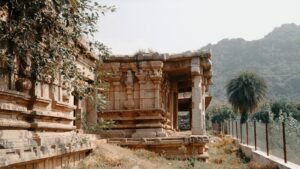
About Kondaveedu Fort
- Location: Kondaveedu Fort is an ancient hill fortress located in Kondaveedu village of Palnadu district, Andhra Pradesh, about 27 km southwest of Guntur city. The fort tops a rugged hill range rising up to 1700 feet above sea level, making it a dominant strategic site historically.
- Historical Foundation: The fortress was initially established in the 13th–14th century by Prolaya Vema Reddy, the founder of the Reddy dynasty, and later completed by his son Anavotha Reddy, who shifted the kingdom’s capital from Addanki to Kondaveedu. It served as the capital of the Reddy Kingdom from 1328 to 1482 CE.
- Political Transitions: Over centuries, Kondaveedu Fort witnessed a series of powerful rulers and battles: it was captured by Vijayanagara emperor Krishnadevaraya in 1516, fought over by the Golconda Sultans throughout the 16th century, and renamed Murtazanagar by Sultan Quli Qutb Shah after his victory in 1579.
- Later, the fort came under French colonial control in 1752 and then the British East India Company in 1788, which eventually abandoned it in the early 19th century.
- Features:
- Fortifications and Bastions: The fort features extensive granite stone ramparts and a network of 23 bastions (burujus) connected by long defensive walls that made it one of the most impregnable forts of its time.
- Entrances and Defensive Works: There are two major three-storied gates—Kolepalli Darwaza and Nadella Darwaza—built with massive granite blocks, along with a defense bunker and a fortified fortress layout.
- Water Management Systems: The fort has three major water tanks—Mutyalamma Cheruvu, Puttalamma Cheruvu and Vedulla Cheruvu—carved and dug into rock, highlighting advanced water harvesting and conservation engineering that provided year-round supply.
- Religious and Cultural Monuments: Within the complex are ruins of temples such as Trikoteshwara Swamy Temple and Gopinatha Temple, alongside a mosque, reflecting Hindu and Muslim architectural influences.
- Architectural Remains and Inscriptions: The fort contains remains of warehouses, granaries, stone inscriptions (including a long 110-m inscription) and other buildings that signify its historical, military and cultural importance.
- Heritage: Kondaveedu Fort is recognized as an important heritage site with active discussions for UNESCO World Heritage consideration owing to its historical continuity.
|
Reddy Dynasty
|
Significance of Kondaveedu Fort
- Prehistoric and Archaeological Importance: Kondaveedu Fort sits on a site with evidence of early human settlement and Buddhist presence dating back 2000 years — including remains of a circular stupa and pillared pavilion from the 3rd century CE.
- Hydrological Engineering Legacy: The fort demonstrates advanced water management systems including interconnected deep wells and reservoirs that not only sustained its population and army but also recharged groundwater, illustrating sophisticated medieval engineering unmatched in many contemporary hill forts.
- Ecological and Herbal Biodiversity Significance: Surrounding the fort are dense forests with over 50 varieties of medicinal and herbal plants, making Kondaveedu not just a cultural site but also an ecologically rich landscape that supports biodiversity and traditional medicinal knowledge.
- Cultural and Ritual Continuity: The site has long been associated with living cultural traditions, with local festivals, temples, Sufi dargah sites, and annual rituals continuing to draw community participation, reflecting a living cultural heritage.
- Tourism and Research Potential: With rising visitor numbers and efforts like Kondaveedu Fest and planned heritage centres, the fort has become central to regional tourism, civic pride, and cultural revival, helping local communities connect with history while boosting the local economy and heritage awareness.
Preservation and Development Initiatives for Kondaveedu Fort
- Ghat Road Construction: The Andhra Pradesh Roads and Buildings Department funded and constructed a 5.1 km ghat road to provide basic access for restoration teams and tourists. Over ₹40 crore was invested between 2014 and 2019 for this purpose.
- Connectivity & Utilities: The State government allocated approximately ₹30 crore for road widening between Edlapadu and Phirangipuram. A power substation was also established near the ghat road at a cost of ₹3 crore to ensure regular electricity supply to the hilltop.
- Monuments Restoration: The Andhra Pradesh Department of Archaeology and Museums undertook the reconstruction of historical structures, including the 14th-century Shivalayam temple and the Sri Narasimha Swamy temple.
- Heritage Centre: A heritage centre was established at the foothills for ₹7 crore to house artifacts, replicas of inscriptions, and historical publications.
- Eco-Tourism Projects: Under the Nagaravanam project, approximately ₹13.35 crore was allocated for eco-tourism facilities, including a bird sanctuary, adventure sports, and the preservation of rare medicinal plants.
- Lake Strengthening: Bunds of the three historical tanks (Puttalamma, Vedulla, and Mutyalamma Cheruvu) were strengthened with boulders to prevent erosion and preserve the ancient water systems.
|
Central Government Initiatives to Protect, and Restore Heritage Sites
|
|
Also Read: Salkhan Fossils Park Added to UNESCO’s Tentative Heritage List |