



India Assumes Chairmanship of the Indian Ocean Naval Symposium
|
General Studies Paper II: Groupings & Agreements Involving India and/or Affecting India’s Interests |
Why in News?
India has officially assumed the Chairmanship of the Indian Ocean Naval Symposium (IONS) at the 9th Conclave of Chiefs held in Visakhapatnam on 20 February 2026, marking its leadership of the maritime forum for 2026–28.
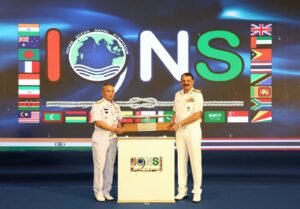
What is the Indian Ocean Naval Symposium (IONS)?
- About: The Indian Ocean Naval Symposium (IONS) is a voluntary maritime security initiative that brings together the navies and maritime security agencies of countries bordering the Indian Ocean Region (IOR). It provides an open and inclusive forum for discussion on regional maritime issues.
- Origin: IONS was conceived and launched by the Indian Navy in February 2008, with the inaugural Conclave held at New Delhi. India served as the first Chair (2008–2010). The initiative marked the first major international maritime security construct of the 21st century in the Indian Ocean.
- Objectives: The primary objective of IONS is to enhance maritime cooperation among IOR navies through strengthening maritime security, information sharing and confidence building and cooperation in Search & Rescue (SAR).
- Nature: IONS is a non-treaty based, voluntary multilateral forum rather than a formal military alliance. It promotes consultative engagement, dialogue, and coordination among littoral states.
- Structure: IONS functions through:
- Rotational Chairmanship (every 2 years)
- Biennial Conclave of Chiefs of Navies
- IONS Working Groups (IWGs)
- Workshops, seminars and expert interactions
- Members: IONS currently comprises around 34 countries (25 Members + 9 Observers) from the IOR. Membership eligibility requires: A permanent territorial presence in the Indian Ocean and Possession of a Navy or maritime security agency.
- Groups: Member countries are geographically classified into four sub-regional groups: South Asian Littorals, West Asian Littorals, East African Littorals, South-East Asian & Australian Littorals.
- Functions:
-
- Biennial Naval Dialogue Mechanism: IONS conducts a Conclave of Chiefs every two years, enabling top naval leadership to deliberate on regional maritime security issues and cooperative frameworks.
- Working Group-Based Functional Cooperation: Specialized IONS Working Groups focus on operational issues such as HADR, maritime security, and interoperability, enhancing coordinated responses.
- Information Sharing Platform: IONS promotes a continuous exchange of maritime domain information among naval professionals to build trust and situational awareness.
- Capacity Building & Training: The forum facilitates joint naval exercises, training programmes, and professional exchanges, improving regional maritime capabilities.
- Confidence-Building Mechanism: IONS strengthens naval diplomacy and friendly maritime relations, contributing to a stable, rules-based maritime order in the Indian Ocean.
Role of India in the Indian Ocean Region (IOR)
- Net Security Provider: India has emerged as a “Net Security Provider” in the Indian Ocean Region (IOR) by actively ensuring freedom of navigation, combating piracy, maritime terrorism, and Illegal, Unreported and Unregulated (IUU) fishing.
- The Indian Navy regularly conducts counter-piracy patrols and Exclusive Economic Zone (EEZ) surveillance in cooperation with littoral countries.
- Maritime information sharing through the Information Fusion Centre – Indian Ocean Region (IFC-IOR), established in 2018, has over 65 international linkages and liaison officers from 12 partner nations.
- Protection of Sea Lanes: Through operations like Operation Sankalp (launched in 2019), India ensures the safe transit of merchant vessels in strategic chokepoints such as the Strait of Hormuz. By 2023, the Indian Navy had deployed 41 warships escorting 503 Indian-flagged vessels carrying approximately 624 lakh tonnes of cargo, thereby protecting India’s trade and energy lifelines.
- Regional Cooperation: India has strengthened its engagement with IOR littoral states such as Mauritius, Maldives, Sri Lanka, and Seychelles through developmental assistance, defence cooperation, and capacity-building programmes. Initiatives such as Mission SAGAR, joint maritime patrols, and training programmes enhance regional capabilities in Humanitarian Assistance and Disaster Relief (HADR), Search and Rescue (SAR), and disaster resilience.
- Strategic Maritime Diplomacy: India has taken a leadership role in regional maritime platforms such as the Indian Ocean Rim Association (IORA), Indian Ocean Naval Symposium (IONS), and multinational naval exercises like MILAN and IBSAMAR. These initiatives enhance interoperability, build confidence among navies, and strengthen collective responses to threats such as drug trafficking, arms smuggling, and piracy.
- SAGAR and MAHASAGAR Vision: India’s maritime engagement is guided by the SAGAR (Security and Growth for All in the Region) doctrine launched in 2015, and its expanded MAHASAGAR Vision (2025). These frameworks aim to strengthen maritime partnerships, promote Blue Economy development, enhance energy security, and address non-traditional threats such as climate change and natural disasters.
Importance of Indian Ocean Region (IOR) for India
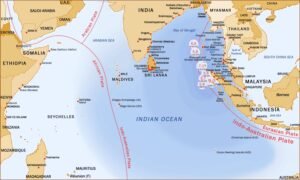
- Geopolitical: The Indian Ocean Region (IOR) holds immense geostrategic importance for India due to its central location between Asia, Africa, and Australia. India is geographically placed at the heart of major maritime chokepoints such as the Strait of Hormuz, Bab-el-Mandeb, and Strait of Malacca, which are crucial for global trade and energy flows. The region carries nearly 80% of global maritime oil trade and about one-third of the world’s bulk cargo traffic.
- Sea Lanes of Communication (SLOCs): The Sea Lanes of Communication (SLOCs) in the IOR are the backbone of India’s energy security and economic sustainability. Approximately 95% of India’s trade by volume and nearly 68% by value is transported via maritime routes through the Indian Ocean.
- Around 80–85% of India’s crude oil imports transit through these SLOCs, especially from West Asia and Africa.
- Any disruption in these sea routes due to piracy, conflict, or geopolitical tensions could directly impact India’s energy supply chain, industrial output, and strategic petroleum reserves.
- Economic Significance: The IOR hosts some of the world’s busiest shipping routes, linking Europe, the Middle East, Africa, and East Asia. Over 50% of global container traffic and nearly 70% of global petroleum shipments pass through the Indian Ocean’s strategic waterways. India’s major ports such as Mumbai, Chennai, Kochi, and Visakhapatnam are directly dependent on uninterrupted maritime trade flows.
|
Indian Ocean Region (IOR)
|
|
Also Read: Second Blue Talks Held in India |