



India Big Cities Facing Water Crisis
|
General Studies Paper II: Government Policies & Interventions, Issues Relating to Development |
Why in News?
According to a recent UN report, half of the world’s 100 largest cities, including major Indian cities like Delhi, face high water stress due to climate change and mismanagement, pushing urban centres toward severe water scarcity and “water bankruptcy” unless urgent action is taken.
Highlights of the Recent UN Report
- Global Water Stress: The new United Nations-linked analysis reveals that nearly half of the world’s 100 largest cities are under high water stress. Out of these, 38 cities sit in regions of “extremely high water stress”, Global cities such as Beijing, New York, Rio de Janeiro, and Delhi facing extreme stress.
- India’s Major Cities: Among the hardest-hit urban centres, Indian cities feature prominently: Delhi ranks 4th globally in water stress, followed by Kolkata (9th), Mumbai (12th), Bengaluru (24th), and Chennai (29th). Other major cities like Hyderabad, Ahmedabad, Surat, and Pune are also grappling with chronic shortages.
- Global Water Bankruptcy: The UNU report frames the situation as an era of “global water bankruptcy”, a term denoting that humanity has overshot the sustainable use of freshwater resources. According to this framing, 75 percent of the world’s population lives in water-insecure regions. Tehran is on the brink of “Day Zero“—the critical point when municipal water supplies run out—marking its sixth consecutive year of severe drought.
- Groundwater Depletion: UN analysis coupled with satellite monitoring shows that about 1.1 billion people live in cities experiencing strong long-term drying trends. Northern India and Pakistan are concentrated in regions where water levels are declining, fewer cities in sub-Saharan Africa are in wetter zones.
- Global Freshwater Reserves: The report finds that water levels in roughly half of the world’s major lakes have declined since the 1990s, while groundwater reserves in some regions have fallen by up to 70 %. This environmental degradation causes roughly 4 billion people to experience acute water scarcity for at least one month annually.
Current Status of Urban Water Stress in India
- National Water Availability: India, with about 18 % of the global population and only 4 % of freshwater resources, faces intrinsic water scarcity pressure, especially in urban areas where demand intensifies rapidly. India’s per capita water availability has fallen dramatically, already below the Falkenmark scarcity threshold for freshwater (1,700 m³ per capita per year), and is projected to drop further by 2031.
- NITI Aayog Findings: The Composite Water Management Index (CWMI) by NITI Aayog highlighted that multiple Indian cities — including Delhi, Bengaluru, Chennai, Hyderabad, Ahmedabad, and others — are on brink of severe water scarcity, with projections showing that many urban centres risk exhausting critical groundwater resources if demand continues to outpace supply.
- Groundwater Dependence: Urban areas in India rely heavily on groundwater — nearly 48 % of urban water supply comes from it. Prolonged over-extraction has led to drastic declines: in Bengaluru, a significant share of borewells runs dry; in Chennai, extraction has exceeded annual recharge and in the Delhi NCR, groundwater remains the primary domestic source despite declining levels.
- State of Groundwater Resources: According to the Central Ground Water Board, about 11.2 % of assessment units are over-exploited, where extraction exceeds natural recharge, with northern India — including Delhi, Punjab, Haryana and Rajasthan — facing critical depletion. In many urban districts, net groundwater availability for future use is approaching zero.
- City-Wise Stress Indicators: Major Indian cities show stark water stress signals: Delhi’s extraction rate is near critical levels, heavily dependent on groundwater; Bengaluru’s surface reservoirs and aquifers have receded, pushing reliance on costly tanker water; Chennai has experienced ‘Day Zero’-like scenarios when reservoirs dry; and cities like Ahmedabad, Pune and Surat face persistent supply deficits.
Major Causes of Water Crisis in Indian Metropolitan Cities
- Uncontrolled Groundwater Over-Extraction: Metropolitan cities have become dangerously dependent on groundwater, leading to a catastrophic decline in water tables. In Delhi, extraction rates have exceeded 137% in several districts. Current 2026 data indicates that 21 major Indian cities are nearing “Day Zero” scenarios where groundwater reserves may be completely exhausted. The proliferation of unregulated private borewells in apartment complexes and commercial hubs—often drilling to depths of 600–1,000 feet—prevents natural replenishment. In Chennai and Delhi, this massive void in subterranean aquifers has even triggered land subsidence.
- Critical Infrastructure Leakage: A major portion of the crisis is caused by Non-Revenue Water (NRW)—treated water that is lost through leaks or theft before reaching consumers. Indian urban utilities lose an average of 38-40% of their potable water to such inefficiencies. Most cities still rely on distribution networks laid over 40 years ago; in Delhi alone, 18% of the pipeline infrastructure is more than 30 years old. These corroded pipes not only waste water but also allow sewage contamination, which led to over 5,500 reported illnesses and 34 deaths in 26 cities between 2025 and early 2026.
- Encroachment and Destruction of Wetlands: Rapid urbanization has systematically destroyed the “natural sponges” of cities—their lakes and wetlands. Bengaluru, once a city of 262 lakes in 1961, now has fewer than 81 remaining, many of which are severely polluted. Concretization (paving over of soil) has reduced the rainwater infiltration surface; for every 1 km² increase in built-up area, groundwater recharge in Delhi decreases by roughly 0.3 million cubic meters. Instead of recharging aquifers, monsoonal rainfall now turns into destructive urban floods, with only 8% of total precipitation being effectively captured nationwide.
Impact of this Water Crisis
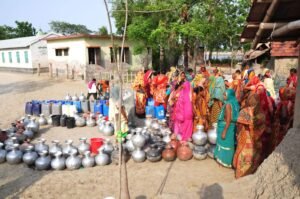
- Deepening Urban Poverty and Social Inequity: The water crisis disproportionately impacts the urban poor, who lack the financial capacity for private tankers or deep borewells. Vulnerable households often spend a substantial portion of their daily income on purchasing water from informal “tanker mafias,” leading to a vicious circle of poverty. The burden falls heavily on women and children in low-income areas, who lose hours queuing at public taps, resulting in lost wages and increased school dropout rates.
- Distress Migration and Demographic Pressure: Chronic water scarcity in rural hinterlands, such as Bundelkhand, triggers distress migration to Tier-1 metros like Delhi and Bengaluru. These “water refugees” typically move into already strained informal settlements, further inflating the demand for urban water infrastructure. By 2026, over 600 million Indians face high to extreme water stress, intensifying this internal displacement.
- Proliferation of Vulnerable Informal Settlements: Slums and unauthorized colonies bear the brunt of water shortages, with only a small fraction of households having access to piped, quality-standard water. Lack of clean water leads to a high incidence of water-borne diseases like cholera and typhoid, causing nearly 200,000 deaths annually in India. The resulting medical expenses and loss of labor productivity further destabilize these fragile settlements.
- Amplification of Urban Heat Island (UHI) Effect: The depletion of urban water bodies and green cover—critical for evaporative cooling—has intensified the UHI effect. Cities like Bengaluru and Delhi now experience “Day Zero” scenarios where rising land surface temperatures dehydrate the local environment, creating a feedback loop that further depletes groundwater. This makes urban centers significantly warmer than their rural surroundings, worsening heat stress for outdoor laborers.
- Significant Economic Losses and GDP Impact: The World Bank warns that water scarcity could result in a 6% loss in India’s GDP by 2050. By 2026, water-intensive sectors like textiles, thermal power, and high-tech manufacturing in hubs like Bengaluru face production slowdowns and operational risks due to water rationing. “Non-revenue water” (losses through leaks and theft) accounts for nearly 58% of the supply in cities like Delhi, representing massive fiscal wastage.
Government Policies to Tackle this Issue
- Jal Jeevan Mission (Urban): The Jal Jeevan Mission (Urban) (JJM-U) is a flagship initiative under the Ministry of Housing and Urban Affairs designed to ensure universal water supply coverage through functional household tap connections in all 4,378 statutory towns across India. It targets bridging an estimated gap of 2.68 crore urban tap connections and 2.64 crore sewer/septage connections in 500 AMRUT cities.
- AMRUT and AMRUT 2.0: The Atal Mission for Rejuvenation and Urban Transformation (AMRUT), launched in 2015, and its expanded phase AMRUT 2.0 (2021-26) focus on strengthening urban water supply, wastewater management, sewerage networks, and water body rejuvenation across 500 cities and numerous statutory towns. AMRUT 2.0 has a mission outlay of ₹2.77 lakh crore and seeks to provide universal coverage of water supply and support water reuse targets (20 % through recycled water).
- Atal Bhujal Yojana: The Atal Bhujal Yojana (Atal Jal), launched in December 2019, is a central sector scheme aimed at scientific and sustainable groundwater management in water-stressed regions of seven states (Gujarat, Haryana, Karnataka, Madhya Pradesh, Maharashtra, Rajasthan and Uttar Pradesh). The scheme focuses on community-led water governance, groundwater recharge, and demand-side management, backed by an extensive network of groundwater monitoring stations to support evidence-based planning.
- Smart Cities Mission: The Smart Cities Mission facilitates 24×7 water supply projects, integrated command & control centres (ICCCs), and adoption of IoT and digital solutions for better urban utility management. In some cities, like Rajkot, smart water infrastructure has been integrated with stormwater management and treated water reuse systems to enhance urban water retention.
- Institutional Reforms: Institutional mechanisms for urban water governance in India hinge on a multi‑tier approach, where the Constitution’s Seventh Schedule empowers State Governments and Urban Local Bodies (ULBs) with responsibility for water supply and management.
- States enact regulations, prepare State Water Action Plans, and oversee municipal utilities, while ULBs handle on‑ground distribution, billing, leakage control, and local planning.
- Some states, like Maharashtra, have introduced policies for circular economies in wastewater reuse across urban local bodies, setting up joint monitoring committees led by district collectors to oversee implementation.
|
Also Read: Ken-Betwa Link Project (KBLP) |