



India-France Critical Technologies Dialogue, Supply Chain & Space Cooperation on Agenda
| General Studies Paper II: International Relations, Groupings & Agreements Involving India |
Why in News?
Recently, India and France inaugurated the Economic Security and Critical Technologies Dialogue, prioritising resilient supply chains and space cooperation to deepen Special Global Strategic Partnership.
What is India-France Economic Security and Critical Technologies Dialogue?
- About: The India–France Economic Security and Critical Technologies Dialogue (ESCTD) is a bilateral institutional mechanism designed to strengthen cooperation in strategically important technologies, economicsecurity and resilient supply chains.
- It brings technological innovation and economic security into the broader framework of the India–France Special Global Strategic Partnership.
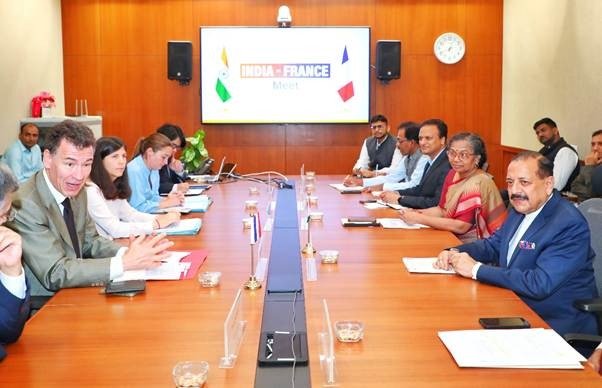
- Inaugural Meeting: The inaugural meeting was held in Paris on 10 November 2026.
- It was co-chaired by India’s Foreign Secretary Vikram Misri and France’s Secretary-General of the Ministry for Europe and Foreign Affairs Martin Briens.
- It was held alongside the third India–France Strategic Space Dialogue, reflecting the growing convergence.
- Areas of Cooperation:
- Critical Technologies: Cooperation in artificial intelligence, semiconductors, advanced computing, telecommunications and other strategic technologies.
- Cybersecurity: Strengthening cyber resilience, protecting critical infrastructure and addressing emerging digital threats.
- Supply Chains: Building reliable supply networks for critical minerals, advanced components and strategic industrial inputs.
- Industrial Partnerships: Encouraging business-to-business collaboration, technology development and investment.
- Economic Security: Addressing vulnerabilities arising from geopolitical tensions, technological concentration and disruptions to international trade.
- Institutional Linkages: The mechanism stems from an agreement during Prime Minister Narendra Modi’s June 2026 visit to France.
- The dialogue aligns with the India-France Innovation Roadmap 2030 and the Economic and Financial Dialogue.
- It ran as part of broader reviews of the Horizon 2047 Roadmap.
What are Critical and Emerging Technologies?
- About: Critical and Emerging Technologies (CETs) are advanced, rapidly evolving innovations that possess dual-use capabilities and hold the power to transform national security, economic competitiveness, and societal governance.
- They are labeled critical because of a nation’s strategic autonomy, and Critical Information Infrastructure (CII).
- Major Technologies:
- Artificial Intelligence (AI) enables machines to simulate human cognitive functions such as reasoning, perception, and autonomous decision-making.
- Machine Learning (ML) and Deep Learning (DL) utilize neural networks and massive datasets to identify patterns without explicit programming.
- In governance and defense, AI powers predictive analytics, autonomous drone swarms, precision agriculture, and real-time medical diagnostics.
- Semiconductors are materials like silicon, gallium nitride (GaN), and silicon carbide (SiC) whose electrical conductivity can be precisely controlled to fabricate integrated circuits.
- They serve as the foundational hardware for every modern electronic device, from smartphones and electric vehicles to advanced radar systems and supercomputers.
- Controlling semiconductor fabrication (fabs) and assembly, testing, marking, and packaging (ATMP) is vital to preventing geopolitical supply-chain choke points.
- Quantum Technology harnesses principles of quantum mechanics—specifically superposition, entanglement, and quantum tunneling—to process information beyond classical binary limits.
- It encompasses Quantum Computing (using qubits for ultra-fast optimization), Quantum Key Distribution (QKD) for unhackable communication, and Quantum Sensing for high-precision navigation without GPS.
- Cybersecurity involves protecting networks, data, and digital infrastructure from cyber-espionage, ransomware, and Distributed Denial-of-Service (DDoS) attacks based on the CIA Triad (Confidentiality, Integrity, Availability).
- 5G and 6G technologies, alongside Open Radio Access Networks (OpenRAN), provide ultra-low latency and massive machine-type communication necessary for Internet of Things (IoT) ecosystems and smart warfare.
- Biotechnology leverages cellular and biomolecular processes to create breakthroughs in mRNA vaccines, CRISPR-Cas9 gene editing, and genetically modified (GM) crops. Synthetic biology and bio-manufacturing enable the engineering of custom microorganisms to produce sustainable biofuels, bioplastics, and Active Pharmaceutical Ingredients (APIs), driving the modern bioeconomy.
- Blockchain is a decentralized, immutable distributed ledger technology (DLT) that records transactions across peer-to-peer networks without central intermediaries.
- Beyond cryptocurrencies, it secures land registry records, supply chain provenance, Central Bank Digital Currencies (CBDCs), and tamper-proof academic credentials.
- India’s Mission-Mode Initiatives:
- IndiaAI Mission: Approved with an outlay of over ₹10,300 crore, the IndiaAI Mission aims to build sovereign compute capacity by deploying more than 38,000 Graphics Processing Units (GPUs).
- It establishes AIKosh (a unified national dataset platform), promotes indigenous Foundational Models, and supports deep-tech startups alongside Safe and Trusted AI governance tools.
- India Semiconductor Mission (ISM) and ISM 2.0: Launched under the Semicon India Programme with a ₹76,000 crore incentive outlay, ISM provides fiscal support for wafer fabs, compound semiconductors, and OSAT/ATMP units.
- ISM 2.0 expands focus toward semiconductor manufacturing equipment, raw materials, and indigenous Intellectual Property (IP), complemented by the Chips to Startup (C2S) programme training 85,000 engineers.
- Key milestones include the Tata-PSMC fabrication plant in Dholera, Micron’s ATMP facility in Sanand, indigenous microprocessors like C-DAC’s DHRUV64, and the Design Linked Incentive (DLI) scheme.
- National Quantum Mission (NQM): With a budget of ₹6,003.65 crore, the National Quantum Mission targets developing intermediate-scale quantum computers of 50–1,000 physical qubits.
- India has established four Thematic Hubs (T-Hubs) across premier institutes, demonstrated a 1,000-km secure quantum communication network, and initiated India’s first Quantum Valley in Amaravati.
- IndiaAI Mission: Approved with an outlay of over ₹10,300 crore, the IndiaAI Mission aims to build sovereign compute capacity by deploying more than 38,000 Graphics Processing Units (GPUs).
- Cybersecurity Architecture: India safeguards its cyberspace through the Information Technology Act, 2000, the Digital Personal Data Protection (DPDP) Act, 2023, and the National Cyber Security Strategy.
- Operational defense is led by CERT-In, the National Critical Information Infrastructure Protection Centre (NCIIPC), the Indian Cyber Crime Coordination Centre (I4C), and the Cyber Swachhta Kendra.
- Research, Supercomputing, and Bioeconomy Missions: The Anusandhan National Research Foundation (ANRF) operationalizes a ₹1 lakh crore R&D corpus to bridge academia-industry gaps in deep tech.
- Under the National Supercomputing Mission (NSM), India has deployed 38 supercomputers (including PARAM Rudra) delivering 47 petaflops of compute, while the BioE3 Policy and National Green Hydrogen Mission accelerate sustainable bio-manufacturing and clean energy.
- Geopolitical Alliances US-India TRUST (formerly iCET): Originally launched in 2023 as the Initiative on Critical and Emerging Technology (iCET), the bilateral partnership was upgraded in February 2025 to TRUST (Transforming the Relationship Utilizing Strategic Technology).
- Steered by both nations’ National Security Advisors, TRUST streamlines export controls, builds a multi-material national security semiconductor fab in India, and secures critical mineral supply chains.
- Challenges:
- Low R&D Expenditure and Private Sector Inertia: India’s Gross Expenditure on Research and Development (GERD) stagnates at roughly 0.65% to 0.7% of GDP, significantly trailing global leaders like the US, China, and South Korea (2%–5%).
- Unlike Western economies where private corporations fund over 70% of R&D, India’s research ecosystem remains disproportionately dependent on public sector funding.
- Supply Chain Vulnerabilities and Import Dependence: India relies heavily on imports for high-end semiconductor wafers, specialized lithography equipment, and critical minerals such as lithium, cobalt, and rare-earth elements.
- Geopolitical conflicts and export restrictions expose India’s manufacturing and defense ambitions to acute supply-chain disruptions.
- Human Capital Deficit and Brain Drain: While India produces a massive pool of STEM graduates, there is an acute shortage of specialized PhD researchers and hardware engineers in niche domains like chip fabrication and quantum error correction.
- High compensation and superior lab infrastructure abroad continue to drive brain drain of top deep-tech talent.
- Ethical, Privacy, and Security Dilemmas: Rapid deployment of generative AI creates risks of algorithmic bias, deepfakes, disinformation, and mass job displacement in white-collar sectors.
- In warfare, Lethal Autonomous Weapons Systems (LAWS) raise severe international humanitarian law and accountability questions, while quantum computing threatens to break current RSA encryption standards.
- Infrastructure and Regulatory Bottlenecks: High-end AI data centers and semiconductor fabs demand uninterrupted ultra-pure water, stable green power grids, and advanced precision logistics.
- Lengthy defense procurement cycles and fragmented regulatory frameworks often struggle to keep pace with the rapid obsolescence of emerging technologies.
- Low R&D Expenditure and Private Sector Inertia: India’s Gross Expenditure on Research and Development (GERD) stagnates at roughly 0.65% to 0.7% of GDP, significantly trailing global leaders like the US, China, and South Korea (2%–5%).
India–France Economic Security and Critical Technologies Dialogue Significance
- Supply Chain Resilience: India actively mitigates supply chain vulnerabilities by diversifying away from single-source geopolitical dependencies.
- Partnering with France secures strategic supplies and critical raw materials, insulating India’s domestic manufacturing and industrial ecosystems from external economic coercion and global market shocks.
- Co-Development: The dialogue accelerates joint research in artificial intelligence, semiconductors, and quantum computing, shifting India from a technology buyer to a co-creator. It bridges startup ecosystems and institutional R&D.
- Digital Infrastructure Protection: Both nations prioritize cybersecurity cooperation. This framework fosters shared intelligence, resilient digital governance, and secure cross-border data flows.
- Technological Sovereignty: Rooted in a shared commitment to a multipolar world order, the dialogue reinforces India’s strategic autonomy.
- It builds sovereign capabilities aligned with Viksit Bharat 2047, ensuring India retains independent decision-making in sensitive dual-use technologies.
- Industrial Synergy: By embedding economic security into commercial ties, the platform directly supports the bilateral goal of doubling trade within five years from its €13.6 billion ($15 billion) baseline in 2025–26.
- It incentivizes industrial partnerships and high-tech foreign direct investment into India.
- Defence Integration: Held alongside the third Strategic Space Dialogue involving ISRO and CNES, the talks link emerging technologies with commercial space and defence manufacturing. This boosts private-sector participation and high-end technology transfers.
- Wider India–EU Tech Alignment: As France serves as India’s third-largest EU trading partner, this bilateral framework acts as a strategic catalyst for broader India–EU relations.
- It harmonizes regulatory standards and strengthens India’s leverage in global technology governance.
India-France Relations
- Historical Evolution: India–France diplomatic relations began in 1947 and strengthened through the peaceful 1954 de facto transfer of French territories like Puducherry.
- Following India’s 1998 Pokhran-II tests, France rejected Western sanctions and signed India’s first Strategic Partnership.
- Ties advanced via the 2008 Civil Nuclear Agreement, the 2023 Horizon 2047 Roadmap (built on Security, Planet, and People pillars), and reached a Special Global Strategic Partnership in February 2026 alongside the Year of Innovation.
- Defense and Security: Defence ties are grounded in strategic autonomy and Make in India. This tie includes Rafale jets, 26 Rafale-M naval fighters, P-75 Scorpene submarines, Safran engine co-development, and joint drills like Shakti, Varuna, and Garuda.
- Both nations actively coordinate on counter-terrorism and Indo-Pacific maritime security.
- India procured 36 Rafale aircraft for its Indian Air Force. In April 2025, an intergovernmental agreement was signed for the Indian Navy.
- The P-75 programme involves construction of six Scorpene-class submarines in India with French collaboration.
- Space, Nuclear, and Technology: Over six decades of ISRO–CNES space cooperation encompass Arianespace launches, Megha-Tropiques, TRISHNA, and Gaganyaan support.
- TRISHNA Mission (Thermal infraRed Imaging Satellite for High-resolution Natural resource Assessment) is a joint Earth-observation mission. Its launch is scheduled for 2027.
- Civil nuclear collaboration spans Small Modular Reactors and the Jaitapur project, while digital initiatives focus on artificial intelligence, quantum computing, and UPI payment integration.
- Economy, Climate, and People: Bilateral trade stands near $15.81 billion, supported by strong French FDI.
- Jointly launching the International Solar Alliance and CDRI drives global climate action.
- Cultural exchanges, Alliance Française, and a goal of hosting 30,000 Indian students in France by 2030 deepen human ties, while France backs India’s UNSC permanent seat.
Frequently Asked Questions (FAQs):
1. What is the India–France Economic Security and Critical Technologies Dialogue?
It is a bilateral mechanism promoting cooperation in critical technologies, economic security, cybersecurity and resilient supply chains.
2. When and where was the inaugural India–France Critical Technologies Dialogue held?
It was held on 10 November 2026 in Paris, France.
3. Who co-chaired the first meeting of the India–France Critical Technologies Dialogue?
India’s Foreign Secretary Vikram Misri and France’s Secretary-General Martin Briens co-chaired the meeting.
4. Which key areas were discussed during the India–France dialogue?
Discussions covered supply-chain resilience, critical technologies, cybersecurity, industrial partnerships and safeguarding strategic supplies.
5. How will this dialogue strengthen India’s strategic partnership with France?
It will strengthen technological sovereignty, economic security, industrial collaboration and strategic autonomy, deepening bilateral cooperation.
Disclaimer: Information in this article is based on official announcements and public records. Details may evolve over time.