




India–Greece Defence Partnership
|
General Studies Paper II: Groupings & Agreements Involving India and/or Affecting India’s Interests |
Why in News?
Recently, India and Greece signed a Joint Declaration of Intent to strengthen their defence partnership, focusing on industrial cooperation and enhanced military engagement. This collaboration aims to boost joint defence production, technology sharing and strategic ties.

Highlights of Joint Declaration of Intent (JDI)
- The JDI formalises strengthening defence industrial cooperation between India and Greece, serving as a foundation to develop a structured five-year roadmap (2026–2031) for collaboration in defence manufacturing, technology development, and joint production.
- It aligns India’s ‘Aatmanirbhar Bharat’ initiative with Greece’s ‘Agenda 2030’ defence reforms to expand capabilities of indigenous defence industries.
- Both countries exchanged the Bilateral Military Cooperation Plan for 2026, detailing planned army, navy, and air force engagements, training exchanges, institutional interactions, and operational activities.
- Greece agreed to deploy a Greek International Liaison Officer at the Information Fusion Centre-Indian Ocean Region (IFC-IOR) in Gurugram, enhancing maritime situational awareness and security coordination between the two ancient seafaring nations.
India–Greece Defence Partnership
- Defiance of 1998 Sanctions: The foundation of modern ties was laid in December 1998 when Greece became the first NATO country to send its Defence Minister to India following the Pokhran-II nuclear tests. Defying global trends of imposing sanctions, Greece signed a landmark MoU on Defence Cooperation, establishing itself as a reliable partner.
- Strategic Partnership Elevation: During Prime Minister Modi’s historic 2023 visit, bilateral relations were upgraded to a Strategic Partnership. This framework prioritized intensified collaboration in maritime security, counter-terrorism, and cyber warfare, institutionalizing what was previously an ad-hoc relationship.
- Advanced Naval Exercises: Maritime synergy reached a peak in September 2025 with the maiden bilateral maritime exercise in the Mediterranean. The Indian stealth frigate INS Trikand and the Greek frigate HS Themistokles conducted complex night VBSS operations, anti-submarine drills, and coordinated gunnery firing.
- Air Force Interoperability: The two air forces have transitioned to high-intensity joint operations. The Indian Air Force (IAF) has been a regular participant in Greece’s multinational exercise INIOCHOS with Su-30 MKI fighters, while the Greek Air Force (HAF) debuted in India’s Tarang Shakti 2024 exercise with its F-16 fleet.
- NSA-Level Dialogue: To manage complex security challenges, both nations established a regular dialogue framework at the level of National Security Advisers (NSAs). This high-level channel ensures strategic alignment on cross-border terrorism and maritime domain awareness.
- Maritime Security Dialogue: The inaugural India-Greece Maritime Security Dialogue was held in December 2025 in Athens. Both sides reaffirmed their commitment to UNCLOS and a rules-based order, focusing on securing vital sea lanes in the Eastern Mediterranean and the Arctic.
- Support for Global Forums: Greece has consistently supported India’s permanent membership in the UNSC and its entry into non-proliferation regimes like the NSG, MTCR, and Wassenaar Arrangement. In return, India maintains a principled stance supporting Greece on the Cyprus issue.
- Historical War Heritage: The partnership is also built on shared history; over 500 Indian soldiers who sacrificed their lives during the World Wars are commemorated in cemeteries across Greece, such as the Phaleron War Cemetery in Athens, which continues to be a site of bilateral military remembrance.
- Training and Education: Military-to-military cooperation has historically involved the exchange of personnel for specialized training. Indian officers have attended the Hellenic National Defence College, while Greek counterparts have participated in courses at India’s National Defence College (NDC).
Historical and Political Ties between India & Greece
- Ancient Diplomatic Roots: Relations trace back to Alexander the Great’s 4th-century BCE campaign, which initiated deep cultural and political contact. This era saw the establishment of the Indo-Greek Kingdoms and the first formal diplomatic mission when Megasthenes served as the Greek ambassador to the court of Chandragupta Maurya.
- Establishment of Modern Ties: Formal diplomatic relations were established in May 1950. Greece opened its embassy in New Delhi that year, while India established its resident embassy in Athens in 1978.
- Post-Independence Convergence: In 1985, Greece joined India in the Six-Nation Delhi Declaration on Nuclear Disarmament, signaling an early political alignment on global peace.
- Geopolitical Solidarity: The relationship is anchored by reciprocal support on core national issues. Greece consistently supports India’s position on Kashmir, viewing it as an internal matter, while India maintains a principled stance in favor of Greece regarding the Cyprus issue.
- Multilateral Support: Greece is a steadfast advocate for India’s permanent membership in the UNSC and has supported India’s entry into global regimes like the NSG, MTCR, and the Wassenaar Arrangement.
India–Greece Comprehensive Bilateral Cooperation
- Strategic Economic Integration: Trade relations have seen a significant surge, with bilateral trade reaching approximately $2 billion in recent years. Both nations have set an ambitious target to double bilateral trade by 2030. India views Greece’s Piraeus Port as a vital entry point for Indian goods into the European market, particularly within the framework of the India-Middle East-Europe Economic Corridor (IMEC).
- Infrastructure and Connectivity: Indian infrastructure giants like GMR Group are leading major projects in Greece, most notably the construction of the Kastelli Airport in Crete. This involvement marks a shift from simple trade to deep capital investment, positioning India as a key player in Greece’s transportation and logistics modernization.
- Mobility and Migration Pact: In early 2024, both nations finalized a Migration and Mobility Partnership Agreement (MMPA). This landmark deal facilitates the legal movement of skilled professionals, students, and seasonal workers, addressing Greece’s labor shortages in agriculture and construction while providing Indian youth with regulated international opportunities.
- Space Technology Collaboration: Building on a 2023 MoU, the Indian Space Research Organisation (ISRO) and the Hellenic Space Center are collaborating on satellite tracking and Earth observation. This partnership focuses on using space data for disaster management and climate monitoring in the Mediterranean and Indian Ocean regions.
- Energy and Green Transition: Both countries are committed to the International Solar Alliance (ISA). Greece, with its high wind and solar potential, is exploring synergies with Indian renewable firms to develop green hydrogen projects. This aligns with Greece’s goal of becoming a green energy hub for Southern Europe.
- Agricultural Cooperation: Agriculture remains a traditional pillar, with Greece exporting olive oil, kiwi, and furs, while India provides tobacco, coffee, and spices. Recent agreements focus on technological exchange in food processing and cold-chain logistics to reduce post-harvest losses.
- Cultural and Educational Exchange: The Cultural Exchange Programme (CEP) for 2022–2026 promotes academic chairs, such as the Dimitrios Galanos Chair for Hellenic Studies at JNU. Both nations are working on the mutual recognition of academic degrees to boost student exchange and joint research initiatives.
- Tourism and People-to-People Ties: Tourism is a booming sector, with a significant increase in Indian travelers visiting Greece for destination weddings and leisure. Efforts are underway to establish direct flight connectivity between New Delhi/Mumbai and Athens to further facilitate business and tourism flows.
- Digital and Cyber Cooperation: Recognizing the threat of disinformation, both nations have initiated a Digital Transformation Dialogue. This focuses on e-governance, fintech solutions, and protecting critical information infrastructure, leveraging India’s “Digital India” expertise to assist Greece’s digital modernization.
- Pharmaceuticals and Healthcare: India, known as the “pharmacy of the world,” has increased its footprint in the Greek generic medicine market. During the pandemic and beyond, both nations have shared best practices in telemedicine and medical research, specifically in oncology and cardiology.
|
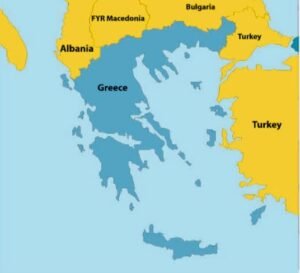
Facts about Greece
|
|
Also Read: India-Argentina Relations |