



India-Japan-Indonesia Trilateral Naval Exercise
|
General Studies Paper II: Government Policies & Interventions, Defence, Various Security Forces & Agencies |
Why in News?
India, Japan and Indonesia conducted a trilateral naval exercise on 13 February 2026 in the Andaman Sea to enhance maritime cooperation and joint operational readiness.
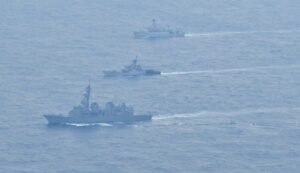
Highlights of India–Japan–Indonesia Trilateral Naval Exercise
- Venue: The India–Japan–Indonesia Trilateral Naval Exercise was conducted in the Andaman Sea, a strategically significant maritime zone located near the Malacca Strait, one of the world’s busiest Sea Lanes of Communication (SLOCs).
-
-
- This region connects the Indian Ocean with the Pacific Ocean, carrying nearly one-third of global maritime trade and energy shipments.
-
- Participating Naval Forces: The exercise involved active operational deployment of the Indian Navy, Japan Maritime Self-Defense Force (JMSDF) and the Indonesian Navy (TNI-AL).
- Objectives: The primary objectives were to enhance interoperability, develop coordinated response mechanisms against maritime threats such as piracy, illegal trafficking, and natural disasters, and promote Humanitarian Assistance and Disaster Relief (HADR) operations.
- Activities: The trilateral naval drill included complex operational manoeuvres such as anti-submarine warfare (ASW), surface warfare exercises, air defence coordination, communication drills, cross-deck helicopter operations, and search-and-rescue (SAR) missions. These multi-dimensional activities were conducted during both Harbour Phase and Sea Phase.
India–Japan–Indonesia Trilateral / Bilateral Military & Naval Exercises
-
- India–Japan Maritime Exercise (JIMEX): The Japan–India Maritime Exercise (JIMEX) is a key bilateral naval exercise conducted between the Indian Navy and Japan Maritime Self-Defense Force since 2012. The 8th edition was conducted in Yokosuka (Japan) in recent years to enhance operational procedures, anti-submarine warfare (ASW), air defence, surface combat operations, and cross-deck helicopter landings, improving interoperability across the entire maritime spectrum.
- India–Japan Maritime Partnership Exercise (MPX): Both navies regularly conduct the Maritime Partnership Exercise (MPX) in the Indian Ocean Region (IOR), including the Andaman Sea. These exercises involve tactical manoeuvres, seamanship drills, aircraft operations, and communication procedures between frontline warships such as INS Sukanya and JS Samidare, ensuring secure international shipping and strengthening cooperation for freedom of navigation in Indo-Pacific waters.
- India–Indonesia Coordinated Patrol (IND-INDO CORPAT): The IND-INDO CORPAT is a bilateral naval coordinated patrol conducted biannually since 2002 by the Indonesian Navy and Indian Navy along their International Maritime Boundary Line (IMBL). Its core objectives include combating maritime piracy, illegal fishing, smuggling, terrorism, and enhancing maritime domain awareness (MDA) to ensure regional stability in the Indian Ocean Region (IOR).
- Exercise GARUD SHAKTI (India–Indonesia): It is a bilateral Army exercise between the Indian Army and the Indonesian National Armed Forces (TNI-AD). The 9th edition was conducted in Indonesia, focusing on counter-terrorism operations, jungle warfare training, urban combat tactics, and joint operational planning, thereby improving military-to-military cooperation and interoperability in unconventional warfare environments.
- Exercise SAMUDRA SHAKTI (Naval Cooperation): It is another India–Indonesia bilateral naval exercise designed to enhance naval combat readiness, search-and-rescue operations, and Humanitarian Assistance and Disaster Relief (HADR) coordination between the two maritime forces. It plays a crucial role in promoting capacity-building, joint patrol coordination and maritime cooperation in Southeast Asian waters.
- Exercise MALABAR (India–Japan Multilateral): India and Japan also participate in the Exercise MALABAR, a major multilateral naval exercise involving India, Japan and other Indo-Pacific partners. The drill includes carrier battle group operations, anti-submarine warfare, maritime interdiction, amphibious operations, and counter-piracy missions, strengthening collective commitment toward a Free and Open Indo-Pacific (FOIP).
- Exercise MILAN (India–Indonesia–Japan Participation): The MILAN Naval Exercise, hosted by India since 1995, is a biennial multilateral maritime exercise in which both Indonesia and Japan regularly participate. Conducted under the Andaman & Nicobar Command, it focuses on professional naval exchanges, joint sea drills, maritime diplomacy and cooperation for maintaining peace and stability across the Indo-Pacific maritime domain.
- Dharma Guardian and Veer Guardian: India and Japan collaborate through Exercise Dharma Guardian (Army) and Exercise Veer Guardian (Air Force). These exercises focus on Counter-Terrorism in semi-urban terrain and Aerial Combat Maneuvers respectively. These drills complement naval efforts by ensuring that all branches of the armed forces can operate together under a unified strategic framework.
Significance of Trilateral & Bilateral Exercises
- Enhancing Maritime Domain Awareness (MDA): By sharing sensor data, satellite tracking, and reconnaissance intelligence, the three nations create a transparent operating environment. This collaboration is essential for monitoring and maintaining a real-time picture of the busy Sea Lines of Communication (SLOCs) that pass through the Sunda and Lombok Straits.
- Ensuring a Rules-Based International Order: By operating together, India, Japan, and Indonesia reaffirm their commitment to the United Nations Convention on the Law of the Sea (UNCLOS). This promotes a “Free and Open Indo-Pacific,” ensuring that international waters remain a global common accessible to all nations for peaceful trade.
- Operational Interoperability and Synergy: Through standardized communication protocols, common tactical signals, and cross-deck helicopter landings, these exercises eliminate friction during joint operations. This synergy is critical for complex tasks like Anti-Submarine Warfare (ASW) and coordinated surface strikes.
- Security of Global Trade Chokepoints: Over 25% of global trade passes through this region. Regular patrols and drills ensure that these “chokepoints” remain free from piracy. This provides a safety net for the energy supplies and commercial goods flowing between the Middle East, Africa, and East Asia.
- Strategic Balancing and Multipolarity: By strengthening “middle power” cooperation, India, Japan, and Indonesia reduce over-reliance on any single superpower for regional security. This strategic autonomy allows these nations to safeguard their national interests while contributing to a balanced and stable geopolitical environment in the Eastern Indian Ocean.
Significance of Japan and Indonesia for India
- Strategic Utility of the Japan Partnership: Japan remains India’s most critical partner for technological synergy and naval modernization. Through exercises like JIMEX, India gains exposure to the Japan Maritime Self-Defence Force’s (JMSDF) world-class Anti-Submarine Warfare (ASW) techniques and advanced sensor technologies. This partnership is vital for India to counter the increasing presence of foreign submarines in the Indian Ocean. Japan’s support for India’s Indo-Pacific Oceans Initiative (IPOI) provides a formal framework for capacity building and joint infrastructure projects, such as the development of the Andaman and Nicobar Islands.
- Geopolitical Weight of the Indonesia Alliance: Indonesia is the “gatekeeper” of the Straits of Malacca, Sunda, and Lombok, through which nearly 40% of India’s trade passes. By strengthening ties, India ensures that these vital Sea Lines of Communication (SLOCs) remain open and secure. Indonesia’s endorsement of India’s SAGAR vision (Security and Growth for All in the Region) is a major diplomatic victory, as it integrates India into the ASEAN maritime framework.
- Countering Regional Hegemony and Encirclement: Collaborating with Japan and Indonesia allows India to break the “string of pearls” strategy aimed at its encirclement. This trilateral alignment creates a “security diamond” that stretches from the North Pacific to the Southern Indian Ocean. By acting as a Net Security Provider, India leverages its central location to provide Maritime Situational Awareness (MSA) to its partners.
- Economic and Logistical Resilience: The signing of Reciprocal Provision of Supplies and Services (RPSS) agreements with Japan allows the Indian Navy to access Japanese bases, extending its operational reach deep into the Pacific. This logistical “force multiplier” ensures that India can protect its overseas investments and energy routes during times of geopolitical tension, reinforcing its role as a stable, reliable economic power in the 21st century.
|
Also Read: Combined Commanders Conference 2025 |