




India Longest 6-Lane Extradosed Earthquake Resistant Bridge in Assam
|
General Studies Paper III: Government Policies & Interventions, Infrastructure |
Why in News?
India’s longest 6-lane extradosed earthquake-resistant bridge, the Guwahati–North Guwahati Bridge over the Brahmaputra in Assam, is now close to inauguration and expected to be dedicated this month. Prime Minister Narendra Modi is likely to inaugurate this strategic infrastructure, significantly boosting connectivity across the region.
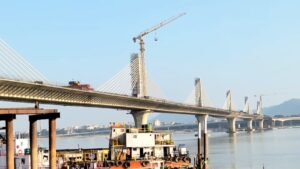
Guwahati–North Guwahati Bridge
- About: The Guwahati–North Guwahati Bridge (Kumar Bhaskar Varma Setu) is a landmark six-lane extradosed bridge over the Brahmaputra River in Assam. Once inaugurated, it will be the longest extradosed bridge in India.
- Location: The bridge spans the Brahmaputra River, connecting Bharalumukh in Guwahati (south bank) to Majgaon in North Guwahati (north bank) in the Kamrup Metropolitan District of Assam.
- Constructed By: The project is being executed under the Assam Public Works Department (PWD) through an Engineering, Procurement & Construction (EPC) contract awarded to SP Singla Constructions Private Ltd.
-
-
- The New Development Bank (NDB) is the principal funding agency, covering about 80 % of the cost, with the remaining financed by the Government of Assam.
-
- Budget: The original budget for the bridge was approximately ₹2,608.68 crore, but due to enhancements the cost was revised to about ₹3,030.48 crore.
- Foundation: Work began after Prime Minister Narendra Modi laid the foundation stone on 9 February 2019, and construction has progressed steadily despite pandemic-related slowdowns.
- Features: The bridge incorporates modern engineering and safety features:
- Structural Engineering and Design: The bridge spans a total project length of 8.4 km, with the main river crossing extending 1.24 km. It features a six-lane carriage way. The superstructure is supported by six massive foundations embedded 56 metres beneath the riverbed, ensuring a design life exceeding 100 years.
- Hybrid Extradosed Design: The bridge utilizes a sophisticated extradosed design, a hybrid between cable-stayed and girder systems. This allows for 200-metre individual spans—the longest in India—reducing the number of river foundations. This structural choice ensures a robust load distribution and enhances the bridge’s aesthetic appeal as a modern engineering marvel.
- High-Tech Monitoring and Aesthetics: The bridge is equipped with a real-time Bridge Health Monitoring System (BHMS), using IoT sensors to provide continuous structural analysis and early warnings for maintenance. For visual grandeur, it features a dynamic lighting system capable of thematic displays, such as the Tricolour on national holidays.
- Logistics and Safety Infrastructure: Functioning as a vital logistics link, the six-lane bridge includes vehicular and pedestrian underpasses to ensure smooth local access without disrupting highway traffic. A dedicated rescue station is situated on the south bank to provide immediate emergency support for stranded vehicles. Most importantly, it is toll-free for private vehicles and city buses.
Significance of Guwahati–North Guwahati Bridge
- Regional Integration: The bridge is a vital “missing link” that integrates the bustling south bank of Guwahati with the rapidly developing North Guwahati (Amingaon) area. By slashing travel time from 90 minutes to just 15 minutes, it effectively fuses the two regions into a cohesive urban unit. This connectivity is crucial for local commuters, students, and patients accessing essential medical services like AIIMS Guwahati.
- Act East Policy Relevance: As a flagship of the Assam Bridge Project, the bridge aligns with India’s Act East Policy by transforming Guwahati into a regional gateway for Southeast Asia. Funded by the New Development Bank (NDB), it enhances multi-modal transport links, positioning Assam as a central economic and cultural hub for trade with neighboring countries like Bhutan and Bangladesh.
- Earthquake-Prone Resilience: Located in the high-risk Seismic Zone V, the bridge features cutting-edge earthquake-resistant technology. It utilizes 24 RESTON-PENDULUM DUPLO isolator bearings, designed to absorb tectonic shocks and accommodate seismic movements of up to ±492 mm. This engineering marvel is built to last for over 100 years.
- Trade, Tourism, and Logistics: The bridge serves as a major logistics catalyst, providing a toll-free route for private vehicles and city buses to bypass the congested Saraighat Bridge. It will boost tourism by making historic sites in North Guwahati more accessible. Improved logistics will significantly lower the cost of transporting essential commodities, benefiting local markets and the Trinity Business Park economic zone.
- Employment and Economy: This project has already seen massive employment generation, primarily using indigenous youth and local labor. Post-launch, it will boost Assam’s economy by facilitating the expansion of the Guwahati Metropolitan Area. The bridge is expected to attract new industrial investments and foster a surge in the hospitality, retail, and transport sectors across the North Bank.
|
Brahmaputra River
|

|
Also Read: Chenab Rail Bridge – The World’s Tallest Railway Arch Bridge |