



India–Netherlands Partnership on Green Hydrogen
|
General Studies Paper II: Government Policies & Interventions, Environmental Pollution & Degradation |
Why in News?
Recently, India and Netherlands have strengthened their partnership on green hydrogen by launching the India–Netherlands Hydrogen Fellowship Programme and signing new academic and research cooperation agreements to boost clean energy innovation.

What is the India–Netherlands Hydrogen Fellowship Programme?
- About: The India–Netherlands Hydrogen Fellowship Programme is a strategic international capacity-building initiative launched in February 2026 as part of the India–Netherlands cooperation on green hydrogen research and innovation.
-
- Department: The fellowship programme was launched by India’s Department of Science and Technology (DST).
- Aims: Its primary vision is to accelerate the transition to sustainable energy by fostering international collaboration and developing human capital specifically for hard-to-abate sectors.
- Focus Areas: Fellows will engage in high-level research focused on five critical pillars:
- System Integration and infrastructure development.
- Safety Protocols and essential regulatory frameworks.
- Techno-economic Analysis to ensure commercial viability.
- Life-cycle Assessment methodologies for environmental impact.
- Indigenisation Pathways to help localise advanced technologies in India.
- Eligibility: This is a national initiative open to a wide range of academic levels across Indian institutions. Eligible applicants include doctoral (PhD) candidates, postdoctoral researchers, and faculty members. The programme released its formal Call for Proposals (CFP) and scheme guidelines simultaneously with its launch.
- Academic Alliance: Under this programme a new Memorandum of Understanding (MoU) was signed between the University of Groningen and 19 Indian Institutes of Technology (IITs). This institutional framework facilitates faculty and student exchanges and joint research projects.
- International Exposure: Participants will spend significant time at the University of Groningen and within the Northern Netherlands Hydrogen Valley, the first official hydrogen valley in Europe.
|
What is Green Hydrogen?
|
India–Netherlands Green Hydrogen Cooperation
- Port of Rotterdam as the European Gateway: The Port of Rotterdam has emerged as a critical hub for India’s hydrogen ambitions. In May 2024, several agreements were solidified to position Rotterdam as the primary entry point for Indian green hydrogen exports into Europe. India aims to produce 5 MMT (Million Metric Tonnes) of green hydrogen by 2030, and the Netherlands provides the necessary liquid hydrogen terminals and pipeline networks to reach the European industrial heartland.
- Memorandum of Understanding on Maritime Energy: A landmark MoU between the Ministry of New and Renewable Energy (MNRE) and the Dutch Ministry of Economic Affairs focuses on the decarbonization of shipping. This includes developing “Green Shipping Corridors” and the infrastructure required for Green Ammonia bunkering. Both nations are collaborating to ensure that the maritime route between the Deendayal Port (Kandla) and Dutch ports becomes a zero-emission trade lane.
- Joint Research and Development (WASH Framework): Bilateral cooperation is heavily driven by scientific innovation under the WASH (Water, Air, Sanitation, and Hydrogen) framework. The Department of Science and Technology (DST) in India and the Netherlands Organisation for Scientific Research (NWO) have launched joint calls for research in high-efficiency electrolysers. Specifically, they are focusing on Anion Exchange Membrane (AEM) technology to reduce reliance on precious metals like iridium and platinum.
- The Hydrogen Valley Innovation Clusters: The Netherlands is a pioneer with its HEAVENN project, the first integrated Hydrogen Valley in Europe. Through this cooperation, Dutch experts are providing technical consultancy to help India establish similar Hydrogen Valleys in regions like Gujarat and Kerala. These clusters integrate production, storage, and local industrial consumption to maximize thermal efficiency and minimize distribution costs.
- Private Sector Supply Chain Integration: Significant commercial deals have bolstered state-level cooperation. For instance, Indian energy major AM Green signed a definitive agreement with the Port of Rotterdam to export green ammonia. This deal is supported by the Dutch Entrepreneurial Development Bank (FMO), which provides blended finance to de-risk large-scale investments in Indian electrolyser manufacturing plants.
- Harmonization of Global Standards: Both countries are working within the International Partnership for Hydrogen and Fuel Cells in the Economy (IPHE) to create uniform “Green” definitions. This ensures that hydrogen produced in India meets the Renewable Energy Directive (RED II/III) criteria of the European Union, facilitating seamless cross-border trade.
Significance of Green Hydrogen Partnerships
- Achieving Strategic Energy Sovereignty: These partnerships are vital for India’s goal of becoming energy independent by 2047. By replacing expensive fossil fuel imports—currently costing over $160 billion annually—with domestically produced green hydrogen, India can drastically reduce its Current Account Deficit and shield itself from the price volatility of global oil and gas markets.
- Global Export Leadership and Trade: By aligning with international partners, India can leverage its low-cost renewable power to become a premier global export hub. Partnerships provide the “off-take” agreements and green shipping corridors necessary to export an estimated 5 MMT per annum by 2030, capturing a significant share of the multi-billion dollar global clean energy market.
- Industrial Protection against Carbon Taxes: Collaboration is essential for India’s heavy industries to bypass the European Union’s Carbon Border Adjustment Mechanism (CBAM). By integrating international green steel and ammonia technologies, Indian manufacturers can ensure their exports remain competitive in a world that increasingly penalizes carbon-intensive products, protecting millions of industrial jobs.
- Catalyst for High-Tech Manufacturing: Partnerships facilitate the transfer of electrolyser technology, enabling the “Make in India” initiative to flourish within the energy sector. This is expected to attract over ₹8 lakh crore ($100 billion) in investments, creating a massive ecosystem for gigafactories and generating approximately 600,000 green-collar jobs for the Indian workforce.
India’s Green Hydrogen Initiatives
- National Green Hydrogen Mission (NGHM): Approved in January 2023 with an initial outlay of ₹19,744 crore, the NGHM is the flagship initiative overseen by the Ministry of New and Renewable Energy (MNRE). It aims to develop a production capacity of at least 5 MMT (Million Metric Tonnes) per annum by 2030. The mission is structured to reduce fossil fuel imports by over ₹1 lakh crore.
- SIGHT Programme (Incentive Schemes): The Strategic Interventions for Green Hydrogen Transition (SIGHT) is the financial backbone of the Mission. It provides two distinct financial incentives: one for the domestic manufacturing of electrolysers (with a five-year cap) and another for the direct production of green hydrogen.
- Green Hydrogen Consumption Mandates: The government is moving toward implementing Green Hydrogen Purchase Obligations (GHPO), similar to Renewable Purchase Obligations. These mandates will require “hard-to-abate” sectors—specifically petroleum refineries, fertilizer plants, and steel units—to replace a certain percentage of their grey hydrogen consumption with green hydrogen, ensuring a guaranteed domestic market for producers.
- Green Hydrogen Hubs and Valleys: The MNRE has identified and funded the development of Green Hydrogen Hubs in regions capable of supporting large-scale production and utilization. States like Gujarat, Odisha, and Andhra Pradesh are being developed as integrated clusters where renewable energy generation, hydrogen production, and industrial consumption coexist to minimize transportation and infrastructure costs.
- Inter-State Transmission System (ISTS) Charges Waiver: To promote cost-effective production, the Ministry of Power has granted a 25-year waiver of ISTS charges for green hydrogen and green ammonia projects commissioned before December 2030. This allows producers to source renewable energy from any part of India without paying heavy wheeling and transmission costs, significantly lowering the Levelized Cost of Hydrogen (LCOH).
- Green Hydrogen Standards and Certification: In August 2023, India became one of the first countries to define a Green Hydrogen Standard. It specifies that hydrogen can only be classified as “Green” if its emission intensity does not exceed 2 kg CO2 equivalent per kg of hydrogen produced. This standard is critical for international trade and for issuing carbon credits under the newly formed Carbon Credit Trading Scheme (CCTS).
- R&D Roadmap and Pilot Projects: The government has allocated ₹400 crore specifically for Research and Development under the NGHM. This includes funding for pilot projects in Green Shipping, Green Steel, and Long-haul Heavy-duty Transportation. These pilots help in testing the commercial viability of hydrogen-powered vessels.
|
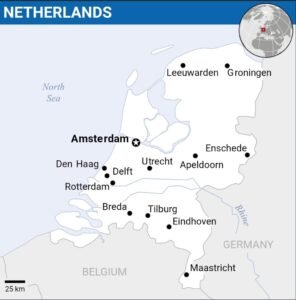
About Netherlands
|
|
Also Read: India’s First Off-Grid Green Hydrogen Plant |