




India Successfully Tests Long-Range Pinaka Guided Rocket
|
General Studies Paper III: Government Policies & Interventions, Defence Technology |
Why in News?
Recently, India’s Defence Research and Development Organisation (DRDO) successfully conducted the maiden flight test of the Pinaka Long Range Guided Rocket (LRGR-120) at the Integrated Test Range (ITR) in Chandipur, Odisha.
- Throughout the flight, the LRGR-120 executed all in-flight manoeuvres as intended. After covering its full range, the rocket impacted the designated target with textbook precision, demonstrating high levels of accuracy.
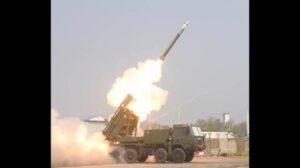
Pinaka Long Range Guided Rocket (LRGR-120):
-
- About: The Pinaka Long Range Guided Rocket (LRGR-120) is an advanced, precision-guided variant of the indigenous Pinaka Multi-Barrel Rocket Launcher (MBRL) system. It is designed to strike high-value targets deep within enemy territory with pinpoint accuracy, significantly enhancing India’s standoff strike capabilities.
- Developed By: The LRGR-120 is a product of comprehensive indigenous R&D coordinated by the Defence Research and Development Organisation (DRDO):
- Lead Designer: Armament Research and Development Establishment (ARDE).
- Key Laboratories: High Energy Materials Research Laboratory (HEMRL) & Research Centre Imarat (RCI) and Defence Research and Development Laboratory (DRDL)
- Production Partners: Economic Explosives Limited (EEL) developed the pre-production units.
-
-
- Testing Facilities: Integrated Test Range (ITR), Chandipur, and Proof & Experimental Establishment (P&EE).
-
- Features:
-
- Strike Range: Maximum operational range of 120 km.
- Guidance & Navigation: Equipped with an advanced guidance package, likely utilizing Inertial Navigation System (INS) and satellite updates (IRNSS/GPS) for mid-course and terminal corrections.
- Accuracy: Described as having “textbook precision,” it achieved a direct hit on its designated target during its maiden flight test.
- Launcher Compatibility: Can be fired from existing in-service Pinaka launchers, allowing the same platform to deploy rockets of varying ranges (40 km, 75 km, and 120 km).
Pinaka Rocket System – Comprehensive Overview
- About: The Pinaka Rocket System is an indigenous multi-barrel rocket launcher (MBRL) developed in India for use by the Indian Army. It is designed to deliver large volumes of firepower quickly against enemy positions and area targets.
- Background: Development began around 1986 as an indigenous alternative to the Russian Grad (BM-21) MBRL. After some successful tests it was inducted into the Indian Army in 2000. It gained fame during the 1999 Kargil War, where it successfully neutralized enemy positions on high-altitude mountain tops.
- Variants:
-
- Pinaka Mk-I: 38–40 km (Unguided).
- Pinaka Mk-II / Guided Pinaka: 60–90 km (Guided).
- LRGR-120 (Current): 120 km (Precision-guided).
- Future Development: Research is underway for variants with ranges of 300 km.
Features of Pinaka Rocket System
- Indigenous Design: The Pinaka Rocket System is a fully indigenous artillery system. Indian scientists designed the system to meet Indian Army terrain and warfare needs.
- Multi-Barrel Launcher: Pinaka uses a multi-barrel launcher that can fire 12 rockets from a single platform. The launcher releases the full salvo in about 44 seconds.
- Long-Range Strike Capability: The system supports multiple rocket variants with ranges from 38 km to 120 km. This range allows deep strike capability without exposing launch units.
- Guided and Unguided Rocket: Pinaka supports both unguided and guided rockets. Guided rockets use navigation and control systems to improve accuracy. This feature enables precision strikes.
- High Accuracy: Guided Pinaka rockets achieve low Circular Error Provability. This improves hit accuracy compared to conventional rocket artillery. Enhanced precision reduces collateral damage.
- Variety of Warhead Types: Pinaka rockets can carry high explosive fragmentation, incendiary, pre-fragmented, and area denial warheads. The system supports both soft and semi-hardened targets.
- Rapid Shoot-and-Scoot Ability: The launcher vehicle can fire and relocate quickly. This shoot-and-scoot feature reduces vulnerability to enemy counter-battery fire.
- High Mobility Vehicle Platform: Pinaka launchers are mounted on 8×8 high-mobility trucks. These vehicles perform effectively in deserts, plains, mountains and rough terrain. The system supports operations along the Line of Actual Control and western borders.
- Automated Fire Control System: Pinaka uses a computerised fire control system. The command post calculates firing data using target inputs and meteorological data.
- Integrated Support Vehicles: Each Pinaka battery includes loader-cum-replenishment vehicles, ammunition carriers and command vehicles. This structure enables rapid reload and sustained fire missions.
- Interoperability with Army Networks: Pinaka integrates with the Indian Army artillery command and control networks. This allows coordination with surveillance assets and ground forces.
- Cost-Effective Artillery Solution: Compared to missile systems Pinaka offers cost-effective firepower. Rockets cost less while delivering high battlefield impact. This balance supports sustained military operations.
Significance for India
-
- Force Multiplication: The Pinaka Rocket System acts as a major force multiplier for the Indian Army. It enables rapid delivery of high-volume firepower within seconds. This capability improves battlefield dominance during offensive and defensive operations. The system supports integrated battle groups introduced after 2019 reforms.
- Credible Deterrence: Pinaka contributes directly to India’s credible conventional deterrence. Long-range rockets with ranges up to 120 km tested in 2025 allow deep strikes without crossing borders. This capability raises the cost of aggression for adversaries. It supports rapid response along the Line of Control and Line of Actual Control. Pinaka plays a role in preserving the regional balance of power in South Asia.
- Atmanirbhar Bharat: Pinaka represents a core success of Atmanirbhar Bharat in defence manufacturing. DRDO led the design while Indian industry handles large-scale production. Indigenous production ensures supply security during crises. Technology absorption strengthens India’s defence ecosystem and supports long-term self-reliance in critical artillery systems.
- Export Potential: Pinaka enhances India’s defence diplomacy through exports and cooperation. India completed its first export delivery to Armenia in 2024. Several countries in Asia, Africa and Europe have shown interest. Competitive cost and proven performance positions India as a reliable defence supplier. This role supports India’s broader global strategic influence.