




India Third Nuclear Missile Submarine INS Aridhaman
|
General Studies Paper III: Indigenization of Technology, Defence Technology |
Why in News?
India’s third indigenous nuclear-powered ballistic missile submarine ‘INS Aridhaman’ is in the final stage of sea trials and is expected to be commissioned between April–May 2026. As part of India’s nuclear triad, this advanced submarine will enhance second-strike capability and strategic security.
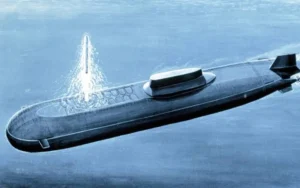
India’s Third Nuclear Missile Submarine- INS Aridhaman
- About: INS Aridhaman (S-4) is India’s third indigenously built Nuclear-Powered Ballistic Missile Submarine (SSBN) of the Arihant-class, designed to provide credible sea-based nuclear deterrence under India’s No-First-Use (NFU) doctrine. It forms the sea-leg of India’s Nuclear Triad.
- Background: The submarine was launched on 23 November 2021 and is expected to be commissioned in April–May 2026 after completing extensive sea trials.
- Developed By: INS Aridhaman has been constructed at the Ship Building Centre (SBC), Visakhapatnam under the classified Advanced Technology Vessel (ATV) Programme, involving collaboration between the Indian Navy, DRDO, and Bhabha Atomic Research Centre (BARC).
- Features:
-
- Displacement & Size: INS Aridhaman has a submerged displacement of 7,000 tonnes and a length of approximately 125–130 metres, making it 1,000 tonnes heavier than INS Arihant, thereby enhancing payload capacity and operational endurance.
- Nuclear Propulsion: It is powered by an 83 MW Compact Light Water Reactor (CLWR-B1) using enriched uranium, enabling virtually unlimited range and endurance, restricted only by crew supplies and maintenance cycles.
- Missile Capability: The submarine is equipped with 8 Vertical Launch System (VLS) tubes, capable of carrying either: 24 × K-15 SLBMs (750 km range), or 8 × K-4 SLBMs (3,500 km range), with future integration planned for K-5 SLBMs (~5,000–6,000 km).
- Stealth & Survivability: The upgraded reactor and hull design ensure a lower acoustic signature, making detection by enemy anti-submarine warfare systems extremely difficult while operating at test depths of 300–400 metres.
- Sensors & Combat Systems: INS Aridhaman integrates advanced indigenous systems such as: USHUS Sonar System, Panchendriya Unified Underwater Communication & Fire-Control System, ensuring superior underwater situational awareness and targeting accuracy.
- Speed & Endurance: The SSBN can achieve speeds of 12 knots surfaced and 24 knots submerged, ensuring stealthy long-duration strategic patrols essential for nuclear deterrence missions.
|
India’s Other Nuclear-Capable Submarines
|
What is a Nuclear-Powered Ballistic Missile Submarine (SSBN)?
- About: A Nuclear-Powered Ballistic Missile Submarine (SSBN) is a strategic submarine designed to carry and launch Submarine-Launched Ballistic Missiles (SLBMs) armed with nuclear warheads. The term SSBN stands for: Ship Submersible Ballistic Nuclear.
- Strategic Purpose: The primary role of an SSBN is to ensure a nation’s credible minimum deterrence by maintaining the capability to retaliate with nuclear weapons even after suffering a first strike. This concept is known as second-strike capability, which is essential for maintaining strategic stability.
- SLBM Launch Capability: SSBNs are equipped with Submarine-Launched Ballistic Missiles (SLBMs) that can be fired from underwater using cold-launch systems. These missiles follow ballistic trajectories and may carry Multiple Independently Targetable Re-entry Vehicles (MIRVs), allowing a single missile to hit multiple targets with high precision.
- Nuclear Propulsion System: Unlike diesel-electric submarines, SSBNs use an onboard nuclear reactor for propulsion, enabling them to operate submerged for months without surfacing. This gives them near-unlimited operational range, limited only by crew endurance and food supplies, making them extremely difficult to detect or track.
- Stealth & Survivability: SSBNs are designed with advanced acoustic quieting technologies, including anechoic hull coatings, pump-jet propulsors, and vibration-isolated machinery. Their ability to remain hidden in deep oceans ensures high survivability against enemy anti-submarine warfare (ASW) systems.
- Operational Deployment: These submarines typically undertake strategic deterrence patrols in designated oceanic zones known as bastions. During patrols, they maintain continuous communication through Very Low Frequency (VLF) or Extremely Low Frequency (ELF) signals, allowing command authorities to issue launch orders if required.
- Global SSBN Operators: Only a few countries possess SSBNs due to technological complexity and cost, including the United States, Russia, United Kingdom, France, China, and India—all relying on SSBNs as the most secure and survivable leg of nuclear deterrence.
Significance of India’s SSBN Programme
- Strategic Depth via K-4 Missiles: The transition from the K-15 (750 km) to the K-4 (3,500 km) SLBM provides massive strategic depth. It allows Indian submarines to target major adversary cities while remaining safely within the protected “bastion” of the Bay of Bengal.
- Indo-Pacific Power Balance: To counter China’s Type 094 (Jin-class), India’s SSBNs maintain a balance of power. They act as a silent deterrent against the People’s Liberation Army Navy (PLAN) incursions into the Indian Ocean Region (IOR).
- Technological Self-Reliance: Under the Advanced Technology Vessel (ATV) project, India developed an 83 MW pressurized water reactor. This indigenous mastery ensures unlimited submerged endurance, removing the need for frequent surfacing and enhancing stealth.
- Diplomacy and Global Status: Owning nuclear submarines cements India’s status in the elite “Big Six” nations. It reinforces India’s role as a Net Security Provider, capable of maintaining long-range maritime surveillance and deterrence.
- Economic Corridor Protection: By securing the Sea Lines of Communication (SLOCs), SSBNs indirectly protect India’s trade. They deter adversaries from attempting a naval blockade during high-tension periods, ensuring economic continuity.
|
Advanced Technology Vessel (ATV) Programme
|
|
Also Read: India’s K-4 Ballistic Missile |