




India to Launch First Indigenous C-295 Military Aircraft by September 2026
|
General Studies Paper II: Defence Technology, Indigenization of Technology |
Why in News?
India is set to roll out its first indigenous Airbus‑Tata C‑295 military transport aircraft from the new Vadodara final assembly line by September 2026, marking a major milestone under the “Make in India” aerospace initiative with significant indigenous content.
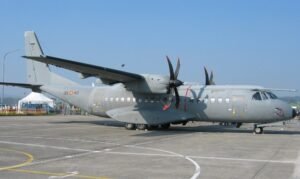
Airbus‑Tata C‑295 Military Transport Aircraft
- About: The Airbus‑Tata C‑295 is a medium tactical transport aircraft designed for versatile military operations including troop movement, cargo logistics, medical evacuation, and special missions. It is now being produced in India under C‑295 Program under the ‘Make in India’ initiative.
- Developed By: The C‑295 was developed by CASA, which later merged into Airbus Defence and Space. In India, the programme is executed by Airbus in partnership with Tata Advanced Systems Limited (TASL) under a strategic industrial collaboration.
- Background: India signed a contract in September 2021 for 56 aircraft to replace the ageing Avro‑748 fleet. The first 16 aircraft were built in Spain, and the remaining 40 were manufactured and assembled in India by TASL at a new Final Assembly Line (FAL) in Vadodara, marking the first private aerospace defence manufacturing in the country.
- Features:
-
- Design and Structure: The C‑295 features a high‑wing design, rear ramp door for fast loading/unloading, and a pressurised cabin of 12.69 m length. Its robust airframe supports operations on soft, semi‑prepared runways. The aircraft can be auto‑reversed in narrow runways.
- Propulsion and Performance: Powered by two Pratt & Whitney Canada PW127G turboprop engines, the C‑295 delivers excellent hot‑and‑high performance with high reliability. It has a maximum cruise speed of ~260 knots (≈480 km/h) and can fly up to 30,000 feet altitude, with an endurance of up to 11 hours.
- Payload and Capacity: The aircraft can carry up to 9 tonnes of payload, including 71 fully equipped troops or 50 paratroopers. It can also be configured for medical evacuation with 24 stretchers and support personnel, parachute drops, and logistic resupply missions.
- Multi‑Mission Capabilities: The C‑295’s mission versatility includes troop/cargo transport, airdrop operations, maritime patrol, search and rescue (SAR), and disaster relief. It can be configured for signals intelligence (SIGINT), electronic warfare, and surveillance.
- Indigenous Systems and Upgrades: For the Indian variant, all 56 aircraft will be fitted with an indigenous Electronic Warfare Suite developed with DPSUs such as Bharat Electronics Ltd (BEL) and Bharat Dynamics Ltd (BDL). This includes radar warning receivers, missile approach warning systems, and countermeasure dispensing systems.
Significance of C‑295 Program
- Defence Self‑Reliance: The C‑295 programme is a flagship for ‘Make in India’, enabling the first large‑scale domestic manufacturing of a military aircraft. The establishment of a complete aerospace ecosystem—from production to maintenance—strengthens India’s defence industrial base and reduces reliance on foreign imports.
- Industrial Multiplier Effect: This project generated thousands of skilled and indirect jobs, involved over 125 MSMEs in the supply chain, and boosted high‑tech manufacturing skills. The aerospace facility in Vadodara supports local industry growth, technology transfer, and long‑term capability building in advanced aviation systems.
- Border Readiness: The aircraft’s STOL (Short Take‑Off and Landing) capability and robust performance enable supply and reinforcement to forward airbases and remote border posts, notably along the Himalayan and North‑Eastern sectors. This extends the IAF’s logistical reach and rapid deployment capacity in high‑stakes scenarios.
- Technological Advancement: By increasing indigenisation levels from an initial ~48% to an expected 75%, the C‑295 programme accelerates technology absorption in precision manufacturing, avionics, and systems integration. It positions India to undertake more advanced indigenous aerospace projects in the future.
- International Defence Ties: The collaboration with Airbus Defence and Space and strategic partnership with Spain underlines India’s global defence cooperation and opens pathways for future technology partnerships, export opportunities, and enhanced global integration of India’s aerospace industry.
|
Other Indigenous Military Aircrafts
|
|
Also Read: HAL & Russia Join Hands to Build SJ-100 Passenger Aircraft in India |