




Indian Army Received Final Batch of Apache AH-64E Helicopters
|
General Studies Paper II: Government Policies and Interventions, Defence |
Why in News?
Recently, the Indian Army finally received the last batch of Apache AH-64E attack helicopters. The arrival completed the Army’s six-helicopter order and marks the completion of a strategically important fleet enhancement for frontline operational readiness.
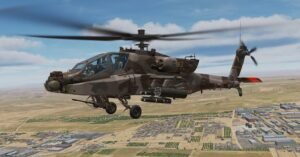
- The helicopters will join the 451 Army Aviation Squadron in Jodhpur after formalities and final tests. The Army announced that the platforms will be assigned to the Jodhpur unit once on-site inspections finish.
India-US Apache AH-64E Deal
- The Government of India approved the purchase of six AH-64E Apache attack helicopters for the Indian Army in 2020. These helicopters were to be bought from Boeing of the United States under a government-to-government arrangement. The decision came after years of planning to modernize Army Aviation.
- The deal for six AH-64E helicopters was signed at an approximate value of USD 600 million (about ₹4,168 crore in 2017 prices as per official estimates). This cost covers the helicopters, weapons, radar and sensor systems, associated spares, and training.
- Before the 2020 signing, the Defence Acquisition Council (DAC) approved the purchase of the Apaches along with weapons in August 2017 at an estimated ₹4,168 crore. This clearance marked the start of the procurement process for Army attack helicopters outside the Air Force’s control.
- Under India’s Defence Procurement Procedure, Boeing agreed to offset commitments. To support this deal and other Apache orders, Tata Boeing Aerospace Limited (TBAL) was created.
- The original plan projected delivery of the first helicopters by mid-2024. However, the schedule shifted due to global supply chain issues and production delays. The first three helicopters only arrived in July 2025 and the final three arrived on 16 December 2025, completing the fleet.
- This Army deal is separate from an earlier contract signed by the Indian Air Force (IAF) in 2015 for 22 Apache helicopters valued at around $1.4 billion. Those helicopters were delivered by 2020 and serve under IAF command.
AH-64E Apache Attack Helicopters
-
- About: The AH-64E Apache Guardian is a state-of-the-art, multi-role attack helicopter developed by the US aerospace major Boeing. It is considered one of the world’s most advanced combat helicopters and serves as a crucial asset for advanced reconnaissance, precision strikes, and close air support missions.
- Manufacturer: The original manufacturer was Hughes Helicopters, which was later acquired by McDonnell Douglas, and then became part of The Boeing Company.
- Development: The Apache program began as the US Army’s Advanced Attack Helicopter (AAH) program in the 1970s. The YAH-64 prototype first flew in 1975, and the AH-64A was introduced into service in 1986. The AH-64E Guardian is the latest and most modern variant.
- Indian Context: India has a joint venture, Tata Boeing Aerospace Limited (TBAL), in Hyderabad that manufactures the Apache fuselages for the global market. The Indian Air Force operates 22 units, and the Indian Army is inducting six more for its Aviation Corps.
- Other Purchasers: Along with India, countries like Egypt, UK, South Korea, Japan, UAE, Saudi Arabia, Kuwait, Netherlands, Qatar, Greece, Indonesia, Israel, and Singapore are using Apache Guardian.
- Key Features:
- High-Intensity: The AH-64E is designed for high-intensity, network-centric warfare and is optimized for operations in diverse environments, including high-altitude and desert conditions. The helicopter reaches speeds above 150 knots and climbs to roughly 20,000 feet service ceiling.
- Longbow Fire Control Radar (FCR): Mounted in a dome above the main rotor blades, this radar provides 360-degree coverage, can detect and classify up to 256 targets, and prioritize the top 16 threats within seconds.
- Modernised Target Acquisition and Designation System (MTADS): Also known as “Arrowhead,” it provides day and night vision capabilities, along with a laser designator for precision targeting.
- Pilot Night Vision System (PNVS): A helmet-mounted display system (IHADSS) allows either crew member to slave the 30mm chain gun to their head movements and aids in flying in low-visibility conditions.
- Digital Connectivity: Features advanced digital operability for seamless data sharing with ground and air assets, enabling network-centric warfare.
- Manned-Unmanned Teaming (MUM-T): Capable of controlling unmanned aerial vehicles (UAVs) to perform scouting and reconnaissance missions, enhancing situational awareness.
- Crash-Resistant Frame: The airframe is designed to meet stringent crashworthiness requirements.
- Integrated Defensive Aids Suite: Includes radar warning receivers, missile warning sensors, and flare/chaff dispensers to protect the aircraft from enemy threats.
- Redundant Systems: Key systems are redundant to ensure the aircraft can withstand significant combat damage.
- Armament: The Apache is equipped with a versatile weapons package for various mission profiles.
- M230 30mm Chain Gun: An automatic cannon located under the forward fuselage, it can fire up to 625 rounds per minute.
- AGM-114 Hellfire Missiles: The primary anti-armor weapon, the helicopter can carry up to 16 laser-guided Hellfire missiles for precision strikes against armored targets.
- Hydra 70 Rockets: Unguided 70mm rockets for use against area targets.
- Stinger Missiles: Air-to-air missiles can also be integrated for self-defence against aerial threats.
Strategic Significance of Apache AH-64E Induction
-
- Independent Army Aviation Offensive Power: The acquisition of Apaches specifically for the Indian Army Aviation Corps reduces the Army’s reliance on the Indian Air Force (IAF) for critical close air support (CAS) missions. This organic capability allows the Army to plan and execute integrated air-ground operations more swiftly and autonomously, improving tactical flexibility and response time in forward areas.
- Network-Centric Warfare Integration: The AH-64E Version 6 is designed for multi-domain operations and features advanced digital connectivity, secure communication suites, and the ability to control unmanned aerial vehicles (UAVs) mid-flight. This manned-unmanned teaming capability dramatically enhances battlefield situational awareness, intelligence, surveillance, and reconnaissance (ISR) efforts, allowing for seamless integration with other land and air assets.
- Deterrence and Regional Power Balancing: The induction of a globally recognized, combat-proven platform like the Apache strengthens India’s overall deterrence posture against potential adversaries, particularly Pakistan and China. It provides a qualitative military edge over older rotary-wing assets in the region and signals India’s commitment to modernizing its forces with high-end, Western technology.
- India–US Defence Cooperation: The Apache induction strengthens India–US strategic defence ties. The helicopter comes through a government-to-government framework under U.S. foreign military sales. The deal reflects growing trust and interoperability between the two nations. The Apache program also supports industrial cooperation through manufacturing partnerships in India.