



ISRO PSLV Third Stage Successful Test: Technical Upgrades & Significance
| General Studies Paper III: Space Technology |
Why in News?
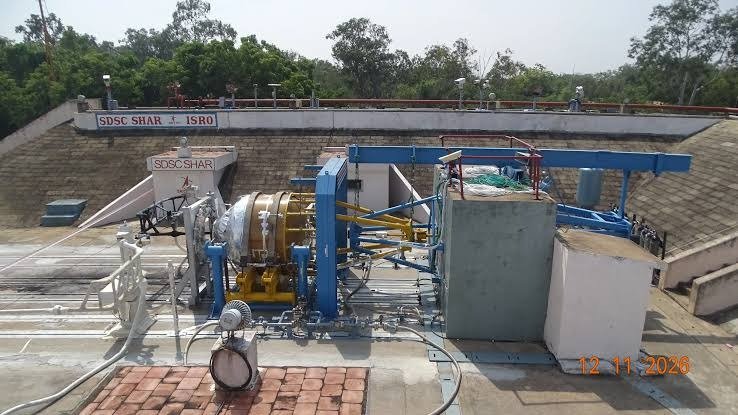
Recently, Indian Space Research Organisation (ISRO) successfully conducted a ground static test of PSLV’s upgraded third stage (PS3) at Sriharikota on November 12, 2026.
What is ISRO PSLV Third Stage Test?
- About: The ISRO PSLV Third Stage Test was a controlled ground static fire test of the upgraded PS3 solid rocket motor conducted on November 12, 2026.
- The PSLV Third Stage (PS3) is the third propulsion stage of India’s Polar Satellite Launch Vehicle (PSLV).
- It is a solid-propellant rocket motor that provides the required thrust after the first two stages have completed their operations.
- It uses Hydroxyl-Terminated Polybutadiene (HTPB)-based solid propellant.
- Location: The test took place at the Static Test Facility located within the Satish Dhawan Space Centre (SDSC) in Sriharikota, Andhra Pradesh.
- Objective: The primary objective was to validate hardware upgrades and quality-control reforms designed to restore the operational reliability of India’s workhorse launch vehicle.
- Previous Failures: Upgrades became critical after consecutive third-stage failures during the PSLV-C61 (May 18, 2025) and PSLV-C62 (January 12, 2026) missions.
- PSLV-C61 suffered a chamber pressure drop caused by a nozzle throat failure, resulting in the loss of the 1,696-kg EOS-09 satellite.
- PSLV-C62 experienced severe roll-rate disturbances and a flight-path deviation near the end of the PS3 burn, losing the strategic EOS-N1 (Anvesha) satellite and 15 co-passenger payloads.
- Because solid rocket motors operate in near-vacuum and cannot be throttled or shut down after ignition, they require zero manufacturing defects.
- Technical Upgrades: Following a comprehensive review, ISRO modified the nozzle configuration to increase design margins beyond expected operational loads.
- Engineers also reinforced mechanical interfaces and added redundancy in sealing systems to prevent pressure leaks.
- ISRO tightened raw material acceptance criteria, revised assembly procedures, and introduced rigorous Non-Destructive Testing (NDT) across all integration and transportation phases.
- Test Results: The upgraded PS3 solid motor performed nominally throughout the static firing.
- ISRO confirmed that the new configuration had been realised and tested successfully.
- ISRO teams will conduct detailed post-test data reviews and execute further ground tests before clearing the revamped third stage for upcoming orbital flights.
What is PSLV?
- About: The Polar Satellite Launch Vehicle (PSLV) is India’s third-generation, indigenously developed expendable launch system.
- It was developed by Indian Space Research Organisation (ISRO).
- It is called as the “Workhorse of ISRO,” it was engineered during the 1980s at the Vikram Sarabhai Space Centre (VSSC) to achieve self-reliance in launching remote sensing satellites.
- It is primarily designed to place satellites into Sun-Synchronous Polar Orbits (SSPO) and Low Earth Orbits (LEO).
- It is also capable of launching spacecraft into other orbits, including sub-Geosynchronous Transfer Orbits.
- Its first successful flight was recorded in October 1994.
- Propulsion Architecture: PSLV stands 44.4 meters tall with a lift-off mass of up to 320 tonnes and is India’s first launch vehicle equipped with liquid stages.
- It employs a four-stage mixed-propulsion architecture alternating between solid and liquid fuels:
- PS1 (First Stage): Uses an S139 solid rocket motor burning HTPB propellant, augmented by up to six solid strap-on boosters for high lift-off thrust.
- PS2 (Second Stage): Powered by the liquid Vikas engine burning UDMH and nitrogen tetroxide for sustained atmospheric ascent.
- PS3 (Third Stage): Features a high-impulse S7 solid motor encased in a composite structure to accelerate the payload outside the dense atmosphere.
- PS4 (Fourth Stage): Utilizes twin restartable L-2-5 liquid engines burning MMH and MON-3 to achieve precise orbital injection.
- Variants and Payload Capacity: To optimize mission economics, ISRO operates four modular configurations:
- PSLV-CA (Core Alone with zero strap-ons, carrying 1,100 kg to Sun-Synchronous Polar Orbit or SSPO),
- PSLV-DL (two strap-ons, 1,257 kg),
- PSLV-QL (four strap-ons, 1,523 kg), and PSLV-XL (six extended strap-ons, delivering 1,750 kg to 600 km SSPO, 3,800 kg to Low Earth Orbit, and 1,425 kg to Sub-Geosynchronous Transfer Orbit).
- Advanced Technologies: PSLV integrates multi-payload adaptors for simultaneous multi-orbit deployments, Secondary Injection Thrust Vector Control (SITVC) for aerodynamic stability, and Roll Control Thrusters (RCT).
- The PSLV Orbital Experimental Module (POEM) repurposes the spent PS4 upper stage as a stabilized orbital microgravity platform for startups and academic institutions.
- Significance: PSLV underpins India’s strategic autonomy, space diplomacy, and commercial space economy via NewSpace India Limited (NSIL).
- It supports multiple national and international requirements through satellite deployment.
- It has been particularly important for launching India’s Earth Observation and remote-sensing satellites.
- It launched flagship missions including:
- Chandrayaan-1 (2008): Launched India’s first lunar exploration mission.
- Mars Orbiter Mission (2013): Launched India’s first interplanetary mission towards Mars.
- AstroSat (2015): Placed India’s first dedicated multi-wavelength space observatory into orbit.
- PSLV-C37 (2017): Established a world record by launching 104 satellites in one mission.
- Aditya-L1 (2023): Launched India’s first dedicated solar observatory.
- SpaDeX (2024): Launched the two satellites supporting India’s space-docking technology demonstration.
Significance of the Successful PS3 Test
- Restoring Launch Reliability: PSLV’s reputation suffered after back-to-back third-stage failures. Validating the modified PS3 motor restores operational confidence and demonstrates ISRO’s indigenous failure-analysis capability.
- Acceleration of Future Missions: Clearing the PS3 bottleneck unlocks the pending launch manifest for vital Earth observation, navigation (IRNSS), and scientific payloads.
- It also supports the broader objectives of Atmanirbhar Bharat, technological self-reliance and indigenous aerospace manufacturing.
- A reliable PSLV is important for India’s expanding ambitions, including the Gaganyaan human spaceflight programme, Bharatiya Antariksh Station, Chandrayaan missions and future planetary exploration.
- Strategic Implications: Re-establishing PSLV dependability ensures strategic autonomy in deploying dual-use reconnaissance assets without foreign reliance.
- These developments encourage higher standards in precision engineering, industrial quality assurance, propulsion technology and materials science.
- They generate opportunities for Indian industries to participate in advanced space manufacturing and research.
- Global Commercial Competitiveness: In a fiercely competitive small-to-medium launch market, proven launch reliability determines insurance premiums and client trust.
- Improved PSLV performance can strengthen opportunities for NSIL, private aerospace manufacturers, satellite startups and component suppliers.
- This supports the objectives of India’s Space Policy 2023, which encourages private-sector participation.
Frequently Asked Questions (FAQs):
1. What is the ISRO PSLV Third Stage Successful Test?
It is a successful ground static firing test validating the strengthened PS3 solid motor configuration.
2. Where was the ISRO PSLV Third Stage Successful Test conducted?
It was conducted at the Static Test Facility, Satish Dhawan Space Centre, Sriharikota, Andhra Pradesh.
3. What is the main objective of the ISRO PSLV Third Stage Successful Test?
To validate technical improvements in nozzle configuration, mechanical interfaces, sealing redundancy and manufacturing quality.
4. Why is the ISRO PSLV Third Stage Successful Test significant?
It strengthens launch vehicle reliability, supports indigenous space technology and helps restore confidence following consecutive PSLV mission anomalies.
5. Which PSLV missions experienced third-stage anomalies before the successful test?
PSLV-C61 (EOS-09) in May 2025 and PSLV-C62 (EOS-N1) in January 2026 experienced third-stage anomalies.
Disclaimer: Information in this article is based on official announcements and public records. Details may evolve over time.
| Also Read: PSLV-C62 Mission |