




Kaziranga Emerges as Global Stronghold for Fishing Cat
|
General Studies Paper II: Wildlife Protection, Biodiversity |
Why in News?
Assam’s Kaziranga National Park and Tiger Reserve has emerged as a global stronghold for the endangered fishing cat, with a 2026 study identifying at least 57 unique individuals across 450 square kilometers.
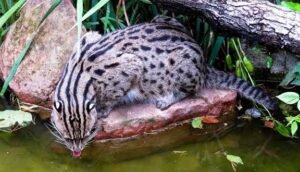
Highlights of Recent Scientific Findings
- Release: On February 22, 2026, the Kaziranga National Park and Tiger Reserve (KNPTR) released its first scientific assessment identifying the area as a critical global stronghold for the Fishing Cat (Prionailurus viverrinus).
- Population Discovery: The study identified at least 57 unique individuals within the reserve. This figure is notably high for a freshwater floodplain ecosystem, indicating that the park supports a dense and viable population of these small felids.
- Geographic Distribution: Researchers mapped the species across an area exceeding 450 square kilometres. The cats were found to be widely distributed, confirming they are common rather than rare within Kaziranga’s vast grassland-wetland complex.
- Methodology and Data Origins: The assessment primarily utilized “by-catch” data—images unintentionally captured by camera traps set during previous All India Tiger Estimation exercises. Because the trap grid was optimized for larger tigers, experts believe the 57-cat count is likely a conservative undercount.
- Ecological Sentinel Status: The thriving population serves as an ecological indicator of wetland health. In Assamese folklore, the cat is known as “Meseka”, a symbol of a balanced ecosystem and rich natural heritage.
- Specialized Habitat Preferences: The study highlighted that Fishing Cats in the reserve rely on wet alluvial grasslands, shallow beels (oxbow lakes), and woodland refugia. These specific habitats are vital for their survival during Kaziranga’s annual monsoon floods.
- Conservation Benchmark: This assessment provides a scientific baseline for monitoring the impact of climate change and altered river systems on freshwater biodiversity. It shifts the conservation narrative from “flagship” megafauna like rhinos to lesser-known specialists of the Brahmaputra floodplains.
The Fishing Cat: A Deep Ecological Analysis
- About: The Fishing Cat (Prionailurus viverrinus) is a medium-sized wild cat that represents one of nature’s most unique evolutionary adaptations. Unlike most felids, this species is a semi-aquatic specialist, uniquely engineered to thrive in the interface between land and water.
- Evolutionary Taxonomy: The Fishing Cat is a member of the Prionailurus lineage, which diverged approximately 4 million years ago. It is more closely related to the Leopard Cat and Flat-headed Cat than to the domestic cat. Its evolution is characterized by specialization in riparian corridors.
- Physical Morphology: This species exhibits a stocky, powerful build with short legs and a thick neck. Adults typically weigh between 5 kg and 16 kg. Their most striking feature is the double-layered fur: a short, dense, waterproof layer next to the skin and longer guard hairs that provide the distinctive spotted pattern used for camouflage.
- Aquatic Adaptations: Unlike most cats, Fishing Cats possess partially webbed paws on their front feet. Its primary function is to provide stability on muddy riverbanks. Their claws are semi-retractable, allowing them to act as serrated hooks for securing slippery aquatic prey.
- Geographic Range: The species is patchily distributed across South and Southeast Asia. Major strongholds include the Indo-Gangetic plains, the Brahmaputra valley, and coastal mangrove forests like the Sundarbans.
- They are also found in the Terai of Nepal and wetlands in Sri Lanka, though they are now likely extinct in parts of Vietnam and Java.
- Specialized Habitat: Fishing Cats are habitat specialists strictly tied to wetlands. They frequent marshes, reed beds, mangrove swamps, and tidal creeks. They are rarely found more than a few kilometers from a permanent water source, as their survival depends on the inter-tidal zones.
- Dietary Patterns: They are opportunistic carnivores. Scat studies reveal a diet consisting of 76% fish, but they also hunt amphibians, crustaceans, mollusks, and even small mammals. They have been observed taking down waterfowl by swimming underneath them and grabbing their legs.
- Hunting Techniques: Fishing Cats employ two main strategies: sit-and-wait and active flushing. They often sit at the water’s edge, using their paws to mimic insect ripples to lure fish. They are capable of diving completely underwater to pursue prey, a rare behavior among felids.
- Reproductive Cycle: Females reach sexual maturity at 15 months. The gestation period lasts roughly 63–70 days, resulting in a litter of 1–4 kittens. In the wild, birth peaks often coincide with the end of the monsoon season.
- Social Structure: They are primarily solitary and nocturnal. Males maintain large home ranges that overlap with several smaller female territories. Communication is maintained through scent marking and a unique vocalization—a low-pitched “chuckle” or “bark” that is distinct from the meows of other small cats.
- Conservation Status: The IUCN Red List classifies the Fishing Cat as Vulnerable.
- The most critical threat is habitat loss due to the conversion of wetlands into shrimp farms, agricultural land, and urban infrastructure.
- They also face threats from retaliatory killing by farmers and snare poaching.
- Legal Protection: In India, the Fishing Cat is a Schedule I species under the Wildlife Protection Act, 1972, granting it the highest level of legal protection. It is also listed under Appendix II of CITES, which regulates international trade to prevent the exploitation of its skin and meat.
Why Fishing Cat Conservation Matters?
- Sentinel of Ecosystem Health: As a habitat specialist, the Fishing Cat serves as a primary indicator species for wetland quality. Research shows its presence confirms low pollution and high biodiversity, as these cats depend on a stable piscivorous food web.
- Safeguarding Vanishing Wetlands: Wetlands are disappearing three times faster than forests, with over 23% of suitable habitat lost to urbanization between 2010 and 2020. Conserving the cat creates a mandate to protect mangroves and floodplains, which are vital for carbon sequestration.
- Biodiversity and Genetic Rarity: This felid is an Evolutionarily Distinct and Globally Endangered (EDGE) species. It possesses 93 morphological adaptations for a semi-aquatic life, including a double-layered waterproof coat, making it a unique branch of the feline tree.
- Climate Resilience and Protection: Wetlands act as “natural sponges” that trap pollutants and buffer against storm surges. In regions like the Sundarbans, fishing cat conservation helps maintain these bio-shields, protecting millions of people from the increasing frequency of cyclones and rising sea levels.
- Food and Economic Security: The cat’s habitat supports the global freshwater fish catch, of which the Ganges and Brahmaputra basins contribute significantly. Protecting these areas ensures fish nurseries remain intact, supporting the livelihoods of local communities and ensuring long-term food security.
|
Kaziranga National Park
|
|
Also Read: Palamu Tiger Reserve’s Vanjeevi Didi Initiative (VDI) |