




LGM‑30G Minuteman III Intercontinental Ballistic Missile
| General Studies Paper III: Defence Technology |
Why in News?
Recently, the United States conducted a successful routine test of the LGM‑30G Minuteman III intercontinental ballistic missile (ICBM) from Vandenberg Space Force Base, California to verify the system’s reliability and readiness as part of America’s nuclear deterrence program.
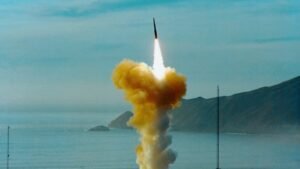
What is LGM‑30G Minuteman III Intercontinental Ballistic Missile (ICBM)?
- About: The LGM-30G Minuteman III is a land-based Intercontinental Ballistic Missile (ICBM) developed by the United States as part of its strategic nuclear forces.
- The term “Minuteman” refers to American colonial militia ready to fight at a minute’s notice.
- It represents the third and most advanced version of the Minuteman missile family and remains the only operational land-based ICBM in the U.S. arsenal today.
-
-
- It constitutes the land-based leg of the U.S. “nuclear triad”, which also includes submarine-launched ballistic missiles (SLBMs) and nuclear-capable strategic bombers.
-
- Development: The Minuteman missile program originated in the late 1950s during the Cold War, when the United States sought a fast-launch nuclear deterrent.
- The Minuteman III program began in 1966 as an improved successor to earlier variants.
-
-
- The first Minuteman III test occurred in August 1968, and it officially entered operational service in 1970, strengthening U.S. strategic deterrence.
-
- Minuteman Series: The Minuteman family includes three major variants: Minuteman I (1962), Minuteman II (1966), and Minuteman III (1970).
-
- Deployment: Currently, about 400 Minuteman III missiles are deployed across three major U.S. Air Force bases: F.E. Warren (Wyoming), Malmstrom (Montana), and Minot (North Dakota).
- It is operated by the United States Air Force.
- These missiles are housed in hardened silos connected to underground Launch Control Centers (LCCs) via survivable buried cables.
- Deployment: Currently, about 400 Minuteman III missiles are deployed across three major U.S. Air Force bases: F.E. Warren (Wyoming), Malmstrom (Montana), and Minot (North Dakota).
- Replacement: The United States plans to gradually replace Minuteman III with the next-generation LGM-35A Sentinel ICBM under the Ground-Based Strategic Deterrent (GBSD) program. However, Minuteman III may remain operational into the 2030s or beyond.
Features of LGM‑30G Minuteman III ICBM
- Physical Dimensions: Each missile stands approximately 18.2 metres (59.9 feet) tall with a diameter of 1.67 metres (5.5 feet). At launch, the missile weighs roughly 36,030 kilograms (79,432 pounds).
- Solid Propulsion System: The missile uses a three-stage solid-propellant rocket motor system, a major technological innovation when introduced. Each stage ignites sequentially and separates after fuel burnout.
- Intercontinental Range: Minuteman III can strike targets at a range exceeding 6,000 miles (about 9,600 km), enabling the United States to reach strategic targets across continents from its domestic missile bases.
- Hypersonic Speed: The missile reaches speeds of around 15,000 miles per hour (approximately Mach 23) during the boost phase. Such extreme velocity allows the missile to travel across continents in roughly 30 minutes.
- Advanced Guidance System: Navigation is managed by a NS50 missile guidance system, which uses an inertial measurement unit to guide the missile toward its pre-programmed coordinates. It does not rely on external signals like GPS.
- Multiple Re-entry Capability: Under the New START Treaty, it is currently deployed with a single nuclear warhead, typically the W78 or W87. Although it was the first ICBM capable of carrying Multiple Independently Targetable Reentry Vehicles (MIRV), current policy limits each missile to one reentry vehicle.
- High-Altitude Trajectory: After launch, the missile travels along a ballistic trajectory reaching altitudes of about 700 miles (1,120 km) before descending toward its target. This trajectory allows the warhead to travel through space before re-entering Earth’s atmosphere at extremely high speed.
ICBM Capabilities of Russia, China and India
- Russia’s RS-28 Sarmat: Russia’s most advanced intercontinental missile is the RS-28 Sarmat, a super-heavy silo-based ICBM developed by the Makeyev Rocket Design Bureau and inducted into service around 2023.
- Designed to replace the Soviet-era R-36M missiles, it has an estimated range of about 18,000 km, enabling global strike capability.
- The missile can carry multiple nuclear warheads or hypersonic glide vehicles such as Avangard, making it one of the most powerful strategic weapons.
- Russia maintains the largest and most diverse land-based ICBM force among nuclear powers, operated by the Strategic Rocket Forces.
- Missiles such as Sarmat, RS-24 Yars, and Topol-M form the backbone of its nuclear deterrence doctrine.
- China’s DF-41: China’s most sophisticated intercontinental missile is the DF-41 (Dongfeng-41), a three-stage solid-fuel, road-mobile ICBM.
- It has an estimated range of 12,000–15,000 km, allowing it to reach targets across continents.
- The missile can carry multiple independently targetable re-entry vehicles (MIRVs) and is designed to enhance China’s strategic nuclear deterrent.
- The People’s Liberation Army Rocket Force (PLARF) operates several long-range missiles including DF-31, DF-5 and DF-41, supporting China’s minimum credible deterrence doctrine.
- India’s Agni-V: India’s most advanced operational long-range missile is the Agni-V intercontinental ballistic missile, developed by the Defence Research and Development Organisation (DRDO).
- The missile has an estimated range of about 5,000–8,000 km, enabling India to reach targets across Asia and parts of Europe.
- It is road-mobile and canister-launched, allowing rapid deployment and improved survivability.
- India’s ICBM development is guided by its “credible minimum deterrence” and “No First Use” nuclear doctrine. Missiles like Agni-V strengthen India’s strategic strike capability and complement the country’s nuclear triad, which includes land-based missiles and submarine-launched ballistic missiles such as K-series systems.
What is the New START Treaty?
|
| Also Read: India Successfully Tests Agni-III Nuclear-Capable Missile |