




NCERT Class 8 Textbook Judiciary Controversy
|
General Studies Paper II: Education, Separation of Power, Indian Judiciary |
Why in News?
The National Council of Educational Research and Training (NCERT) has withdrawn its newly released Class 8 Social Science textbook after objections from the Supreme Court over a chapter referring to “corruption in the judiciary”.
What is NCERT Class 8 Textbook Judiciary Controversy?
- Background: The National Council of Educational Research and Training released a new Class 8 Social Science textbook titled Exploring Society: India and Beyond (Part-2) in February 2026, as part of the NEP 2020/NCF 2023 curriculum revision.
- A chapter on “The Role of Judiciary in Our Society” triggered controversy for discussing corruption and institutional challenges within the judiciary.
- Controversial Content: The textbook explicitly referred to “corruption at various levels of the judiciary” as one of the major challenges faced by the Indian judicial system, alongside structural issues affecting justice delivery and institutional efficiency.
-
-
- The chapter highlighted the massive backlog of pending cases including nearly 81,000 cases in the Supreme Court, over 62 lakh in High Courts, and about 4.7 crore cases in subordinate courts, indicating systemic delays in justice delivery.
- It attributed these issues to shortage of judges, complex legal procedures, and inadequate infrastructure, presenting them as administrative constraints affecting access to justice, especially for economically weaker sections.
- The text quoted remarks made in July 2025 by former Chief Justice B.R. Gavai, acknowledging instances of misconduct and stressing the need for transparency and accountability to rebuild public trust in judicial institutions.
-
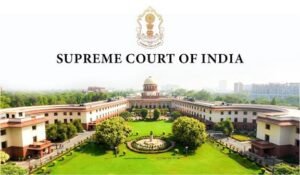
- Supreme Court’s Order: On 25 February 2026, the Supreme Court of India took suo motu cognisance of the matter, expressing concern that such content in school curriculum could undermine institutional credibility among young students.
-
-
- The Court observed that the choice of words in the foundational curriculum might demean the dignity and authority of the judiciary, potentially eroding public confidence in constitutional bodies.
- Subsequently, the Court ordered an immediate ban on printing, publication, and digital dissemination of the textbook containing the contentious section.
- Authorities were directed to seize all physical copies and remove soft copies from circulation, ensuring the disputed content did not remain accessible in the academic ecosystem.
- A show-cause notice was issued to the NCERT Director and the Department of School Education, asking why proceedings under the Contempt of Courts Act should not be initiated.
-
- NCERT’s Response: Following the court’s sharp rebuke, NCERT immediately pulled the textbook from its website and halted all sales.
- The council issued an official apology, characterizing the inclusion of the controversial material as an “error of judgement” and “purely unintentional“.
- NCERT has since committed to rewriting the chapter in consultation with appropriate authorities for the 2026-27 academic session.
Constitutional Balance Between Educational Freedom and Institutional Accountability
- Article 19(1)(a) Foundations: Educational freedom is an extension of the Right to Freedom of Speech. It allows scholars to critique state organs, provided such discourse does not violate “reasonable restrictions” under Article 19(2), such as contempt of court.
- Separation of Powers: This doctrine prevents the Executive—which often controls curricula—from using education to delegitimize the Judiciary or Legislature. It maintains a functional equilibrium between state organs through mutual respect.
- Institutional Integrity: While institutions must remain accountable, the Constitution protects their reputational integrity. Academic work must offer “fair comment” rather than “scandalising” the court or eroding public confidence.
- Right to Know: Citizens possess a fundamental Right to Know about institutional functioning. Textbooks fulfill this by providing data-driven insights into systemic challenges, serving as a passive accountability mechanism.
- Judicial Review: The Supreme Court exercises Judicial Review over educational policies. This ensures that academic autonomy does not infringe upon constitutional morality or misrepresent the legal framework to students.
- Pedagogical Responsibility: Jurisprudence distinguishes between adult discourse and school curricula. The state prioritizes protecting “tender minds” from biased misconceptions, ensuring complex institutional failures are presented with proper context.
- Article 51A Duties: Under Article 51A(a), citizens have a Fundamental Duty to respect the Constitution. Educational freedom is thus guided by the need for reformative and constructive critique rather than destructive disparagement.
- Factual Authenticity: Academic freedom is anchored in intellectual honesty. The use of unverified or selective data is viewed as an abuse of freedom, requiring rigorous cross-verification with the concerned institutions.
- External Accountability: Educational freedom serves as an external check on power. It creates a public record of institutional performance, driving reform through informed analysis without bypassing formal legal safeguards.
- Regulated Autonomy: Bodies like NCERT enjoy administrative autonomy, but this is exercised “within the law.” State regulation ensures that education serves the public interest and adheres to principles of justice.
|
Recent NCERT Textbook Revisions
|
|
Also Read: No Detention Policy |