



Nepal General Election 2026
| General Studies Paper II: Effect of Policies & Politics of Countries on India’s Interests |
Why in News?
The 2026 general election in Nepal is being held on 5 March 2026 to elect 275 members of the House of Representatives, the country’s lower parliament. The election was called after major youth-led protests in 2025 forced the previous government to resign.
Highlights of the 2026 Nepal General Election
-
- Election Date: The 2026 Nepal General Election is being held on 5 March 2026 to elect members of the House of Representatives.
- The early election was announced after the September 2025 youth-led protests that forced the resignation of Prime Minister K.P. Sharma Oli, triggering political transition.
- Seats: A total of 275 seats are contested in the election. Among them some members are elected through First-Past-The-Post (FPTP) from single-member constituencies, while some are filled through proportional representation (PR) using nationwide party lists.
- Voters: The Election Commission of Nepal registered 18,903,689 eligible voters for the 2026 election. The electorate includes approximately 9.66 million male voters, 9.24 million female voters, and around 200 voters categorized as “others.” More than one million new voters, mostly young citizens, were added after the 2025 protests.
- Political Parties: The election features candidates from about 68 political parties along with independent contenders. Over 3,400 candidates are competing for seats.
- Key parties contesting the election include the Nepali Congress (NC), Communist Party of Nepal–Unified Marxist Leninist (CPN-UML), Communist Party of Nepal–Maoist Centre, Rastriya Swatantra Party (RSP), Rastriya Prajatantra Party (RPP), Janamat Party, and People’s Socialist Party (Nepal).
- A major feature of the 2026 election is the rise of the Rastriya Swatantra Party led by Balendra “Balen” Shah, a former rapper and Kathmandu mayor.
- Former Prime Minister K.P. Sharma Oli leads the CPN-UML, framing the election as a referendum on national stability.
- The Rastriya Prajatantra Party (RPP), led by Rajendra Lingden, has campaigned on a platform of restoring the constitutional monarchy and a Hindu state.
- Campaign: Election campaigns focused heavily on anti-corruption reforms, youth employment, governance accountability, and economic recovery. The campaign period saw active rallies, digital outreach, and youth mobilisation.
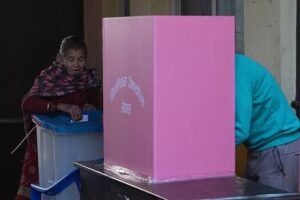
- Voting Process: Voting is conducted across over 23,000 polling stations nationwide, with voters casting two separate ballots—one for constituency candidates and another for proportional party lists.
- Security Arrangements: To prevent a recurrence of violence, the government deployed over 320,000 security personnel, including the Nepal Army and 149,000 temporary “election police”.
- Election Date: The 2026 Nepal General Election is being held on 5 March 2026 to elect members of the House of Representatives.
- India’s Role: India supplied around 650 vehicles of various sizes, including 4×4 double-cab pickups and trucks, to assist with election logistics in challenging terrain.
-
- Security forces, including India’s Sashastra Seema Bal (SSB) and the Armed Police Force (APF) of Nepal, conducted joint patrols and enhanced surveillance to prevent illegal activities.
- Result Announcement: Vote counting began soon after polling closed. The Election Commission will announce FPTP results within 24 hours, while the more complex PR seat allocations were expected to take between one and two days.
Electoral System and Structure of Nepal’s Parliament
- Parliamentary System: Nepal follows a federal democratic republican system established under the 2015 Constitution of Nepal. The country’s federal parliament consists of two houses—the House of Representatives (lower house) and the National Assembly (upper house). Legislative power at the federal level is exercised by this bicameral parliament along with the President.
- House of Representatives (Pratinidhi Sabha): The House of Representatives is the lower and more powerful chamber of Nepal’s Federal Parliament. It consists of 275 members, elected for a five-year term unless dissolved earlier. This house forms the government, approves the budget, and holds the executive accountable through parliamentary oversight.
- National Assembly (Rastriya Sabha): The National Assembly functions as the upper house of Nepal’s parliament and has 59 members. Members serve six-year staggered terms, with one-third retiring every two years. The assembly reviews legislation passed by the lower house and represents provincial interests in the federal system.
- Mixed Electoral System: Nepal uses a mixed electoral system combining First-Past-the-Post (FPTP) and Proportional Representation (PR). This hybrid system aims to balance direct constituency representation with inclusive proportional representation of political parties and marginalized groups.
- First-Past-the-Post (FPTP) Seats: Out of the 275 seats, 165 members are elected through the FPTP system from single-member constituencies. In this system, the candidate receiving the highest number of votes in a constituency wins the seat, even without securing an absolute majority.
- Proportional Representation (PR) Seats: The remaining 110 seats are filled through nationwide proportional representation based on party lists submitted before the election. Seats are allocated according to the percentage of votes received by each party, ensuring broader political representation.
- Electoral Threshold Requirement: Political parties must secure at least 3% of the total valid proportional votes nationwide to qualify for PR seats. This electoral threshold prevents excessive fragmentation in parliament while encouraging stable party competition.
- Inclusive Representation Rules: Nepal’s electoral system mandates inclusive representation for marginalized groups. Party lists for proportional seats must include women, Dalits, indigenous nationalities, Madhesis, Tharus, Muslims, and backward regions, promoting social inclusion and diversity in parliament.
- Gender Representation Requirement: The constitution requires that at least 33% of the total members of the Federal Parliament must be women. Political parties must adjust their proportional lists to ensure that this constitutional requirement is fulfilled after election results are finalized.
- Election Commission of Nepal: The Election Commission of Nepal (ECN) is the constitutional body responsible for conducting elections, registering political parties, managing voter lists, and supervising the counting process.
- Voting Process: All Nepalese citizens aged 18 years and above are eligible to vote. During elections, voters cast two separate ballots—one for their constituency candidate (FPTP) and another for their preferred political party (PR list).
- Government Formation Mechanism: After elections, the party or coalition securing a majority of seats (at least 138 out of 275) in the House of Representatives forms the government. The Prime Minister is appointed by the President of Nepal from the majority party or coalition leader.
Geopolitical Importance of 2026 Nepal Election
- Foreign Policy Balance: The 2026 Nepal General Election is crucial for determining Nepal’s foreign policy orientation between India and China. Nepal traditionally follows a balanced diplomacy with both neighbors. The election outcome could influence how Kathmandu manages strategic partnerships, infrastructure projects, and political engagement with these two regional powers.
- India–Nepal Economic Connectivity: The election holds major importance for India–Nepal economic cooperation, as India remains Nepal’s largest trade partner and key transit route for global trade. More than two-thirds of Nepal’s merchandise trade and most petroleum supplies come through India. The new government will therefore shape policies on cross-border trade and connectivity projects linking the two countries.
- Himalayan Region: Nepal’s political direction is closely watched because the country lies in the strategically sensitive Himalayan corridor. Global observers view the election as part of a broader India–China geopolitical competition, where infrastructure investments, connectivity initiatives, and political influence are increasing.
- Security: Nepal shares an open and largely unrestricted border with India, allowing free movement of people and goods. The election therefore has implications for border management, security cooperation, and migration flows between the two countries. A stable government in Kathmandu is important for maintaining peaceful cross-border relations.
- Connectivity Projects: The election outcome will also influence Nepal’s participation in regional connectivity initiatives, including transport corridors, rail links, hydropower trade, and tourism networks with neighboring countries. Policies adopted by the new government could determine the pace of South Asian economic integration and infrastructure development.
| Also Read: Political Crisis in Nepal |