



New Proposed Global Power Group CORE FIVE
|
General Studies Paper II: Groupings & Agreements Involving India and/or Affecting India’s Interests |
Why in News?
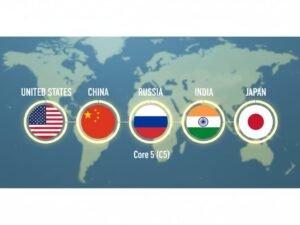
According to the American website POLITICO, US President Donald Trump is reportedly considering a new elite global forum named “Core Five (C5)”. This proposed group would include the United States, Russia, China, India and Japan, while reducing the influence of Europe-centric G7.
Core Five (C5) Bloc: A Proposed Shift in Global Power Architecture
-
- About: The Core Five, also referred to as the C5 Bloc, is a proposed informal grouping of major global powers. Reports about the proposal surfaced in early December 2025. The concept reflects a belief that global decision making should be led by states with real strategic influence. The proposal signals dissatisfaction with older institutions that are seen as slow and regionally skewed.
- Trace: The notion appears in reporting about a longer version of the U.S. 2025 National Security Strategy. The public NSS was published on 4 December 2025 while fuller drafts were reviewed by the media.
- Member Countries: The proposed grouping would include the United States, China, Russia, India, and Japan. Each of these states holds strategic weight by population economy or military.
- Objectives: The primary aim of the C5 Bloc is strategic coordination among dominant powers. It seeks faster consultation on global crises. It aims to manage conflict escalation through direct dialogue. The first agenda item reportedly would focus on Middle East security and possible normalisation between Israel and Saudi Arabia.
Reasons Behind the Proposed C5 Bloc
- Compact Forum for Great Powers: Policymakers want a smaller forum to discuss urgent global crises. They believe five heavyweight states can act faster than larger clubs. The idea surfaced around the 2025 National Security Strategy release on 4 December 2025.
- Emerging Multipolar Reality: Officials see the world as less Western centric by the mid 2020s. They want a grouping that mirrors actual power distribution. They argue the C5 would recognise political and military weight over older criteria like shared wealth or liberal norms.
- Manage Security Issues Directly: Leaders aim to use the forum to address immediate security flashpoints. Reported early agendas include Middle East deconfliction and great power arms concerns. A compact format could allow direct leader engagement on matters that might otherwise escalate.
- Reconfigure Economic & Technological Cooperation: Policymakers seek to coordinate on trade chokepoints and critical technology. They worry about supply chain risks in minerals, semiconductors and AI in 2025 and beyond. New industrial coalitions in December 2025 show the priority given to tech security.
- Strategic Rebalancing Away from Europe: The proposal aims to reduce the dominance of Europe centred forums. Washington’s strategy papers in December 2025 shift rhetorical focus from Europe to great power management. European capitals have publicly expressed alarm at the potential sidelining of the G7 and NATO partners.
Significance of Proposed C5 Countries
- United States: The United States has an estimated population of about 335 million people in 2025. This population supports a large labour force and a strong consumer market. The U.S. economy remains the largest in the world with a nominal GDP above $30 trillion in 2025, according to IMF and World Economic Outlook estimates. This high economic output comes from services technology manufacturing and finance sectors. The U.S. presence in the proposed C5 adds global financial and military influence that shapes world outcomes.
- China: China’s population stands near 1.40 billion as of 2024, making it one of the most populous countries globally. In 2025 China’s estimated nominal GDP is about $19.2 trillion, placing it second only to the United States in total economic output. China also stands as the largest economy when measured by purchasing power parity (PPP) with over $39 trillion in GDP (PPP) in 2025. The combination of a vast population and massive economy makes China a central actor in any global strategic forum.
- India: India’s population is around 1.46 billion in 2025, making it the world’s most populous country. India’s large workforce and expanding middle class fuel economic growth. In 2025 India’s nominal GDP is estimated at about $4.19 trillion, positioning it among the top five global economies. The International Monetary Fund projects India will remain one of the fastest growing major economies with growth rates above 6 % in 2025 and 2026. This growth trajectory enhances India’s strategic importance in global decision making.
- Japan: Japan’s population is around 124 million people, although it faces aging demographic trends that slow growth. Despite this, Japan sustains a highly advanced and diversified economy. In 2025 Japan’s nominal GDP is about $4.18 trillion, roughly equal to India’s output but with far higher per capita productivity. Japan also leads in technology, automotive and industrial sectors. Japan’s economic strength and innovation capacity bring stability and expertise to a grouping such as the C5.
- Russia: Russia’s population is approximately 143 million people, making it a mid-sized power demographically. Russia’s economy is smaller compared to the other C5 members with a nominal GDP estimated around $2.5 trillion in 2026 projections, but it remains significant due to energy exports and military capabilities. Russia’s role in global energy supply particularly oil and gas gives it leverage in global markets and diplomatic negotiations.
Challenges Facing the Proposed C5 Bloc
- Strategic Rivalries: The biggest challenge to the C5 Bloc is the presence of unresolved rivalries among its proposed members. The United States and China remain locked in strategic competition over trade technology Taiwan and influence in the Indo Pacific since 2018. India and China still face border tensions following clashes along the Line of Actual Control since 2020. Russia and the United States continue to experience strained relations due to sanctions imposed after the Ukraine conflict that escalated in 2022. These disputes reduce trust and make consensus difficult.
- Absence of Shared Political Values: The C5 brings together countries with very different political systems. The United States and India function as electoral democracies. China follows a single party socialist system. Russia operates under a centralized power structure. Japan is a constitutional monarchy with a parliamentary system. These differences affect views on human rights, sovereignty, rule of law and global norms. Past multilateral forums show that value divergence slows decision making.
- Marginalisation of Existing Global Institutions: The formation of a C5 risks weakening established global platforms like the G7, G20, and United Nations. The G20 already represents major economies and accounts for over 85 percent of global GDP as of 2024. Creating a parallel elite forum may reduce the legitimacy of inclusive institutions. Smaller and middle powers may feel excluded from global decision making. This perception can lead to resistance and reduced cooperation.
- Resistance from Partner Countries: Traditional allies of the United States especially in Europe may view the C5 as a strategic downgrade. European economies like Germany, France and the United Kingdom have historically shaped global rules through the G7. Exclusion from a new core forum may trigger diplomatic pushback. Similarly countries in Southeast Asia Africa and Latin America may fear concentration of power.
|
Also Read: BRICS Summit 2025 |