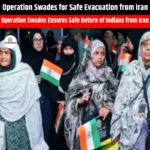
Operation Swades for Safe Evacuation from Iran
|
General Studies Paper II: Government policies and interventions, Humanitarian Assistance |
Why in News?
India has launched Operation Swades to bring back Indian citizens from Iran amid rising unrest and safety concerns in the country. The government is prioritizing the protection and safe return of its nationals, including students, professionals and others, as the situation evolves.

What is Operation Swades?
- About: Operation Swades is a humanitarian evacuation mission launched by the Government of India in January 2026 to bring back Indian citizens from Iran amid rising instability and safety concerns. The first special flight departing Tehran landed in New Delhi as part of this mission.
- Reason: Operation Swades was launched because of growing safety threats to Indians in Iran, where violent protests and instability put lives at risk.
-
-
- According to the Human Rights Activists News Agency (HRANA), the death toll related to the anti-government protests in Iran has reached at least 2,677, with an additional 1,693 cases still under investigation.
-
- Approximately 12,000 Indian citizens live in Iran, of whom around 10,000 are believed to be present and potentially seeking evacuation amid the unrest; these include students, professionals, businesspeople and tourists.
-
-
- The U.S. administration warned Iran of “grave consequences” and military action if mass executions of protesters proceeded. Such volatile military dynamics made the situation more precarious for foreign citizens living in Iran.
-
- Objectives: The primary objectives of Operation Swades are:
-
-
- Safe evacuation and repatriation of Indian citizens from Iran.
- Ensuring continuous communication and support via Indian embassies and helpline services.
- Coordinated movement out of high-risk zones to secure points for onward travel.
- Protection of vulnerable groups such as students and healthcare professionals.
- Coordination: The operation is executed by the Ministry of External Affairs in conjunction with the Indian Embassy in Tehran and other international partners as needed. The MEA has also coordinated travel advisories and emergency contact support to ensure all Indian nationals know how to reach assistance quickly.
-
- Evacuation: The Indian Embassy in Tehran has issued advisories encouraging citizens to keep essential documents ready and maintain contact with the Embassy; helpline numbers and e-mail contacts were disseminated to assist Indians in distress. Evacuation typically follows coordinated routes depending on security conditions: Direct air evacuations from Tehran when airspace and safety permit or via third countries or land borders (e.g., Armenia) when direct routes are restricted.
Reasons for the Unrest in Iran
- Severe Economic Crisis: A primary driver of the unrest has been Iran’s deepening economic crisis, marked by a sharp depreciation of the Iranian rial to historic lows, a collapse of purchasing power, and inflation exceeding 40-50 percent, with essential goods like food and medicine becoming unaffordable for many households.
- Impact of International Sanctions: Long-standing international sanctions, particularly those targeting Iran’s oil exports and financial transactions, have significantly reduced state revenues and foreign exchange reserves. These sanctions, re-imposed or intensified due to nuclear and regional security concerns, have compounded economic stagnation.
- Wage Decline: Parallel to inflation, real wages in Iran have plummeted as incomes failed to keep pace with surging prices. Workers faced unpaid or delayed salaries, declining purchasing power, and job insecurity, prompting strikes and demonstrations by labour groups, trade unions, and bazaari merchants.
- Political Discontent: While economic grievances were the immediate trigger, protests rapidly evolved into broader political dissent. Demonstrators voiced frustration with the ruling clerical establishment and called for systemic reforms, greater freedoms, and accountability.
India’s Earlier Successful Evacuation from Iran
- Operation Sindhu was a major humanitarian evacuation mission launched by the Government of India on 18 June 2025 to safely bring back Indian nationals from conflict‑hit Iran and Israel amid escalating hostilities between the two countries.
- The core objective of Operation Sindhu was to ensure the swift and secure repatriation of Indian citizens at risk due to conflict escalation. This involved diplomatic outreach, coordination with neighbouring transit countries such as Armenia and Turkmenistan.
- The first successful evacuation under Operation Sindhu saw 110 Indian students carried out of northern Iran to Yerevan, Armenia, from where they were flown to New Delhi on 18–19 June 2025.
- By late June 2025, over 4,415 Indian nationals were evacuated — including 3,597 from Iran and 818 from Israel — through 19 special evacuation flights, including operations using IAF C‑17 aircrafts and commercial charters. The missions brought home more than 1,500 women and 500 children.
Major Evacuation and Humanitarian Operations Carried out by India:
|
Operation Name |
Year |
Objective |
|
Operation Sukoon |
2006 |
Evacuation of Indian, Nepalese, Sri Lankan and some Lebanese nationals during the Lebanon War. |
|
Operation Safe Homecoming |
2011 |
Evacuation of Indian nationals from Libya amid civil war. |
|
Operation Maitri |
2015 |
Rescue, relief and evacuation following the Nepal earthquake; brought home thousands of Indians and assisted foreigners. |
|
Operation Raahat |
2015 |
Evacuation of Indian citizens and foreign nationals from Yemen during the crisis involving Houthi rebels. |
|
Operation Sankat Mochan |
2016 |
Evacuation of Indians and others from South Sudan during the civil war. |
|
Operation Samudra Setu |
2020 |
Naval evacuation of Indian citizens from Gulf and island nations amid the COVID‑19 pandemic. |
|
Operation Devi Shakti |
2021 |
Emergency evacuation of Indian nationals and at‑risk Afghan civilians after the fall of Kabul. |
|
Operation Ganga |
2,022 |
Evacuation of over 18,000 Indian citizens (mostly students) from Ukraine during the Russia‑Ukraine conflict. |
|
Operation Dost |
2023 |
Humanitarian response to the Turkey‑Syria earthquake with rescue teams and aid. |
|
Operation Kaveri |
2023 |
Evacuation of Indian citizens and some foreign nationals from Sudan amid intense civil conflict. |
|
Operation Ajay |
2023 |
Evacuation mission for Indian nationals from Israel during heightened conflict in the region. |
|
Operation Indravati |
2024 |
Evacuation of Indian nationals from Haiti during gang violence and civil instability. |
|
Operation Sagar Bandhu |
2025 |
Humanitarian relief and evacuation from Sri Lanka after Cyclone Ditwah, including search, rescue, relief supplies and evacuation of stranded Indians |
|
Also Read: Operation Aaghat 3.0 |