



Rajasthan Budget 2026-27
|
General Studies Paper III: Government Policies & Interventions |
Why in News?
Recently, Rajasthan Budget 2026-27 was presented on 11 February 2026 by Deputy Chief Minister & Finance Minister Diya Kumari in the Rajasthan Legislative Assembly, focusing on infrastructure, social welfare and economic growth.
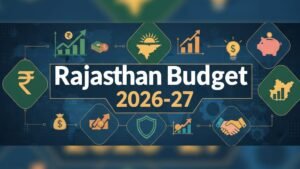
Key Highlights of Rajasthan Budget 2026-27
- Fiscal Indicators:
- Total Budget Size: ₹6,10,956 crore.
- Projected Revenue Receipts: ₹3,25,740 crore 14 lakh.
- Projected Revenue Expenditure: ₹3,50,054 crore 7 lakh.
- Projected Revenue Deficit: ₹24,313 crore 93 lakh.
- Projected Fiscal Deficit: ₹79,492 crore 52 lakh (representing 3.69% of GSDP).
- GSDP Growth: The Gross State Domestic Product has risen to ₹21,52,100 crore for the 2026-27 period.
- The government has set 10 key developmental resolutions/pillars to achieve Viksit Rajasthan @ 2047:
First Pillar: Infrastructure Expansion
-
- Road Infrastructure:
- Allocation of ₹1,800 crore for the building, repairing, and improvement of State Highways, Flyovers, Elevated Roads, Bridges, ROBs, and RUBs.
- Provisions of ₹1,400 crore for Non-Patchable Roads and ₹600 crore for Missing Link Roads.
- Development of 250 Atal Pragati Paths with an outlay of ₹500 crore.
- Investment of ₹400 crore to create approach roads for logistic parks and industrial zones.
- Dedicated expenditure of ₹500 crore for general road repairs.
- Investment exceeding ₹920 crore for the construction of ROBs/RUBs.
- Upgrading over 1,000 km of roads to State Highways and more than 2,000 km to Main District Roads (MDR).
- Allocating more than ₹2,700 crore for developing 500 km of State Highways.
- Deployment of an Intelligent Traffic Management System (ITMS) featuring 2,000 cameras with a ₹100 crore budget.
- Drinking Water:
- Expenditure surpassing ₹5,000 crore for drinking water infrastructure under the Mukhyamantri Jal Jeevan Mission (Urban).
- Provision of 3 lakh water connections via the AMRUT 2.0 initiative.
- Allocation of ₹650 crore for a new Transmission Line (TM-II) connecting Surajpura to Chaksu.
- Installation of 1,200 handpumps and 600 tubewells.
- Budget of ₹10 crore for a Centre of Excellence.
- Founding of the Bureau of Water Use Efficiency.
- Introduction of the Rajasthan State Water Policy.
- Energy:
- Establishment of one hundred ten 33 KV GSS, thirteen 132 KV GSS, and six 220 KV GSS.
- Creation of Solar Parks in Jaisalmer and Bikaner with a capacity of 4,830 MW.
Second Pillar: Improving Civic Amenities & Quality of Life
- Installation of 7 lakh Street Lights across the state.
- Allocation of ₹150 crore for the Panchgaurav Yojana for district-level infrastructure.
- Introduction of the RAJ-SETU (Rajasthan Structured Enabler for Transformative Urban and Infrastructure Financing) Fund.
Third Pillar: Investment Promotion & Industrial Development
- Infrastructure development and land aggregation for industrial sectors.
- Budget of ₹350 crore for Plug and Play Facilities for Micro and Small Enterprises at the division level.
- Development of Multi-Modal Logistic Hubs and Inland Container Depots (ICD).
- Addition of 14 new chapters to the Rajasthan Foundation.
- Allocation of ₹15 crore for Small and Micro units under the Rajasthan ODOP Policy, 2024.
Fourth Pillar: Human Resource Development
-
- Youth Welfare and Development:
- Release of the ‘Skill Policy’, ‘Youth Policy’, and ‘Employment Policy’. The state has fulfilled over 1 lakh government appointments and generated over 2 lakh private sector opportunities toward the goal of 4 lakh jobs. Currently, 1.43 lakh posts are being recruited, with a calendar issued for 1 lakh additional posts.
- Mukhyamantri Yuva Swarozgar Yojana: ₹1,000 crore for interest subsidies on loans for 1 lakh youth.
- Formation of the Rajasthan State Testing Agency (RSTA).
- Launching the VIBRANT (Value-driven Innovation and Business Research for Aspiration and Nurturing Talent) startup program.
- Establishing Rani Laxmi Bai Centres in 150 colleges for 25,000 female students.
- DREAM Programme: Digital mentoring and career guidance for 50,000 college students.
- Raj-SAVERA: A statewide awareness and rehabilitation program against drugs.
- Opening an Institute of Skill Development and Vocational Training in every district.
- iStart Ambassador Programme for mentorship of new startups.
- Budget of ₹30 crore for 3 Next Generation Technology Techno Hubs.
- Financial aid of ₹20,000 via e-vouchers for students in grades 8, 10, and 12.
- Cycle e-vouchers for underprivileged girls in grade 9.
- DBT of ₹250 crore for free uniforms for 40 lakh students (Classes 1-8).
- Ensuring toilet facilities for girls in every school.
- Budget of ₹550 crore for repairing 2,500+ schools.
- Raj PAHAL Programme: A “School on Wheels” for every district.
- AI Personalised Learning Labs in 1,000 schools.
- Upgrading 400 schools to CM-RISE standards with a ₹1,000 crore budget.
- Allocation of ₹50 crore for ‘Khelo Rajasthan Youth Games’ at all levels.
- Medical and Health:
- RAJ-SURAKSHA Scheme for urgent accident response and stabilization.
- Raj-MAMTA Programme for mental health with cells at district headquarters.
- ₹75 crore for a 500-bed IPD Tower at JK Lone Hospital, Jaipur.
- Establishment of 500 new Drug Distribution Counters.
- Budget of ₹500 crore for modern rest houses at medical colleges in Jaipur, Jodhpur, Ajmer, Kota, Udaipur, and Bikaner.
- ₹100 crore for Atal Arogya Food Courts.
Fifth Pillar: Strengthening Social Security
- ₹100 crore for Rural Women BPOs at the district level.
- Mukhyamantri Lakhpati Didi Rin Yojana: Loan limit raised to ₹1.5 lakh.
- ₹20 crore for 50 new Enterprises.
- Opening ‘Raj Sakhi Stores’ at the division level.
- Establishing Entrepreneurship and Capacity Building Centres in all districts.
- Mukhyamantri Nari Shakti Udyam Protsahan Yojana: Loan limit increased to ₹1 crore for women/SHGs.
- ₹500 crore for 11,000 Amrit Poshan Vatikas.
- Introduction of the ‘Rajasthan State Early Childhood Care, Development and Education Policy’.
- Converting 7,500 Anganwadis into Nandghars.
- Expansion of ‘Kishori Balika Yojna’ to all 27 aspirational blocks, benefiting 50,000+ girls.
- Shram-Setu Mobile App for labor employment and welfare.
Sixth Pillar: Tourism, Art, and Cultural Heritage
- Developing an Ultra-luxury Special Tourism Zone (STZ) in Khuri, Jaisalmer.
- Creating a Tourist Facilitation Centre in Kuldhara.
- ₹100 crore for the Advanced Braj Convention Centre in Bharatpur.
- Shekhawati Haweli Conservation Scheme: ₹200 crore over two years for the restoration of 660+ Hawelis in Churu, Sikar, and Jhunjhunu.
- Formation of the ‘Thar Cultural Circuit’ (Jaisalmer, Bikaner, Jodhpur, Jalore, Barmer).
- Establishing a War Museum in Jhunjhunu.
Seventh Pillar: Good Governance and Digital Transformation
- Implementing Next Generation Citizen Service Reforms.
- Phased rollout of Smart Service Centres in all urban bodies.
- Providing 100 key services via WhatsApp.
- Empowering 25,000 youth and women as ‘Mini e-Mitras’.
- Issuing new IT, Geo-Spatial, and Digital Infrastructure Facilitation Policies.
- Establishing CM PRAMAN as a dedicated policy strategy unit.
- Rajasthan Jan Vishwas Adhiniyam 2.0 reforms.
- Introduction of a Drone Policy and a State Drone Cell.
- Creation of the ‘Marudhara Rajbhoomi Digital Atlas’.
- Centralised Quality Control Labs for construction works.
- Establishing a De-regulation Cell and Business Reforms 2.0.
- Founding the Rajasthan Cyber Crime Control Centre (R4C).
- ‘Salary Account Package’ for government employees.
- Phased rollout of ‘Mukhyamantri Shishu-Vatsalya Sadan’.
- Introduction of State Panchayat Awards.
Eighth Pillar: Agricultural Development and Farmers’ Welfare
- Agricultural:
-
- Over ₹11,300 crore for state irrigation facilities.
- ₹1,500 crore for 50,000 Solar Pumps.
- ₹160 crore subsidy for farm equipment (Power Tillers, Cultivators, etc.) for 50,000 farmers.
- ₹96 crore for 500 Custom Hiring Centres.
- Free Napier Grass for 5,000 farmers.
- Establishing an Agri Stack PMU for data-driven farming support.
- Knowledge Enhancement visits for 3,300 farmers.
- Subsidy for 5,000 farmers for vertical support system agriculture.
- Subsidy for 500 Solar Crop Dryers.
- Mission Raj GIFT for unique agro-processed products.
- ₹20 crore for 100 godowns (250 MT and 500 MT capacities).
- Hosting a National Level Spice Conclave.
- Centres of Excellence: Onion/Veg (Alwar), Kinnow (Sriganganagar), Mango (Banswara).
- Organic Food Markets in Udaipur, Kota, and Jodhpur.
- New Agri-mandis in Dausa, Banswara, Sriganganagar, and vegetable mandis in Bharatpur and Sawai Madhopur.
- Upahar Vikray Kendras in all districts.
- Animal Husbandry and Dairy:
- 200 new Veterinary Sub Centres.
- Upgrading 25 sub-centres to hospitals and 50 hospitals to First Class status.
- Doubling the Dairy Infrastructure Development Fund to ₹2,000 crore.
- ₹100 crore for Saras Outlets in UP, MP, and NCR.
- ₹700 crore subsidy for 5 lakh farmers under Mukhyamantri Dugdh Utpadak Sambal Yojana.
- 1,000 Milk Collection Centres in rural regions.
- ₹200 crore for a 3 lakh liter/day processing plant in Alwar.
- Allocation of 500 Dairy Booths.
- Training 1 lakh farmers in value-added milk products.
- Poultry Feed Unit in Ajmer.
Ninth Pillar: Green Growth and Environmental Sustainability
- Mission ‘Hariyalo-Rajasthan’: Planting 10 crore trees.
- Namo-Nurseries and Namo Vans at various administrative levels.
- ₹32 crore for ‘Oxyzones’ in 16 districts (including Jaipur, Ajmer, Bikaner).
- ₹31 crore for Khumbha Biological Park in Chittorgarh.
- Project PRITHWI: ₹1,500 crore for wildlife conservation.
- MJSA 2.0 (Phase III): ₹2,500 crore for water harvesting in 5,000 villages.
- Establishing a 1,000-hectare Land Bank.
- Wild Animal Treatment Centres in Jaipur, Kota, Bundi, Udaipur, Alwar, and Sawai Madhopur.
- Avian Disease Centres in Bharatpur, Sambhar, and Kuchaman.
- New Eco and Nature Parks in Bhilwara and Tonk.
- ₹25 crore for 291 Wildlife Ambulances and Rapid Mobility Teams.
- Centre of Excellence for Natural Farming in Jobner.
- Bio Gas Plants in Jodhpur and Jaipur.
- Air quality early warning systems in Jodhpur.
- ₹20 crore for Air Quality Monitoring Stations in Bharatpur and Alwar regions.
- Noise Monitoring Stations in major cities (Jaipur, Ajmer, Bikaner, etc.).
- Green School Programme in every district.
- Carbon Credit Pilot Project for farmers.
- ₹1,000 crore for Common Effluent Treatment Plants (CETPs) (Balotra, etc.).
- Issuing a Solid Waste Management Policy for urban bodies.
Tenth Pillar: Achieving a $4.3 Trillion Economy by 2047
- 7.59% increase in the agriculture budget provision.
- Enhancing investment through new policies in MSME, Export Promotion, and Logistics.
- Single Window 2.0 with a single digital track for permissions.
- Energy Transition Skilling Cluster for renewable energy and EV sectors.
- RIPS (Rajasthan Investment Promotion Scheme): Full digitalization of incentives and Payroll subsidy options for the Textile Industry.
- Inclusion of integrated solar cell manufacturing and container manufacturing as thrust sectors under RIPS-2024.
|
Also Read: Union Budget 2026-27 |