




Repo Rate Remains Unchanged at 5.25%
|
General Studies Paper II: Fiscal Policy, Inclusive Development |
Why in News?
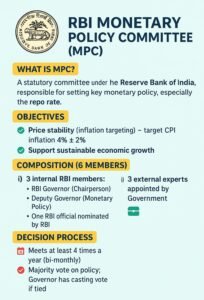
The RBI’s Monetary Policy Committee (MPC) unanimously voted to keep the repo rate unchanged at 5.25% during its final meeting of the 2025-26 fiscal year on February 6, 2026, continuing a neutral stance to balance growth and inflation.

What is Repo Rate?
- About: Repo rate is the interest rate at which the central bank lends short-term funds to commercial banks using government securities as collateral. This is the interest rate at which the Reserve Bank of India (RBI) supplies funds to banks during cash shortages under repurchase agreements.
- Working: When commercial banks need money, they sell approved government securities to the RBI and agree to repurchase them later. The interest charged on this transaction is the repo rate. This is a core tool of the RBI’s Liquidity Adjustment Facility (LAF).
- Role: The repo rate is a primary instrument of monetary policy used by the RBI to influence credit conditions and the overall money supply in the economy. By adjusting the repo rate, the RBI can either tighten or ease liquidity. This mechanism helps control inflation and support economic growth.
- Impact: When the RBI raises the repo rate, it increases the cost of borrowing for banks, leading them to charge higher interest rates on loans to businesses and consumers. This reduces spending and investment, helping to curb high inflation. Conversely, lowering the repo rate makes loans cheaper, encouraging borrowing, consumption, and investment.
- Reverse Repo Rate: The reverse repo rate is the rate the RBI pays banks on deposits they make with it. The reverse repo rate acts as a tool to absorb excess liquidity from the banking system.
Why RBI Maintained Repo Rate Unchanged?
- Strong Domestic Economic Growth: India’s economic growth remains robust, with real GDP expected at about 7.4 percent in FY26, supported by resilient domestic demand, healthy agricultural output, and rising services activity. This strong growth reduces the immediate need to change interest rates, as current policy settings continue to support momentum.
- Controlled and Benign Inflation: CPI inflation for FY26 was revised slightly upward to 2.1 percent, but still below the upper threshold, indicating that price pressures are contained. Despite an expected uptick due to base effects, inflation is projected to stay manageable.
- Global Uncertainties and External Headwinds: The RBI also weighed global economic uncertainties, including volatile commodity prices, geopolitical tensions and mixed global growth outlooks. These external headwinds could disrupt financial conditions or inflation, prompting the MPC to adopt a cautious approach by keeping the rate unchanged until clearer signals emerge.
- Trade Deals Easing External Pressures: Recent major trade agreements — especially with the United States and the European Union — are expected to boost exports and reduce tariff pressures, supporting economic stability. These structural positive developments helped mitigate downside risks from global uncertainty.
Implications of Unchanged Repo Rate
- Stability in Lending and Borrowing Costs: The lending rates and borrowing costs for households and businesses are likely to remain stable in the near term. External benchmark-linked loans, such as those tied directly to the repo rate, will not see immediate changes in interest payments.
- Home Loan EMIs Likely Unchanged: Since many home loans are linked to the repo rate, the decision ensures that Equated Monthly Instalments (EMIs) for existing and new borrowers are not expected to rise. This supports consumer confidence in the housing market.
- Stability in Deposit Rates: Banks are generally cautious about lowering deposit interest rates when the policy rate is unchanged. This means fixed deposit returns and savings rates will likely remain stable, benefitting savers who rely on interest income.
- Predictability for Businesses and Markets: The status quo on rates provides policy certainty for businesses and financial markets, helping firms plan investment, hiring, and expansion decisions with reduced risk of sudden interest cost changes. It also offers market stability, attracting long-term capital flows.
Other Highlights of the 2026 Monetary Policy Meeting
- The Standing Deposit Facility (SDF) rate remained at 5.00 percent, while the Marginal Standing Facility (MSF) rate and the Bank Rate stayed at 5.50 percent. RBI aimed to stabilize borrowing costs across the banking system.
- The RBI raised its real GDP growth projection for FY26 to 7.4 percent, supported by favorable fiscal measures such as increased capital expenditure in the Union Budget 2026.
- Retail inflation — measured by the Consumer Price Index (CPI) — was projected at 2.1 percent for FY26, slightly higher than earlier estimates but still well within the RBI’s tolerance band of 2–6 percent.
- Quarterly forecasts indicate a rise in inflation to about 3.2 percent in Q4 FY26, and around 4 percent in Q1 FY27, with further modest increases in Q2 FY27.
- RBI emphasised that it will remain proactive in liquidity management, ensuring sufficient liquidity in the banking system to facilitate effective monetary policy transmission.
- The RBI proposed a framework to compensate customers up to ₹25,000 for losses from small-value digital payment frauds, highlighting consumer protection in an era of expanding digital transactions.
|
Key Terms:
|
|
Also Read: RBI Reduces Interest Rates By 0.25% |