




Silver Prices in India Reach Record High
|
General Studies Paper II: Business, Market Analysis, Mobilization of Resources |
Why in News?
Silver prices in India have surged to historic highs, crossing ₹4 lakh per kilogram on the MCX amid strong investor demand and industrial use, prompting experts to caution about overheating and potential sharp corrections ahead.
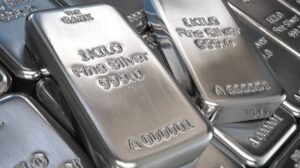
Current Trends and Record Levels in Silver Prices
- Silver prices in India have entered an era of vertical growth, shattering all previous historical benchmarks. As of January 29, 2026, silver reached a monumental lifetime high, breaching the ₹4,10,000 per kg mark on the Multi Commodity Exchange (MCX). This represents a staggering intraday surge of over 7%, as the metal continues its record-breaking rally from the start of the year.
- The statistical trend for January 2026 shows extreme momentum, with prices appreciating by 72.3% in a single month. This follows a blockbuster performance in 2025, where silver delivered returns of over 160%, far outpacing gold and traditional equities. In just one year, the price has transitioned from an average of ₹85,000 per kg in early 2025 to over ₹4 lakh today, representing a year-on-year growth of nearly 370%.
- Looking at the long-term historical trajectory, silver’s appreciation has accelerated exponentially. In 2000, silver was priced at approximately ₹7,900 per kg, rising to ₹27,000 by 2010, and reaching ₹63,000 by 2020. While it took twenty years to grow by ₹55,000, the metal has gained over ₹3,00,000 in value in the last 13 months alone, illustrating a sharp shift from linear growth to a vertical price trend.
- Current city-wise statistics show slight variations due to local taxes and demand. In Chennai, prices are currently highest at ₹4,05,870 per kg, while Delhi and Mumbai are tracking closely at ₹4,03,990 and ₹4,04,690 respectively. Market analysts at GoodReturns note that the metal has maintained a “higher-high” formation throughout the last four quarters, with no significant retracement below the ₹3,40,000 support level during the recent surge.
Factors Driving the Surge in Silver Demand
- Industrial Demand Boom: A major driver of silver demand is its critical role in green technologies, especially solar photovoltaic (PV) panels. Silver’s unmatched electrical conductivity makes it indispensable in solar cells, and global solar installations continue to expand rapidly, pushing industrial consumption higher. Demand from electric vehicles (EVs), semiconductor manufacturing, and 5G network components further anchors silver as a key input for the global energy and technology transition.
- Elevated Investment Demand: Besides industrial use, silver has regained appeal as a safe‑haven asset in times of economic uncertainty, inflationary pressures, and currency weakness, similar to gold but with higher volatility. Strong inflows into silver‑backed Exchange‑Traded Funds (ETFs) and growing interest from both retail and institutional investors have tightened physical markets, pushing prices upward.
- Persistent Supply Deficits: Silver’s price is also underpinned by a structural supply deficit: global supply has consistently lagged behind demand for several consecutive years, creating a persistent gap that supports higher prices. Unlike gold, most silver is produced as a by‑product of copper, lead and zinc mining, making it difficult for supply to expand quickly in response to rising demand. This inelastic supply structure amplifies price sensitivity.
- Role of Monetary Policy: Expectations around monetary policy — especially U.S. Federal Reserve rate cuts — weaken the U.S. dollar, boosting demand for non‑yielding assets like silver. Lower interest rates reduce the opportunity cost of holding precious metals, increasing their attractiveness relative to bonds and equities. Weaker currency environments in key markets, including the impact of rupee depreciation for Indian buyers, further amplify domestic price pressures.
- Geopolitical Uncertainty: Ongoing geopolitical friction — including tensions around trade policy, sanctions, and energy supply routes has increased safe‑haven demand for precious metals. Silver, with its blend of monetary and industrial appeal, benefits from these shifts: investors seeking protection from market risks diversify into precious metals. Escalating stress in global politics and trade environments thus adds an extra layer of upward momentum.
Economic and Inflationary Implications
- Core Inflation Pressure: While headline inflation has moderated in early 2026, Economic Survey 2026 indicates that rising precious metal prices are keeping core inflation sticky, rising from 3.5% in FY25 to 4.3% in FY26.
- Imported Inflation: As India relies on imports for over 80% of its silver needs, the record high prices combined with a weakening Rupee are driving “imported inflation,” directly increasing the cost of raw materials for domestic industries.
- Jewelry Demand Shift: High prices have led to price inelasticity in the wedding sector, where consumers adapt by choosing lighter designs or lower purity. Conversely, retail demand for silver bars and coins fell by 20% in January 2026 as buyers waited for price stabilization.
- Branding & Financialization: Organised retailers like Titan and Kalyan Jewellers are launching dedicated silver sub-brands to capture younger “Gen Z” consumers who view silver as a trendy, affordable alternative to gold.
- Industrial Cost Push: Silver is critical for India’s green energy transition. Rising costs are increasing the financing requirements for solar photovoltaic projects and Electric Vehicle (EV) manufacturing, potentially slowing down capacity expansion in these strategic sectors.
- Corporate Gains: While consumers face high costs, major domestic producers like Hindustan Zinc have seen record profitability, with silver contributing nearly 35-40% of their EBITDA in Q3 FY26.
Warning on Silver
- High Volatility and Correction Risk: After an unprecedented 72% surge in January 2026 alone, analysts widely caution that the market is vulnerable to sharp pullbacks as traders book profits. Such sharp rallies have historically been followed by significant corrections, with some past episodes seeing slumps of over 60%.
- “Froth” in the Market: The demand for silver exchange-traded funds (ETFs) is showing significant premiums over their actual asset values, a sign of speculative fervor that often precedes a price reversion.
- Government Intervention: Speculation is rife that the Indian government may increase import duties to curb the widening Current Account Deficit caused by high-value imports. A duty hike would likely disrupt the market and affect domestic prices.
- Physical Silver Liquidity Concerns: For those holding physical silver bars or coins, the “buy/sell spread” at local jewelers can be substantial. When attempting to sell, investors may face challenges in getting the real-time market price, incurring high costs for purity verification or melting.
- Counterfeit Risks: The high price of silver increases the risk of counterfeit products in the unorganized market. The Bureau of Indian Standards (BIS) advises buying only hallmarked silver from reputable dealers.
|
Also Read: Silver Shines Bright with 30% Surge in 2025 |