Space Food for Astronauts
|
General Studies Paper III: Space Technology |
Why in News?
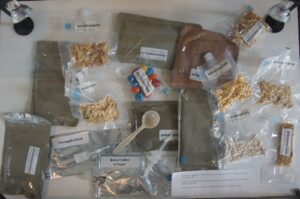
Recently, NASA’s Artemis II astronauts revealed a diverse space food menu including mango salad, beef brisket and smoothies. All these meals are rehydratable and designed for microgravity.
What is Space Food?
- About: Space Food refers to specially designed, processed, and packaged food meant for astronauts to consume in the microgravity environment of space missions.
- It must fulfill nutritional requirements, ensure long shelf life, and remain safe and easy to consume in zero gravity where normal eating is difficult.
- Unlike Earth food, space food is engineered to avoid crumb formation, microbial growth, and spoilage, while maintaining taste, texture, and digestibility.
- It is a restricted food system, meaning astronauts rely entirely on a pre-planned, limited diet optimized for mission constraints like mass, volume, and energy efficiency.
- Types: Space food is classified based on processing, storage, and consumption method:
- Rehydratable Food: These are freeze-dried foods where water is removed to reduce weight. Before eating, astronauts add water using onboard systems. Examples include soups, scrambled eggs, and rice dishes.
- Thermostabilized Food: These foods are heat-processed to destroy microorganisms and stored in retort pouches or cans. Examples include meat, stews, and desserts, similar to military MREs.
- Natural Form Food: Ready-to-eat items like nuts, cookies, granola bars, and tortillas. They require no preparation and provide convenience.
- Irradiated Food: Foods like beef steak are sterilized using ionizing radiation to increase shelf life and ensure safety.
- Fresh Food: Includes fruits and vegetables, supplied during resupply missions and consumed early due to short shelf life.
- Beverages: Powdered drinks like coffee, tea, and juices, stored in vacuum-sealed pouches, consumed via straws to prevent floating liquids.
- Agencies: The development of space food is led by specialized institutions such as NASA’s Space Food Systems Laboratory (Johnson Space Center), which handles menu design, food processing, packaging, and nutritional research.
- Several international space agencies, including Roscosmos, ESA and JAXA, are actively developing culturally adapted space food systems.
- In preparation for the Gaganyaan human spaceflight mission and future long-duration missions, ISRO is developing specialized Indian food items.
- Food Processing: Food processing ensures safety, nutrition, and usability in extreme conditions.
- Freeze-Drying: Removes moisture to reduce weight and spoilage, enabling long-duration missions.
- Thermal Processing: Heating destroys pathogens, producing thermostabilized foods safe for long storage.
- Irradiation: Used to sterilize high-protein foods like meat without altering nutritional value.
- Sensory Evaluation: Foods are tested for taste, smell, and texture, as astronauts often experience reduced taste sensitivity in microgravity.
- Engineering Considerations: Food must be lightweight, compact, easy to prepare, and crumb-free, ensuring operational efficiency.
- Packaging and Storage: Packaging is a critical technological component in space food systems. Packaging Types Includes retort pouches, cans, tubes, and vacuum-sealed packets, designed for durability and safety.
- Packaging must be lightweight, leak-proof, easy to open, and disposable, with minimal waste generation.
- Food is stored in spacecraft pantries, organized by labels and barcodes for tracking astronaut diets.
- Foods are designed to last months to years, especially for deep space missions without resupply.
- Food is packaged and stored on Earth, then transported and loaded into spacecraft shortly before launch.
- Consumption: Eating in space involves unique physiological and environmental challenges.
- Food and liquids float, so astronauts use special containers, straws, and magnetic trays.
- Astronauts typically consume three meals and snacks daily, ensuring balanced nutrition (1900–3200 calories/day).
- Food is prepared using rehydration systems and food warmers onboard spacecraft.
- Historical Evolution: The history of space food began during the 1960s space race. In 1961, Yuri Gagarin became the first human to eat in space, consuming pureed food from tubes. In 1962 John Glenn became the first American to eat in space.
- During the Apollo Missions (1969–1972), space food improved with the introduction of 70 food items, freeze-dried meals and bite-sized cubes.
- The Skylab program (1970s) marked a major advancement, featuring a space kitchen (galley) where astronauts could rehydrate and heat food.
- With the Space Shuttle Era (1980s–2000s), astronauts gained access to improved food systems including reheating and rehydration facilities.
- Astronauts aboard the International Space Station (ISS) enjoy a diverse menu of over 200 items, including international cuisines, beverages, and occasional fresh foods.
- Japan Aerospace Exploration Agency has created space-compatible versions of traditional Japanese food, including ramen, sushi, rice with
- South Korea‘s first astronaut, Yi So-yeon, flew in April 2008 and brought Korean food items, including Kimchi specially modified for space, to the ISS.
- On 3 May 2015, Italian astronaut Samantha Cristoforetti became the first person to drink freshly brewed coffee in space.
- Artemis II mission (2026) introduced around 189 food items, including mango salad, beef brisket, and smoothies, all shelf-stable and rehydratable.
Why Space Food Matters in Space?
- Bone Health: Microgravity causes a calcium imbalance that leads to a loss of bone mineral density.
- Space food provides elevated levels of calcium and Vitamin D to help prevent bone loss and manage risks such as osteoporosis.
- Without these nutrients, astronauts face a high risk of fractures and kidney stones.
- Muscle Preservation: Astronauts lose muscle mass quickly because space has no weight to resist.
- Food must contain high protein to support muscle repair. Essential amino acids like Leucine trigger muscle growth.
- Sufficient calories ensure the body does not burn its own muscle for energy.
- Radiation Protection: Space radiation causes oxidative stress and DNA damage. Food acts as a biological shield by providing antioxidants like Vitamin C and Vitamin E.
- These compounds help neutralize free radicals produced by cosmic rays. Functional foods with Omega-3 fatty acids further reduce radiation-induced inflammation.
- Psychological Morale: Isolation and confinement cause extreme stress and menu fatigue. Delicious and familiar foods provide comfort and a “reminder of home”.
- Fresh crops grown on the ISS, like lettuce, improve mood and social bonding during meals. Palatable food prevents anorexia, where astronauts stop eating due to boredom.
- Microbiome Stability: Spaceflight alters the gut microbiome, reducing beneficial bacteria like Lactobacillus. Space food now includes probiotics and prebiotic fibers to restore gut health.
- A healthy gut supports the immune system and the gut-brain axis. This prevents digestive issues and helps regulate the astronaut’s mood.
|
Also Read: NASA’s Artemis II Mission |