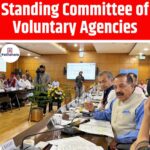




Standing Committee of Voluntary Agencies
| General Studies Paper III: Employment, Government Policies & Interventions |
Why in News?
Recently, Union Minister Dr. Jitendra Singh chaired the 35th meeting of the Standing Committee of Voluntary Agencies (SCOVA) in New Delhi on March 10, 2026 to discuss welfare issues directly with various ministries to improve ease of living.
What is the Standing Committee of Voluntary Agencies (SCOVA)?
- About: The Standing Committee of Voluntary Agencies (SCOVA) is a consultative forum of the Government of India that facilitates dialogue between the government and Central Government pensioners through their associations. It was constituted on 31 July 1986.
- Department: SCOVA functions under the Department of Pension & Pensioners’ Welfare (DoPPW), which operates within the Ministry of Personnel, Public Grievances and Pensions.
- Historical Context: The committee was formed following recommendations of the Parliamentary Consultative Committee, which emphasized the need for a structured platform to consult pensioners’ organizations on welfare policies.
-
-
- Before SCOVA, there was no formal institutional forum where pensioners’ associations could present their grievances or suggestions directly to policymakers.
- Frequency: SCOVA functions primarily through periodic consultative meetings, usually organized in New Delhi.
-
- Objectives: SCOVA provides feedback on the implementation of programmes and policies of the Department of Pension and Pensioners’ Welfare.
- It offers a forum to discuss and critically examine policy initiatives affecting pensioners, ensuring that practical concerns are addressed.
- It works to mobilize voluntary efforts by pensioners’ associations to supplement government initiatives for the welfare of retired employees.
Composition and Organizational Structure of SCOVA
- Members: The SCOVA is headed by the Minister of State for Personnel, Public Grievances and Pensions, who functions as the Chairperson of the committee.
- The Secretary of the DoPPW acts as the Convener and Member-Secretary, responsible for coordinating meetings, preparing agendas, and ensuring follow-up action on decisions.
- The committee includes both official members (government representatives) and non-official members (representatives of pensioners’ associations).
- Representation of Pensioners’ Associations: A distinctive feature of SCOVA is the representation of pensioners’ welfare associations from across India.
- The committee generally includes 15 non-official members, representing various pensioners’ organizations.
- These members are divided into two categories: a Standing Group (5 associations) and a Rotating Group (10 associations).
- The Standing Group generally serves for multiple terms, while Rotating Group members are nominated for shorter fixed tenures.
- These associations represent pensioners from different ministries, services, and regions, including civil services, defence personnel, railway pensioners, and postal employees.
- Central Government Ministries: SCOVA also includes official members from various ministries including the Ministry of Finance, Ministry of Defence, Ministry of Railways, Department of Posts, Department of Telecommunications, and Ministry of Health and Family Welfare, along with agencies such as the Central Pension Accounting Office and Defence Accounts authorities.
Functions of Standing Committee of Voluntary Agencies (SCOVA)
- Grievance Redressal Mechanism: SCOVA acts as a high-level forum to resolve complex, long-pending pension disputes. For instance, it monitors the CPENGRAMS portal, which tracks thousands of complaints, ensuring a resolution rate often exceeding 90% through direct ministerial intervention.
- Policy Feedback Loop: It provides the Department of Pension & Pensioners’ Welfare (DoPPW) with grassroots feedback on policy implementation. By consulting with 30+ member associations, the committee identifies gaps in the disbursement of Additional Pension for seniors aged 80 and above.
- Digital Literacy Initiatives: A core function is promoting the Digital Life Certificate (Jeevan Pramaan). SCOVA associations were instrumental in the recent Nationwide DLC Campaign 2.0, which successfully targeted over 100 cities to facilitate biometric authentication for elderly citizens.
- Health Benefit Oversight: The committee reviews the extension of CGHS (Central Government Health Scheme) facilities. Data shows SCOVA advocacy has led to the empanelment of more private hospitals, improving healthcare access for nearly 1.5 million central pensioners.
- Simplification of Rules: SCOVA works to eliminate redundant paperwork. Recent efforts focused on the Bhavishya portal, a mandatory online system for processing pension cases, which has reduced the processing time by approximately 25% across various departments.
- Welfare Grant Distribution: It oversees the disbursement of Grants-in-Aid to registered voluntary agencies. These funds support the operational costs of Pensioners’ Associations, enabling them to maintain offices and assist members in remote regions effectively.
- Awareness Workshops: The body organizes regional Awareness Programs to educate retirees on their rights. These sessions cover critical updates like the Fixed Medical Allowance (FMA) hikes and the nuances of the 7th Central Pay Commission recommendations.
- Inter-Ministerial Coordination: SCOVA ensures synergy between the Ministry of Finance, Ministry of Railways, and Postal Department. This coordination is crucial for synchronizing pension revisions, preventing delays that historically affected nearly 6.8 million beneficiaries.
Major Policy Reforms Addressed by SCOVA
- 7th CPC Anomalies Resolution: SCOVA addressed the Notional Pay Fixation issue for pre-2016 retirees. By enforcing Concordance Tables, the committee ensured the upward revision of pensions for over 2.5 million individuals, rectifying pay disparity across various service cadres.
- DIRGHAYU Digital Awareness: A significant past initiative was the launch of the DIRGHAYU mobile application. This tool provided a real-time dashboard for pensioners to track their Pension Payment Orders (PPO), reducing physical visits to the Pensions Accounting Office by nearly 40%.
- Restoration of Commuted Pension: The committee successfully deliberated on the 15-year restoration period for commuted pensions. This addressed a major financial concern for elderly retirees, ensuring that the full pension amount is restored automatically after 180 months of deduction.
- Enhancement of Compassionate Allowance: SCOVA championed the cause of families of deceased employees by improving Family Pension rules. A key success was increasing the minimum pension to ₹9,000, providing a social safety net for approximately 1.2 lakh low-income households.
- Bank CPPC Centralization: To tackle disbursement errors, SCOVA mandated the creation of Centralized Pension Processing Centres (CPPC) in all major banks. This structural shift reduced overpayment and underpayment errors by an estimated 15% across the banking sector.
- Medical Reimbursement Simplification: The committee addressed the delay in High-Value Medical Claims (above ₹2 lakh). By delegating financial powers to HODs, the processing time for emergency medical reimbursements was slashed from 6 months to 30 days.
- Pre-2006 Pension Parity: A landmark historical issue was the Pro-rata Pension for those with less than 33 years of service. SCOVA’s persistence led to a policy change allowing full pension after 20 years of service, benefiting thousands of early retirees.
- Identification of Ghost Pensioners: Through the Aadhaar-seeding initiative, SCOVA helped clean the pension database. This initiative identified nearly 2% redundant entries, saving the national exchequer crores while ensuring legitimate beneficiaries received their Dearness Relief (DR) on time.
| Also Read: Supreme Court Orders Time-Bound Review of EPF Wage Ceiling |