




Strait of Hormuz
|
General Studies Paper II: Impact of Policies and Politics of Countries on India’s Interests |
Why in News?
Recently, tensions after US–Israel strikes on Iran reportedly prompted Iran’s Islamic Revolutionary Guard Corps (IRGC) to warn ships against passing through the Strait of Hormuz, disrupting global oil transit as insurers and shipping firms suspend operations, with several tankers halting movement amid rising security risks.
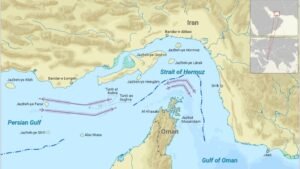
What is the Strait of Hormuz?
-
- About: The Strait of Hormuz is a narrow maritime passage located between Iran to the north and Oman to the south (Musandam Peninsula).
- Location: It forms a natural maritime boundary between the Middle East mainland and the Arabian Peninsula, making it geopolitically crucial.
- It connects the Persian Gulf in the west with the Gulf of Oman in the east, which further opens into the Arabian Sea and the Indian Ocean.
- Physical Characteristic: The strait is approximately 90–95 km wide at its broadest point but narrows down to about 33 km at its narrowest point, making it a natural chokepoint for global maritime transport.
- The average depth ranges between 60 to 80 meters, allowing safe passage for Ultra Large Crude Carriers (ULCCs) and other deep-draft vessels transporting crude oil and LNG.
- It has designated Traffic Separation Schemes (TSS) consisting of two 3-km-wide shipping lanes for inbound and outbound vessels with a 2-km-wide separation buffer zone.
- Coastal Control: The northern coastline is controlled by Iran, while the southern coastline is controlled by Oman’s Musandam exclave.
- Islands: Several islands such as Qeshm Island and Hormuz Island lie within or near the strait, influencing territorial waters, surveillance, and shipping routes.
- Climatic & Oceanographic: The region experiences high salinity, strong tidal currents, and seasonal winds, which impact navigation safety, vessel speed, and maritime operations year-round.
- Legal Status: Under the United Nations Convention on the Law of the Sea (UNCLOS), the strait qualifies as an international waterway, allowing ships the right of transit passage even through territorial waters.
Significance of Strait of Hormuz
- Global Energy Lifeline: The Strait of Hormuz is the world’s most important oil transit chokepoint, through which nearly 17–20 million barrels per day (bpd) of petroleum liquids pass—accounting for about 20–21% of global oil consumption.
- Major crude exports from Saudi Arabia, Iraq, Kuwait, and the United Arab Emirates depend on this narrow maritime route.
- Critical LNG Trade Route: Apart from oil, the strait facilitates large-scale Liquefied Natural Gas (LNG) shipments. Around 30% of LNG are transported to international markets via this strait. A significant portion of LNG exports from Qatar, one of the world’s leading LNG exporters, transits through Hormuz, making it vital for global natural gas supply chains.
- Strategic Maritime Chokepoint: Due to its narrow width of about 33 km and shipping lanes of just 3 km in each direction, the strait represents a major strategic vulnerability where disruption can severely impact international maritime trade.
- Geo-Political Importance: Situated between Iran and Oman, the strait lies at the centre of West Asian geopolitical rivalries. Its proximity to military bases such as the U.S. Fifth Fleet in Manama, Bahrain enhances its strategic military value.
- During the 1980–88 Iran–Iraq War, the “Tanker War” phase saw attacks on oil tankers in and around the strait. Since 2019, tanker incidents and geopolitical rivalry have renewed concerns over stability.
- Limited Alternative Transit Options: Although pipelines like Saudi Arabia’s East–West Pipeline and UAE’s Abu Dhabi–Fujairah pipeline bypass the strait, their capacity cannot fully replace Hormuz’s massive daily transit volume.
Strategic Significance of Strait of Hormuz for India
- Energy Security Imperative: The Strait of Hormuz is crucial for India’s energy security, as nearly 60–65% of India’s crude oil imports originate from Gulf countries and transit through this route. Any disruption directly threatens India’s petroleum supply chain, affecting transport, industry, and power generation sectors.
- Dependence on Gulf Hydrocarbons: India imports substantial crude oil from Saudi Arabia, Iraq, the United Arab Emirates, and Kuwait. These shipments must pass through Hormuz, making uninterrupted maritime access vital for maintaining energy import stability.
- Natural Gas Supply Linkage: India also depends on Liquefied Natural Gas (LNG) imports from Qatar, one of its largest LNG suppliers. Imports of 80–85% LNG transiting Hormuz play a key role in supporting India’s clean energy transition and urban gas distribution networks.
- Trade & Economic Stability: Hormuz acts as a critical gateway for India’s bilateral trade with West Asia, which exceeds USD 150 billion annually. Any instability in the strait can disrupt supply chains, delay shipments, and adversely affect India’s trade balance and economic growth.
- Indian Diaspora Safety: Over 9 million Indian expatriates reside in Gulf countries such as the UAE, Saudi Arabia, and Kuwait. Escalation of tensions around the strait can threaten evacuation routes, remittance flows, and the safety of Indian nationals in the region.
- Maritime Security: The strait’s proximity to India’s extended maritime neighbourhood necessitates enhanced surveillance by the Indian Navy to ensure Sea Lines of Communication (SLOCs) remain secure for commercial shipping and strategic assets.
- Strategic Connectivity Initiatives: India’s investment in regional infrastructure projects such as Chabahar Port in Iran strengthens its access to Central Asia and reduces overdependence on vulnerable sea routes passing through Hormuz.
|
Other Major Strategic Straits
|
|
Also Read: Iran-Israel Conflict |