



Supreme Court Judge Questions Collegium Over Transfer Move
|
General Studies Paper II: Judiciary, Indian Constitution |
Why in News?
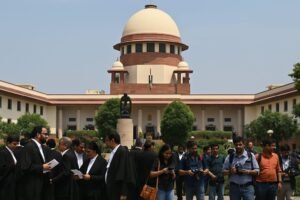
Supreme Court judge Justice Ujjal Bhuyan publicly questioned the Collegium’s decision to alter a High Court judge’s transfer following a Central Government request, warning this undermines judicial independence and could weaken the judiciary’s autonomy.
Highlights of Supreme Court Judge’s Objection to Transfer Decision
- Supreme Court Justice Ujjal Bhuyan criticized the Collegium system’s decision on a High Court judge’s transfer.
- Originally the Collegium proposed Justice Atul Sreedharan’s transfer from the Madhya Pradesh High Court to the Chhattisgarh High Court. But in October 2025, the Collegium modified its recommendation to transfer him instead to the Allahabad High Court after a request from the Central Government.
- Justice Bhuyan described this as a “striking intrusion of executive influence” into a process designed to be free from political pressure.
- Justice Bhuyan emphasised that the transfer and posting of High Court judges are exclusively internal matters of the judiciary and that the Central Government “can have no say” in such decisions.
- Justice Bhuyan warned that using transfers as a tool to penalise judges for decisions that may be “inconvenient” to the government undermines the credibility of the judiciary.
What is the Collegium System?
- About: The Collegium System in India is a judicial mechanism for appointments and transfers of judges to the Supreme Court and High Courts. It is not explicitly mentioned in the Constitution, but has evolved through Supreme Court judicial interpretations to ensure judicial primacy.
- Constitutional Basis: Although the word “collegium” does not appear in the Constitution, its authority is derived from judicial interpretations of Article 124(2) (appointment of Supreme Court judges) and Article 217(1) (appointment of High Court judges). These provisions require the President to consult the Chief Justice of India (CJI) and other judges before appointments, which the Supreme Court interpreted to mean the judiciary should have the final say.
- Evolution: The evolution of the collegium happened in three key stages:
-
-
- First Judges Case (S. P. Gupta v. Union of India, 1981) — The Supreme Court held that “consultation” does not mean “concurrence,” giving the executive (President and government) greater influence in judicial appointments.
- Second Judges Case (Supreme Court Advocates-on-Record Assn. v. Union of India, 1993) — Overruled the First Judges Case, held that the CJI’s advice is binding, and created the collegium with the CJI and two senior Supreme Court judges.
- Third Judges Case (1998) — Expanded the collegium to include the CJI and four senior-most Supreme Court judges, shaping the current structure and procedure.
-
- Structure: The Supreme Court Collegium is composed of the Chief Justice of India and the four senior-most judges of the Supreme Court. For High Court appointments, the collegium consists of the Chief Justice of that High Court and the two senior-most judges of that court. Both sets of recommendations are reviewed and finalised by the Supreme Court Collegium before being sent to the government.
-
- Appointment Process: Under the collegium system:
- Names of prospective judges are proposed by the relevant collegium based on merit, integrity, and seniority.
- For Supreme Court judges, the Supreme Court Collegium makes the recommendation to the Central Government; for High Courts, the High Court collegium’s recommendations go to the Supreme Court Collegium and then to the government.
- The Central Government can seek clarifications or request reconsideration, but if the collegium reiterates its recommendation, the government must appoint the person.
- Appointment Process: Under the collegium system:
- Transfer: The collegium also recommends transfers of High Court judges. Under Article 222, the President may transfer judges after consulting the Chief Justice of India. In practice, the collegium initiates and finalises transfer proposals.
- Attempted Reform: In 2014, Parliament passed the National Judicial Appointments Commission (NJAC) Act and the 99th Constitutional Amendment to replace the collegium with a commission including members from government and civil society. However, in October 2015, the Supreme Court struck down the amendment and the NJAC as unconstitutional, restoring the collegium system on grounds that it preserves judicial independence and the basic structure of the Constitution.
- Debates: The collegium system faces criticism for lack of transparency, accountability, and diversity — with concerns over opaque decision-making, delays in appointments, and allegations of nepotism or limited representation. These debates continue to inform discussions on judicial reforms.
Historical Flashpoints in the Collegium Era
- In August 2019, the Supreme Court Collegium transferred Justice Vijaya Tahilramani, then Chief Justice of the Madras High Court, to the much smaller Meghalaya High Court — a move perceived by many as a demotion due to the drastic difference in judicial workload and stature. Justice Tahilramani sought reconsideration, but the Collegium reaffirmed the transfer citing “better administration of justice,” without public reasoning.
- The midnight transfer of Justice S. Muralidhar from the Delhi High Court to the Punjab & Haryana High Court on 26 February 2020 sparked widespread controversy. The Supreme Court Collegium, led by then-CJI S. A. Bobde recommended the transfer, which was interpreted by lawyers, civil society and media as a punitive action against Justice Muralidhar for a judgment holding the police and authorities accountable during the 2020 Delhi riots.
- The appointment of Justice Vipul M. Pancholi as a Judge of the Supreme Court became controversial in 2025 due to a formal dissent by Justice B. V. Nagarathna within the Collegium — a rare occurrence. Justice Nagarathna contended that Pancholi, ranked 57th in all-India seniority, superseded many more senior and meritorious judges, and that his elevation risked credibility and representation balance on the Supreme Court.
|
National Judicial Appointments Commission (NJAC) Act
|
|
Also Read: SC/ST Reservation in Supreme Court |