




White Phosphorus Munition
| General Studies Paper III: Nuclear Technology, Chemical Properties |
Why in News?
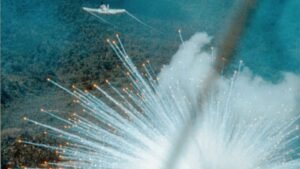
Recently, Human Rights Watch (HRW) accused the Israeli military of using air-burst white phosphorus munitions over populated areas in Lebanon, while Israel claims they use the substance only for smokescreens.
What is White Phosphorus?
- About: White phosphorus (WP) is a highly reactive chemical allotrope of the element phosphorus. It is a waxy, yellowish-white solid that ignites spontaneously when exposed to oxygen.
- Composition: White phosphorus consists of tetrahedral molecules where four phosphorus atoms are bonded together creating high internal strain.
- Its chemical formula is P₄, and it belongs to the group 15 elements (pnictogens) in the periodic table.
- Discovery: White phosphorus was first discovered in 1669 by German alchemist Hennig Brand while attempting to create the philosopher’s stone.
- It was produced by heating residues from boiled urine, making it the first element discovered through chemical experimentation in modern history.
- Physical Properties: The substance appears as a soft, wax-like solid with a pale yellow or white color and a garlic-like odor. It has a melting point of about 44°C and a boiling point near 280°C.
- White phosphorus is insoluble in water but soluble in organic solvents like carbon disulfide.
- White phosphorus is pyrophoric, meaning it ignites spontaneously in air at around 30°C.
- Production: Modern production occurs by heating phosphate rock, silica, and coke in an electric furnace at around 1,500°C. The reaction produces phosphorus vapor, which is then condensed underwater to prevent oxidation. Major producers include China, Kazakhstan, and Vietnam.
- Storage: Because of its extreme reactivity, white phosphorus must be stored underwater or in inert atmospheres to prevent contact with oxygen.
- Applications: White phosphorus is mainly used in military smoke munitions and incendiary devices.
- It also has limited industrial uses in producing phosphoric acid, fertilizers, and chemical intermediates.
What are White Phosphorus Munitions?
- About: White Phosphorus (WP) munitions are military weapons containing white phosphorus used primarily for smoke generation, illumination, and incendiary effects.
- Composition: These munitions contain white phosphorus (P₄) sealed inside artillery shells, bombs, rockets, or mortar rounds.
- Mechanism: Upon detonation, the phosphorus is dispersed into burning particles that react with oxygen to form phosphorus pentoxide (P₂O₅), creating dense smoke clouds and high-temperature flames.
- Types: Common forms include artillery shells, aerial bombs, and grenades. Notable examples include 155 mm artillery shells (such as the M825 smoke round) and mortar-delivered WP shells.
- Military Functions: The main role of WP munitions is smoke screening to conceal troop movements, vehicles, and equipment. They are also used for target marking, battlefield illumination, and signaling, enabling forces to coordinate attacks in combat environments.
- Global Usage: White phosphorus munitions have been used in several modern conflicts, including the Iraq War (2004), the Syrian Civil War, and the Russia–Ukraine conflict.
Why White Phosphorus Munitions are So Dangerous?
- Extremely High Combustion Temperature: White phosphorus munitions are dangerous because the substance burns at extremely high temperatures ranging from about 800°C to over 1,300°C. When dispersed in combat, burning particles can ignite clothing, vegetation, buildings, and fuel sources, causing widespread fires and severe destruction.
- Persistent Burning and Re-Ignition: A major hazard is that white phosphorus continues burning until oxygen is completely cut off. Small fragments can remain active inside wounds or on surfaces and may reignite when exposed to air, even hours or days later.
- Severe Chemical and Thermal Burns: Unlike ordinary fires, white phosphorus causes combined thermal and chemical burns. The burning particles stick to skin and clothing, penetrating deep tissues and sometimes reaching bone level, leading to extensive tissue destruction.
- Highly Toxic Absorption in the Body: White phosphorus is lipid-soluble, meaning it easily penetrates human tissue and enters the bloodstream. Once absorbed, it can damage vital organs such as the liver, kidneys, and heart, and severe exposure may result in systemic poisoning.
- Dangerous Smoke and Airborne Effects: Burning phosphorus releases phosphorus oxides, which react with moisture in the air to form corrosive phosphoric acids. Inhalation of these fumes irritates the eyes, lungs, and respiratory tract, and in high concentrations can cause serious lung injury or pulmonary edema.
- Delayed Systemic Health Effects: Exposure may produce delayed toxic effects, sometimes appearing hours or days later. Victims can progress through stages leading to shock, neurological damage, and multi-organ failure, which in severe cases results in death even after initial survival.
International Regulations Governing White Phosphorus Weapons
-
- Convention on Certain Conventional Weapons (CCW): Adopted in 1980 under the United Nations, the convention seeks to limit weapons with indiscriminate humanitarian effects. As of 2024, about 117 states are parties to the CCW framework.
- Protocol III of the CCW specifically addresses incendiary weapons, which include weapons designed to set fire or cause burn injuries. The protocol restricts the use of air-delivered incendiary weapons in areas with civilian concentrations.
- Chemical Weapons Convention: White phosphorus is not classified as a chemical weapon under the Chemical Weapons Convention (1993) because its effects result from heat and flame rather than toxic chemical action on life processes.
- International Humanitarian Law (IHL) Principles: Even when not explicitly banned, the use of white phosphorus is governed by customary International Humanitarian Law. Key principles include distinction, proportionality, and precaution.
- Additional Protocol I to the Geneva Conventions: Additional Protocol I (1977) strengthens humanitarian protections by banning weapons that cause “superfluous injury or unnecessary suffering.” It also prohibits methods of warfare whose effects cannot be limited.
- Convention on Certain Conventional Weapons (CCW): Adopted in 1980 under the United Nations, the convention seeks to limit weapons with indiscriminate humanitarian effects. As of 2024, about 117 states are parties to the CCW framework.
- Globally Harmonized System of Classification and Labeling of Chemicals (GHS): White phosphorus is classified under the Globally Harmonized System of Classification and Labeling of Chemicals (GHS) as a “Pyrophoric solid, category 1” (UN Number 1381 or 2447 for molten), indicates it is among the most unstable pyrophoric substances, designed for substances that ignite spontaneously within five minutes of exposure to air.
| Also Read: The Poison Dart Frog |