




World Longest Snake Discovered in Indonesia
|
General Studies Paper III: Conservation, Wildlife Protection |
Why in News?
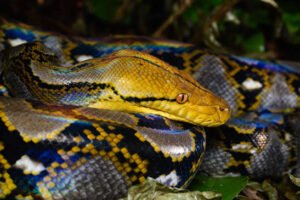
Recently, a giant female reticulated python named “Ibu Baron” has been discovered and officially confirmed as the world’s longest wild snake by ‘Guinness World Records’.
|
World’s Longest Snake – Ibu Baron
|
World’s Longest Living Snake Species – Reticulated Python
- About: The Reticulated Python (Malayopython reticulatus) is a non-venomous constrictor snake belonging to the family Pythonidae, widely recognized as the longest living snake species on Earth.
- The Latin name reticulatus means “net-like”, referring to its complex geometric skin pattern of tan, black, white, yellow, and brown scales.
- Distribution & Habitat: Reticulated pythons are native to South and Southeast Asia, with a broad range extending from Bangladesh, India (including Nicobar and recent mainland records), Myanmar, Thailand, Laos, Cambodia, and Vietnam, to Malaysia, Indonesia, and the Philippines.
- They inhabit tropical rainforests, woodlands, grasslands, riversides, and sometimes human-modified landscapes.
- Physical Characteristics: This species is famed for its extraordinary size, making it the world’s longest snake. Most adults fall below 5 meters (16.4 ft), exceptionally large individuals may grow between 7 m and 8 m (23–26 ft).
- Reticulated pythons weigh commonly between 75 kg and over 100 kg, with massive individuals exceeding 100 kg. Females tend to grow larger than males.
- Behavior & Diet: Reticulated pythons are nocturnal apex predators and use constriction to subdue prey.
- They ambush animals, striking quickly and coiling their powerful bodies to cut off circulation.
- Their diet includes small mammals, birds, pigs, deer, civets, and occasionally domestic animals; large individuals can consume animals up to a quarter of their own length or weight.
- They are excellent swimmers and climbers, enabling them to exploit diverse environments.
- Life Cycle: Reticulated pythons breed seasonally, with females laying 20–80 eggs per clutch, though some records show even higher counts.
- Females coil around eggs for incubation (about 2–3 months), using muscular shivering to generate heat.
- Sexual maturity typically occurs between 3–5 years, and they can live over 20 years in the wild and up to 30 years in captivity.
- Role in Forest Ecosystems: The Reticulated Python functions as an apex predator in tropical forests of South and Southeast Asia, controlling the populations of mammals and birds.
-
-
- By reducing rodent infestations, they indirectly decrease crop damage and the spread of rodent-borne diseases.
- Healthy populations of these pythons often indicate intact forest habitats and functioning food webs.
-
- Conservation Status: The IUCN lists the reticulated python as Least Concern due to its wide distribution and adaptability.
- In some regions outside its native range (e.g., Florida, USA), it is considered an invasive species, leading to management or removal policies.
Human-Wildlife Interaction and Conservation Challenges in Indonesia
- Deforestation: Indonesia has one of the highest rates of deforestation in the world, driven by palm oil expansion, illegal logging, mining, and agricultural plantations. This rapid habitat destruction fragments forests and reduces space for wildlife such as tigers, orangutans, elephants, and snakes, forcing more frequent interactions with humans.
- Human-Snake Conflict: As forest areas shrink, human-snake conflicts have increased, especially in areas near expanding residential zones. Reticulated pythons and other large snakes are often killed due to fear and lack of public awareness, including two fatalities in South Sulawesi in 2024 and incidents of snakes entering villages or agricultural land cause panic and sometimes injury.
- Wildlife Poaching: Illegal hunting and wildlife trafficking continue to threaten Indonesia’s biodiversity. Animals such as pangolins are heavily poached for scales and meat, which are sold domestically and internationally. Enforcement has led to large seizures—e.g., confiscation of 109 kg of pangolin scales in West Kalimantan, representing hundreds of individuals.
- Natural Disasters: Recent severe floods and landslides in Sumatra—linked in part to deforestation—have devastated habitats and increased human-wildlife interactions. For example, Tapanuli orangutans were driven into human areas after their forest was damaged, increasing conflict risks and complicating conservation efforts.
Global Initiatives and Conservation Steps to Protect Snakes
- IUCN Specialist Groups for Snake Conservation: The IUCN Viper Specialist Group (VSG) represents a global coordinated network of herpetologists and conservation biologists dedicated to the assessment and protection of viper species worldwide.
- Legal Frameworks: International agreements like CITES and regional conservation policies help regulate wildlife trade, curb illegal trafficking, and protect endangered snake species.
- Global Snakebite Awareness: The Snake Conservation and Bite Awareness Foundation conducts international outreach to reduce snakebite fatalities while emphasizing snake ecological importance. Their work includes geospatial data collection, public education on safe coexistence.
- WHO’s Snakebite Roadmap: Under the World Health Organization’s Snakebite Roadmap (2019), the Snakebite Community Engagement Network strengthens local capacity, trains community experts in prevention and first aid, and promotes community‑based education programs.
- World Snake Day: World Snake Day (16 July) is observed globally to raise awareness about snake conservation, teach people about the ecological roles of snakes, dispel myths, and encourage tolerance and protection of snakes.
- Conservation Grants: Organizations like Save The Snakes provide grants and funding to grassroots leaders working on local snake protection projects, strengthening community‑based conservation around the world.
|
Snakes of India:
|
|
Also Read: Tamil Nadu Allocates ₹1 Crore for Wildlife Protection |